
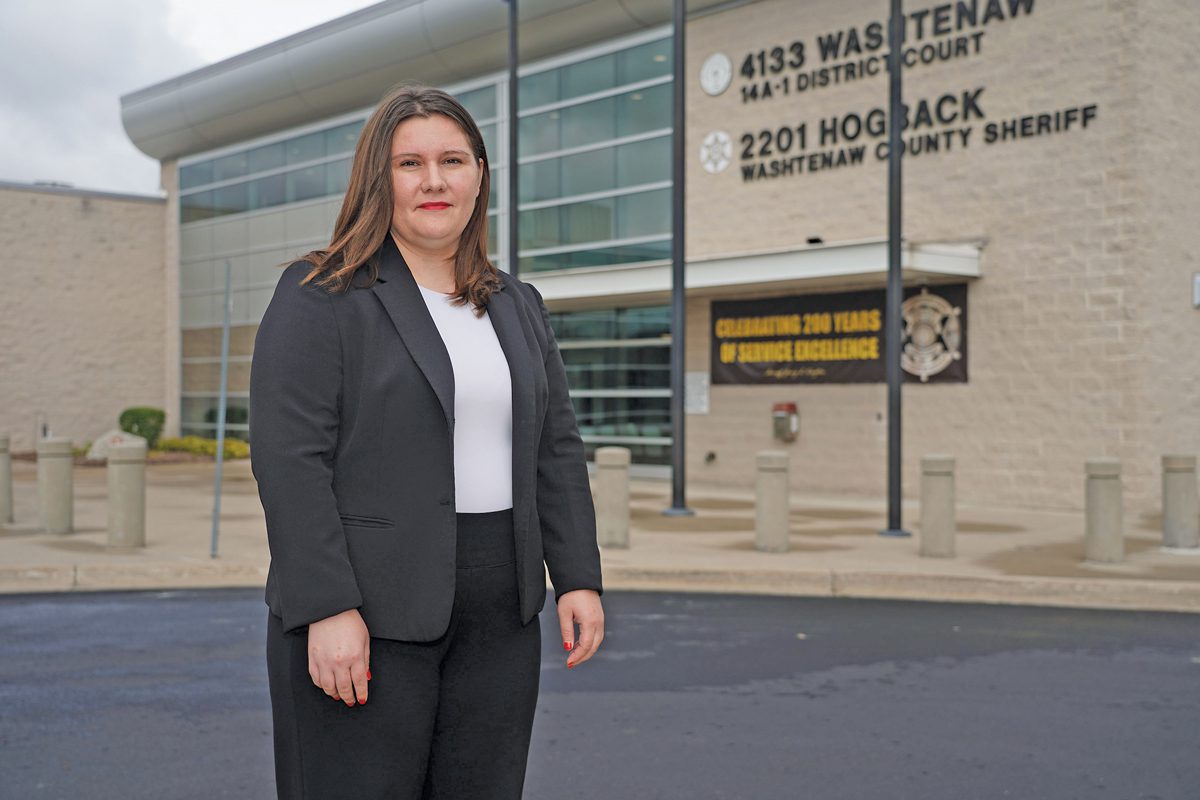
Washtenaw County Sheriff Alyshia Dyer, shown here at her department’s headquarters, has bristled at scrutiny from county leaders. “I think government fighting against each other is just not helpful,” she says. | J. Adrian Wylie
In late February, when I started researching Alyshia Dyer (Washtenaw County’s first female sheriff) and her first year-plus on the job, there was already much to unpack and discuss.
She’d clashed with County Commissioners over budgeting and control of human resources (the latter resulted in Dyer filing a lawsuit), but seemed on the same page as county leaders when it came to not facilitating ICE. She was cheered for restoring in-person visits at the county jail, but she’d also weathered two serious, back-to-back police crises in Ypsilanti in January. (Four officers shot and killed an unarmed driver after a late-night, high speed chase; and there was a thirty-hour standoff on W. Cross St., wherein Ruben Peeler, a sword-wielding fifty-three-year-old in mental duress, was eventually escorted from his home, after a SWAT team caused significant damage.)
It’s … a lot. And just when I thought I’d wrapped my head around the conflicts, kudos, and controversies surrounding Dyer, the Trump administration sued Washtenaw County (naming Dyer specifically) on April 9 for obstructing ICE operations. Meanwhile, Dyer’s lawsuit had reached a settlement on March 18: Dyer eliminated one HR position in her office, but retained authority to screen and hire candidates, make discipline decisions, and conduct internal investigations into policy violations; the county would be responsible for investigating any alleged employment law violations.
On May 8, MLive reported the primary reason for this HR battle: an unnamed female deputy had told investigators that she and sergeant Jeremy Yono had had a monthslong sexual relationship, including after Yono was promoted to sergeant (and thus the woman’s direct supervisor) in June 2025. Some of their encounters were nonconsensual, she told investigators.
The ensuing Michigan State Police investigation resulted in no charges against Yono, who’s denied all accusations of sexual assault. But because he would likely face termination from Dyer’s office for policy violations, he resigned in early March.
“It’s upsetting,” says Katie Scott, chair of the Washtenaw County Board of Commissioners. “I learned more from the MLive article than I had otherwise.”
Months before, following the commissioners’ nearly unanimous passage of a resolution shifting sheriff’s office HR oversight to the county, Scott had been surprised that Dyer responded with a lawsuit. “I thought everybody would just be able to get together and have a conversation about it, and that was my mistake,” she says. “I certainly wasn’t interested in breaching anyone’s constitutional authority.”
“[The Commissioners] had heard some rumors … and they decided to pass a resolution because they felt they needed to do that,” says Dyer. “However, the board is not in charge of the Sheriff’s Office, so there’s a problem there, but also, we didn’t do anything that would warrant that type of response. … I think having government fighting against each other is just not helpful.”
It seemed, for a brief moment, that as bumpy and painful as this series of events had been, Dyer and the commissioners might possibly start to put it behind them, now that the information had been made public and a settlement had been reached.
“I’m committed to working on the relationship myself,” Scott says. “The sheriff and I now will go to coffee or lunch at least once a month to talk about things as they come up. I think that’s really helped.”
But just days later, when I sat down to draft yet another version of this story, I checked the news to see that MLive’s top story that day, May 14, concerned a burned marijuana cigarette reportedly found in Dyer’s county-issued SUV when she’d turned it in for another vehicle in June 2025. The county had hired a law firm to investigate, but their findings were inconclusive. Dyer told MLive she doesn’t smoke marijuana, nor was there anything in the car when she’d turned it in.
Dyer took to Facebook, sharing a redacted version of the investigation report (that commissioners had not planned to release) and remarking that “your county tax dollars paid for this scavenger hunt.” Dyer sharply criticized the quality of the investigation, then called out Scott in particular, suggesting that putting the jail’s budget on a diet while hiring a corporate law firm to investigate the SUV joint and reinvestigate the Yono case was all about a “petty grudge” and a “one-sided beef.”
Scott responded with her own Facebook statement, beginning with “Oversight is not a ‘beef.’ It is part of governance.” Scott defended independent inquiries as necessary for objectivity and reminded constituents that the Board doesn’t act as an autocracy. “This is not personal for me,” she wrote. “I do not have a personal ‘feud’ with the Sheriff. … Public institutions work best when disagreements remain grounded in professionalism and respect for governance structures, even when tensions exist.”
Flashback: The Next Sheriff (Aug. 2024)
In addition, there’s also still significant community fallout from the Cross St. neighbors who witnessed Ruben Peeler’s standoff and evacuation on January 4. Community organizer and activist Yodit Mesfin Johnson wrote an open letter to numerous local law enforcement offices, inviting other community members to cosign. In it, she wrote, “You cannot flash-bang someone into mental health. You cannot tear gas someone into stability. You cannot loudspeaker someone into wellness. What you can do is traumatize them … and call it a successful resolution because nobody died. That is an appallingly low bar.”
When asked about this incident, Scott says, “If all of the policies were followed, that’s fantastic. But just because it’s policy, that doesn’t mean that it was right. So let’s look at what happened … and see if there’s someplace in the policy where it needs to be improved. … Nobody wakes up in the morning and says, I’m gonna go to work today and really mess things up. Everybody is probably coming with the best intentions to do the right thing. … So what happened in the process to allow that to happen? And that’s how you make things better. You don’t just say it’s the policy and move on.”
Dyer, who grew up in Ypsilanti, acknowledges that there’s often room for improvement when it comes to law enforcement response, but also notes that onlookers don’t see and hear everything that’s happening during a crisis.
“The opportunity here is to highlight what we all agree on, which is, nobody wants to send out a SWAT team, right?” Dyer says. “There was a real risk of officers being injured trying to get [Peeler] into custody. And the mental health team and crisis team did try to de-escalate, and it did not work. … When something is already that escalated, what do we do, absent of a specialized response?
“… I empathize with the whole neighborhood and the family, of course. And because of the damage to the house, we are working with Ypsilanti city leadership to see if there’s any support we can offer in that arena. Because I think that will help tremendously as well, for people to heal.”
Dyer has likely had to do some of that herself. At age seventeen, she ran away from her single parent home in Ypsilanti, but she still graduated from Ypsilanti High and became a first generation college student via WCC’s police academy. She worked for seven years as a full-time deputy sheriff in the road patrol division, and her experiences piqued her interest in social work. She earned a bachelor’s degree in police administration (while working) from EMU in 2018, then shifted to part-time while earning master’s degrees in social work and policy from U-M in 2022.
During the pandemic, Dyer made the switch from cop to therapist, and she focused her efforts on health justice, working with Metropolitan Organizing Strategy Enabling Strength. This pointed her toward legal reform work, in the courts and in policing, and she was part of a successful campaign to prevent police from installing automated license plate readers in Ypsilanti Township.
“That really affirmed my decision to run for sheriff,” says Dyer.
Her most gratifying win so far (she says, without having to think about it) was reinstating in-person visits at the jail.
“We still have the video visits, we have phone visits, but giving children the opportunity to be with a parent—it’s just priceless,” Dyer says. “ … I’m also really proud of my team when it comes to our hiring. We were in pretty critical staffing levels when we started, and we are actually getting to the point now where people have to fight for overtime shifts”
Dyer has also successfully fought against increasing lockdowns as a cost-saving measure, and last year, she achieved a balanced budget.
“One of the most important things she’s done is elevate reentry as a priority,” says Ann Arbor City Councilmember Jen Eyer. “Creating a new division focused on housing and support for people leaving the jail has the potential to change lives and improve public safety simultaneously.” She understands that meaningful change, especially around mental health response, takes time, and she’s building that foundation in the right way.”
Not everyone agrees, of course. And judging by the number of battles she’s waged already, there’s surely more to come. Is this because Dyer’s a woman in a position of power pushing against “the establishment” to make substantive progressive change? Or is it because Dyer often views professional disagreements as personal attacks?
Either way, Dyer is not shy about speaking her mind directly to the people who voted for her.
“The community is much more forgiving than public officials,” Dyer says. “ … They just want information. … The national climate has got people on edge already, and it’s my job to show them that even if I can’t always give them all the answers, I’ll give them as much as I can.”