
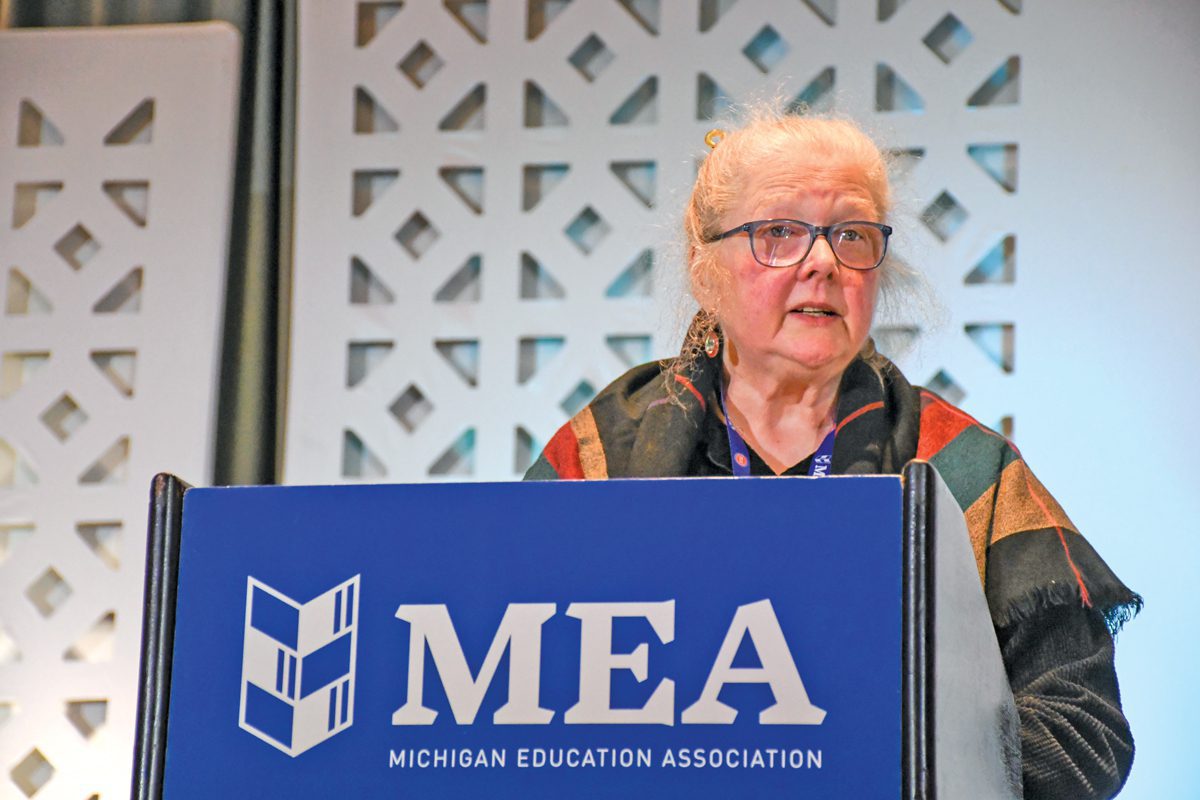
In April, Kathy Kosobud was awarded the Michigan Education Association’s David McMahon Human Rights Award. Kosobud has taught vocational skills, worked as an aide in classrooms for students with emotional impairments, served as a staff advocate for the Student Advocacy Center, and managed PFLAG Ann Arbor. | Courtesy of Michigan Education Association
“I don’t like to stand by when I witness injustices.”
So says Kathy Kosobud, a longtime Ann Arbor resident and educator who received the David McMahon Human Rights Award from the Michigan Education Association in April. The award honors moral and ethical leadership in the fields of human and civil rights.
Her advocacy work goes back to her junior year at Ann Arbor High School. “There was a dust-up among students at the school,” she recalls. “The Black students were being tracked and not allowed to enroll in AP classes. They staged a walkout.”
She wrote a letter to the editor of the Ann Arbor News, arguing that students should be making their own choices about their future. Teachers did not receive her opinions well. “They told me that the students would be overchallenged and unhappy,” she says. “I argued that everyone should still get to make the choice of what classes to take, rather than be tracked.”
While “nobody really won that fight,” she would remember this throughout her high school career, which ultimately led her to a split shift at Ann Arbor High, because of a delay in opening Huron. By spring, Kosobud was taking classes at U-M.
The idea of being a teacher wasn’t even a twinkle in her eye.
After graduating from U-M with a degree in theater design and a minor in art history, Kosobud went to work at a theater supply rental company, but was laid off soon after. This layoff, while devastating at the time, was the turning point for what led to a decades-long career of working with people with special needs.
“Somehow, I caught wind that people could participate in a national student loan program where you pay it back in service, so I volunteered at Dexter Middle School doing craft projects with at-risk kids as a test of my interest,” she says. “Later, I got a job working in the high school counseling office and in the library. And it occurred to me that this was a pretty good deal—working with kids who have additional needs.”
She went on to earn her special education teacher certification from EMU, then taught vocational skills to students ages fourteen to twenty-six in Lenawee County. Her students made and sold Christmas ornaments, worked on cleaning crews, and sold craft projects at annual fundraisers, while continuing to learn basic academic skills.
These life-changing skills provided the kids with work experience as well as enabling them to earn a small income.
Kosobud’s own life was changing around this time. In 1981, she gave birth to her older daughter. “I said I would stay away for two years, but didn’t make it that long,” she laughs. “I worked as an aide in an emotionally impaired classroom in AAPS, and later I returned to an SXI [severely multiply impaired] classroom in Lenawee for a couple of years.”
Kosobud spent seven years teaching adults to read in Washtenaw County. “There were so many great people,” she remembers. “I remember this one man who was in his sixties. He and his wife got their kids through college, raised successful and literate kids, while all the time he couldn’t read. He had to work on the farm as a kid, and would be punished when he returned to school, and one day he had enough and left. He told me that his goal was to be able to open a newspaper, read it, and be able to talk about what was going on.”
After the birth of her second child, Kosobud returned to K–12 teaching, first at Community High, and then Clague Middle School, mostly teaching math and providing classroom support to students with special needs.
It was at Clague where Kosobud participated in the field test of National Board Certification, a top advanced professional credential in teaching. “I became one of the first eighty-seven teachers in the country to attain National Board Certification as a middle school resource math educator.” She was “borrowed” out of the classroom to serve as a teacher in residence for the National Board for Professional Teaching Standards. During that time, “I worked with special ed teachers from all over the country. I got to see exemplary teaching in a variety of settings and meet people I am still friends with today.”
In 2005, Kosobud was offered a fellowship at MSU to work toward a PhD in disability studies in education. “That was when I said, okay, I’m done, I think I’m retired,” she remembers.
At MSU, she completed doctoral research on the communication challenges between families of students with disabilities and schools. She was also active in the Learning Disabilities Association of Michigan as its president and representative to the Special Education Advisory Committee for the state. During this time, changes were made in the state’s diploma system: if a student couldn’t pass certain classes (including Algebra 2), they wouldn’t receive a diploma, only a Certificate of Completion.
“An eleventh grader summed it up well—‘So all I get is this piece of paper that says I went to school for four years? What good is that?’”
Kosobud spoke to the State Board of Education, spoke out at the Special Education Advisory Committee, led parent meetings—and change happened. Students could now take alternate classes that still allowed for a diploma.
In 2012, Kosobud left MSU and began her long association as a staff advocate for the Student Advocacy Center (SAC). One case that sticks with her is that of a young man being harassed by an ex, who went to the school office to get help. Instead, he was suspended for “‘loss of control’ and his mother was told to keep him out of school,” she remembers. “While managing his grief, he had this to deal with.”
Thanks to Kosobud’s efforts, they were able to work out an agreement to get the student back in school and ensure his former boyfriend stayed away from him.
“It was tricky, because the ex-boyfriend was not out to his family, so we had to protect his privacy, but also make sure he didn’t continue to harass our student,” she says. “It took a lot of negotiating with staff, administrators, and the district’s attorney to get it right.”
It is no surprise that the pandemic did little to slow Kosobud’s advocacy. She retired from SAC to get hip replacement surgery and was recovering at home when the lockdown began. The parent of a transgender woman, Kosobud took over management of PFLAG Ann Arbor during the pandemic lockdown when the previous board was ready to disband the chapter. She took the group online to support families when in-person meetings were not possible, and when schools reopened, advocated on behalf of transgender students at AAPS.
“The hall monitors at one school were enacting a practice that went against the district policy when they decided to ‘protect’ girls from transgender girls by locking all of the bathroom doors,” she says. This meant that no girl had free access to bathrooms, and transgender girls were forced to out themselves.
“I heard nothing to indicate that the boys’ bathrooms were also being locked to ‘protect’ the boys from transgender boys who might venture into the bathrooms,” says Kosobud. “This whole thing set me off because the school district has a policy of nondiscrimination clearly laid out.”
A solution was reached when single-stall bathrooms were made available to all students.
Technically, Kosobud is still “retired,” but she says she’s still not sure she’s done: “It is still shocking to me that children’s futures are so affected by their zip codes, the language that they speak, and the color of their skin.”