
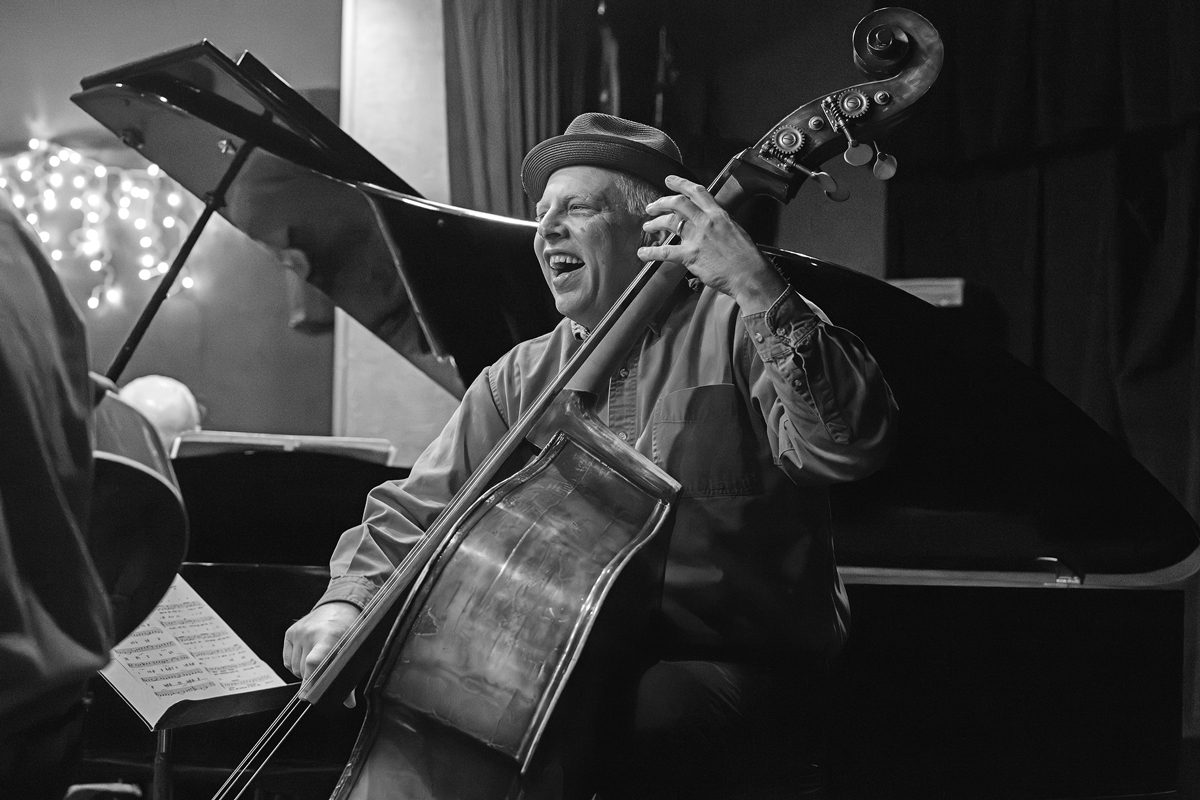
Bassist Paul Keller plays a gig at the Zal Gaz Grotto on May 12. “When you touch people, it’s the same jolt of electricity for the musicians and the listeners,” he says. | Photo: Doug Coombe
Drummer Sean Dobbins and bassist Paul Keller were playing a private party—just background music to fill the pauses in conversation and soften the clinking of silverware, but then people began bopping in their seats. Soon, they were applauding after solos. A guest requested a song.
“Paul looked at me and said, ‘It’s a show now, right?’” Dobbins recalls.
The life of a jazz musician: sometimes you’re headlining a concert house in front of an audience who came to see you specifically and listen with rapt attention, and sometimes you’re playing a club where your music blends with the chatter of the crowd. Hey, a gig’s a gig. But what’s it like for the musicians onstage? And how are the audiences in the Ann Arbor jazz scene?
Keller has played internationally at top clubs, touring with Diana Krall and other luminaries. But the bassist doesn’t mind playing background music at a restaurant where people may not be listening—he treats those gigs as rehearsals. “I’ll play music for anyone,” he says.
Flashback: The Paul Keller Orchestra (Mar. 2011) and Sean Dobbins and the Modern Jazz (May 2011)
At Zal Gaz Grotto, where he’s played for over fifteen years, people come at least partly for the music. At Blue LLama, they come as much for the music as for the dining experience. And at the Kerrytown Concert House, the music is the thing.
“At all three of those venues, people are well-behaved and are a sophisticated audience. We almost never have a problem with too much chatter,” Keller says, noting that it is somewhat different at Blue LLama than, say, Hill Auditorium: “There’s food and waiters and a bar. It’s a concert, and yet it’s a bar.”
Keller never judges audiences, even if they’re not attentive. He tries to give them what they came to enjoy. “I have two eyes and some common sense, and in a room full of eighty-year-olds, if they say ‘Do what you want,’ I’ll do what they want.”
At Glacier Hills and other assisted living facilities, he selects hits from the 1930s, ’40s, and earlier. “We also vary how gentle we are with them. If it’s memory-care people, sometimes it’s super-gentle music, minimal jazz. Music can bring them back. I’ve seen people in wheelchairs stand up and sing.”
For Keller, the joy is not finding the right audience but finding the right way to connect with a given audience in any venue. “When you touch people, it’s the same jolt of electricity for the musicians and the listeners,” he says.
Dobbins also knows the importance of these connections. “You have to understand the expectations of the audience. In a concert setting, they’re looking for more of a presentation. They may look for newer material. At Blue LLama, you have to make sure you bring recognizable material,” he says.
Another difference between concerts and clubs: phones. At a concert, audience members likely only take them out to memorialize the show. At a restaurant or bar, they might get lost scrolling—or forget to turn off their ringer.
Once when a phone rang, Dobbins laughed and told the audience member if the call was about an available gig, he’d take it. “I think humanizing the situation is better, so I usually make it into a funny event when that happens.”
Mishaps notwithstanding, Dobbins loves the local music scene. He says local venues often showcase local talent, and that gives young musicians a chance to develop. “I don’t play the Ravens Club much, but I’m happy seeing my old student Jesse Kramer developing a following there.” He says young artists draw young audiences, serving “an artistic, social, and educational purpose. … I’m very proud of the young lions!”
Pianist Rick Roe has been serving that artistic purpose since his days playing solo piano at the Gandy Dancer and the Earle in the ’80s and ’90s, where jazz may be a plus but isn’t the point. “At these restaurants, people come for dinner,” he says. “At the Earle, the tables are a distance from the piano” so the conversations don’t bother him. And, every so often, the audience perks up and really listens there. “It is enjoyable when it happens and usually increases tips,” he says.
Related: Pianist Rick Roe (Sept. 2024)
At Blue LLama, dinner sometimes takes center stage. “They are a fine dining establishment, too. [A server] might explain the menu during a song, but they do it quietly,” notes Roe. “If there’s a bar, you’re bound to get some people feeling good and talking a little louder.”
Back in the day, Roe played the Del Rio, a countercultural meeting place on Washington and Ashley that offered free jazz Sunday nights from 1969 to 2003. It was also a bar and restaurant, but, he says, Sunday nights were “about celebrating the music.”
Dobbins also has fond memories of past clubs. Bassist Ron Brooks, owner of the Bird of Paradise “would let young musicians play, even though they weren’t old enough to sit at the bar,” he recalls. “It goes back to the Del Rio, too. … The current clubs are carrying on the tradition.”
Under the photo, you say “his Easy Street Band, ” making two errors. The Easy Street JAZZ Band plays on Tuesdays and is led by Terry Kimura. Keller also plays in this band and leads his band, PKO, on Mondays. So it is not “his” band, and the band name is incorrect.