
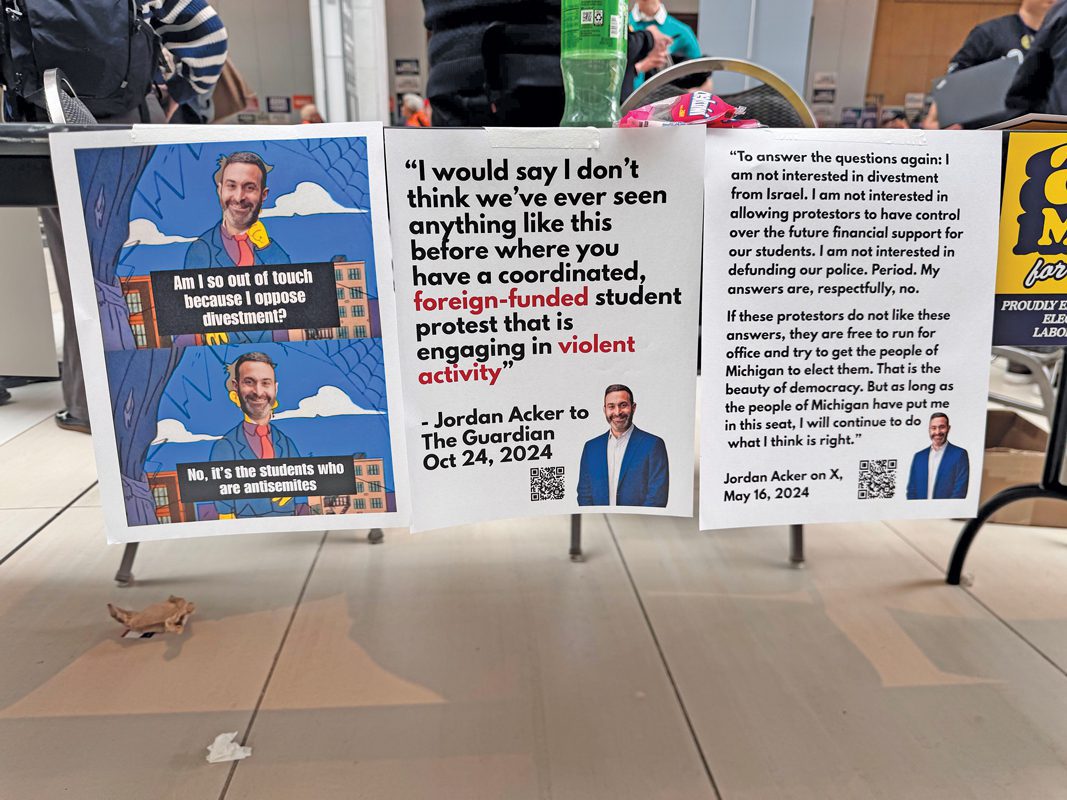
Posters opposing U-M Regent Jordan Acker’s reelection bid at the Michigan Democratic Party convention in April. Acker’s loss shows how the conflict in Gaza has spilled over into local politics. | Steve Friess
In May 2024, a week before police stormed and dismantled the Gaza solidarity encampment on the Diag, first-term Democrat U-M Regent Jordan Acker wrote on social media that he would never budge from his view that the university must not divest its endowment from companies that profit from Israel’s military campaign in Gaza. “If these protesters do not like these answers, they are free to run for office and try to get the people of Michigan to elect them,” Acker posited.
Whether Acker imagined they would take his words literally and find a candidate to shove him off the ballot two years later is anyone’s guess. Acker hasn’t spoken to any journalists since late April when, at the Michigan Democratic Party convention in Detroit, he failed to be renominated. (He did not respond to Observer inquiries throughout May.)
As Acker suggested, the demonstrators found a candidate—Dearborn-based civil rights attorney Democrat Amir Makled—and then persuaded a majority of convention delegates that Makled, not Acker, belonged on November’s ballot alongside renominated incumbent regent Democrat Paul Brown.
Remarkably, Acker’s downfall isn’t the only recent evidence that the Gaza War—despite being halted by a ceasefire since October and overshadowed in the international media’s attention by the U.S.-Israeli invasion of Iran—continues to have tremendous resonance in local affairs.
Related
Funding Fight: “No business as usual, no clubs as usual, and no programming as usual” until the U-M divests from companies associated with the Israeli military. (May 2024)
Two weeks after Acker lost, outgoing Faculty Senate chair and historian Derek Peterson set off a national scandal by telling U-M’s class of 2026 at the main commencement in the Big House of his gratitude to campus activists who “over these past two years opened our hearts to the injustice and inhumanity of Israel’s war in Gaza.” President Domenico Grasso issued an apology for Peterson’s remarks which, in turn, infuriated and alarmed many free-speech and academic-freedom advocates wondering what was so controversial about Peterson’s comments.
How is it that, in our attention-shortened society, Gaza still causes so much political drama in Ann Arbor?
“There are issues that happen in world politics that are really defining of the time, and the war in Gaza is one of those,” says Makled, who served pro bono as defense attorney for some U-M students charged with felonies related to campus protests. Those charges were later dropped. “It comes down to the University of Michigan, and every college or university in the country for that matter, needing to allow dialogue and academic freedom and free speech. It’s gonna still be at the top of mind of many of the people and on the minds of voters and taxpayers as we see our tax dollars being spent for foreign wars.”
Indeed, newly elected U-M student president Summit Louth, who gave a nominating speech for Makled at the Detroit convention, says the local impact of the war in Gaza endures because of how unsatisfying the university’s response has been—as illustrated by Grasso’s apology for Peterson’s remarks. On other hot topics, U-M leaders are permissive of activists and sometimes even come down publicly on their side. But on Gaza, “they won’t just compromise on anything.”
“When we protested about the threat that ICE poses to our campus, they’re on it,” Louth says. “When a former student lost their GSI [graduate student instructor] position and got detained by ICE, the regents responded and the student got out on bail. The regents showed up. With the Iran war, students showed they cared very deeply about the Iran war and the regents released an email saying they wanted to support students affected by it. But with Gaza, they just refuse to recognize the immense suffering of students who have lost people or even to recognize the scholars at this university who are just so concerned by the impact it’s going to have on academia.”
Republican regent Sarah Hubbard, who along with Acker has been outspoken in support of not divesting from Israeli companies, says the Gaza issue is providing fuel for the ascendancy of the Democratic Party’s progressives.
“The rhetoric around campus is not something we’re seeing across the board in a significantly bipartisan way, it’s something being politicized by the far left,” says Hubbard, whose home was targeted by pro-Palestinian vandals at the height of the demonstrations. “It is disappointing that this continues to be such a big issue, and I think it’s very anti-Semitic at the end of the day.”
Indeed, some Acker supporters believe he was targeted for being Jewish, pointing to the fact that Brown also rebuffed efforts to divest but did not become the focus of pro-Palestinian activist ire at the convention.
“People have said the only difference between Paul Brown and Jordan Acker was his religion, but that’s just factually incorrect,” says Tony DiMeglio, who graduated from U-M in 2024 and now cochairs the Michigan Democratic Party’s Progressive Caucus. “Paul Brown at least has been very supportive of the trans and queer community very explicitly and he has made efforts to engage with student activists and communities in different ways. … He’s by no means perfect, but he definitely was not the primary target for the student movements because he didn’t target the students like Jordan Acker did.”
Brown also wasn’t facing personal scandal. Days before the convention, the Guardian reported on messages Acker allegedly sent on Slack in 2020 and 2021 using lewd language to describe a political strategist and a U-M student, both female. Acker denied the authenticity of the messages, but U-M has hired an external law firm to investigate the matter.
For his part, Makled insists his campaign wasn’t anti-Acker so much as to join a board that has largely been inhospitable on several topics, Gaza being just one.
“I would say that we ran against the culture of fear on campus that we found to be very concerning,” he says. “We found that DEI was being gutted and that other issues like gender-affirming care were being cut at the pressure of the Trump administration. We need a board that is willing to push back. As we saw with the Professor Peterson moment, he spoke his mind and gave, I thought, a beautiful remark. I ran because I want regents to be willing to push back at the pressure that we’re receiving from Washington.”