
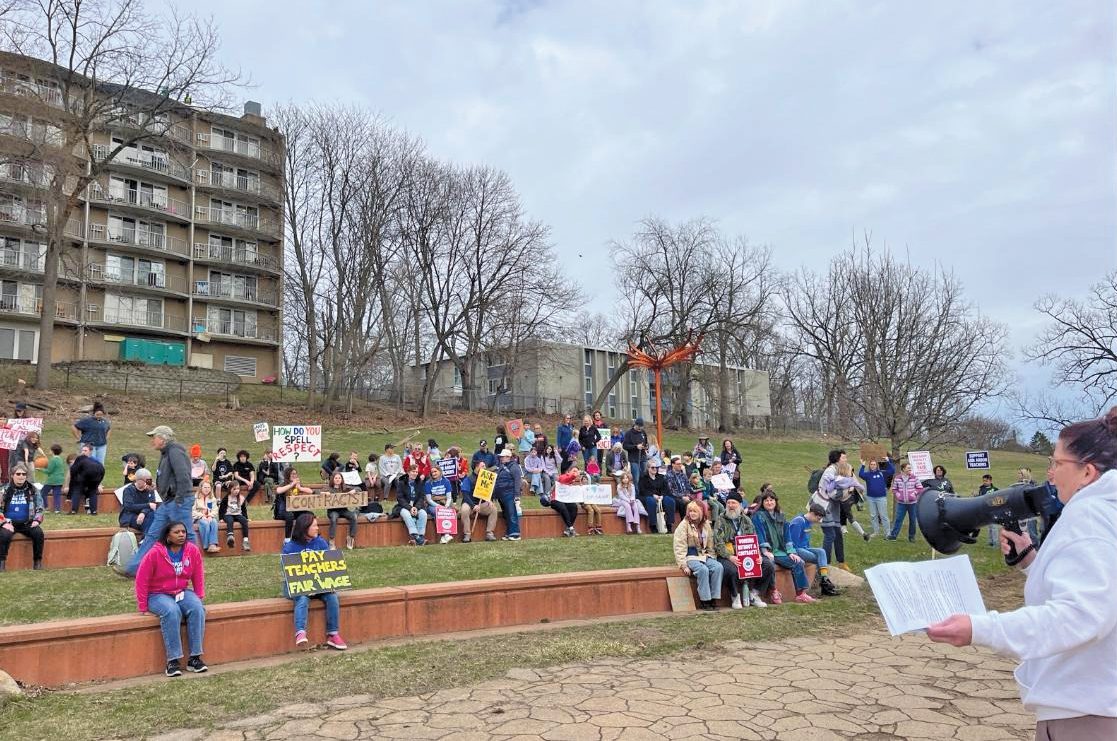
On March 25, an Ann Arbor Open “Support Ann Arbor Teachers” picket and rally marched to West Park. Union members overwhelmingly rejected a proposed teachers contract that the school district called a “good-faith effort.” | C. Jason Pasquale
After a whopping 99.6 percent of the members of the Ann Arbor Education Association (AAEA) voted against a tentative teachers contract in April, two big questions remained: What now? And, also, why did the union make everyone vote on an agreement that was so universally loathed?
The answer to the first question is quick and easy: negotiators for Ann Arbor Public Schools and the AAEA will schedule new dates to meet and work on an agreement that has more than an ice cube’s chance in hell of gaining support from an angry, restive teaching workforce.
But the answer to the second question provides important insight into just how brutal and vituperous those talks are going to be.
Why did the AAEA’s leaders force that vote and then urge their members to reject it? To embarrass the district and send both the AAEA membership and the community a message, says AAEA president Fred Klein. The negotiations, which began with direct talks in November but moved to mediation in February after the existing contract expired at the end of 2025, remained unproductive to the teachers’ side. Legally, though, AAEA couldn’t disclose any details of how far apart the sides were.
“We said, look, let’s let our members see this offer because they had put ‘confidential’ across the top of all of their proposals and so we couldn’t share anything like that,” Klein says. “We thought, well, if we TA [tentative-agreement] it, it becomes public. That was our strategy. We’ve never had a ratification vote that lopsided before, and it sent a strong message.”
Related: Water From a Stone (Feb. 2026)
For her part, Superintendent Jazz Parks seemed surprised by the outcome, writing in a letter to the community that “the tentative agreement … represented a genuine, good-faith effort to address the priorities raised during negotiations while also meeting our responsibility to ensure the district’s long-term financial health.” AAPS has struggled financially in recent years, notably having to resolve a $25 million deficit with layoffs and program cuts.
Yet that proposal, which the Observer published first on Facebook before the voting began, offered virtually no concessions by the district. The teachers, who already make significantly less than in comparable districts, would get a 1.5 percent annual pay raise for two years, well below inflation, and would make teachers give up their rights to pay less for health insurance even if a bill that passed the state Legislature in December 2024 that would require public employers to pay at least 80 percent is signed into law. The tentative agreement also reduced teachers’ paid prep time and increased some class sizes.
“Health care has been a big problem and it’s getting worse because our rates went up two years ago by 24 percent and they went up this year by 18 percent,” Klein says. “Those two years in a row have taken so much money out of our members’ paychecks.”
Indeed, the rising cost of insurance and slow pace of salary increases is prompting teachers like Andrew Smith to leave AAPS. Smith, sixty-three, hoped to retire when he hit “a full forty” years on the job but tapped out last summer at thirty-eight.
“As a retiree right now, I’m getting health insurance which is as good or better than what I got while I was teaching, and I’m paying less for it as a retiree than I was paying for it as a teacher,” the former Huron High German teacher says. “Retiring is a big decision with a lot of different variables, but people do sit down with calculators and figure out where things are going.”
AAPS communications director Andrew Cluley declined to provide anyone for the Observer to talk to about the negotiations, instead referring to Parks’s written statement.
In negotiations, Klein says, the AAEA has asked the AAPS to increase the top administrators’ health insurance costs—which are significantly less—as a gesture of solidarity, but were rebuffed. The savings wouldn’t be much for the district, but the message would be significant, he says. “Back in 2010, when we took a 3 percent pay cut, Todd Roberts, the then-superintendent, took an 8 percent pay cut for him and all his cabinet. We hoped Jazz and her cabinet would say, ‘Look, we understand how hard this insurance thing is impacting teachers, so we’ll take the same deal in solidarity.’ They would not do it, which was quite disappointing.”
The rejection of the tentative agreement may portend a lengthy negotiation period that does have precedent; teachers in the Okemos Public Schools have worked without a contract since June 2025, for example. But in a strange way, the lopsided “no” vote left teachers feeling better, Klein says.
“Morale for teachers in Ann Arbor has been so low for a long time and getting, if you can believe it, lower every day that this whole thing drags on,” he says. “But that no vote did a lot to change morale. I think teachers felt, hey, we’ve taken a step toward fixing this. We’ve tried to do it diplomatically through bargaining, but we get empty promise after empty promise from the district. We’ve heard it all. ‘Oh, next year it’ll be better. Oh, we’ll be more fiscally responsible. We’ll save money. Our fund balance will grow and we’ll be able to pay you more.’ None of that ever happened. It has not happened for twenty years. But this vote was a first, real step in fighting back.”
While teachers cannot legally strike in Michigan, it has happened; AAEA teachers struck for two weeks in 1994 after just six fruitless months of talks. Might one come in the 2026–27 academic year?
Flashback: After the Strike (Oct. 1994) [page 11]
“I think people are ready to escalate actions,” Klein says. “I’m not saying strike. I’m not saying that, but members are ready to do things right now like I’ve never seen them before. We’re gonna try to reach a ratifiable deal that will get us back on the right track with the district. That’s our goal. We’re not there yet. We haven’t really begun.”