
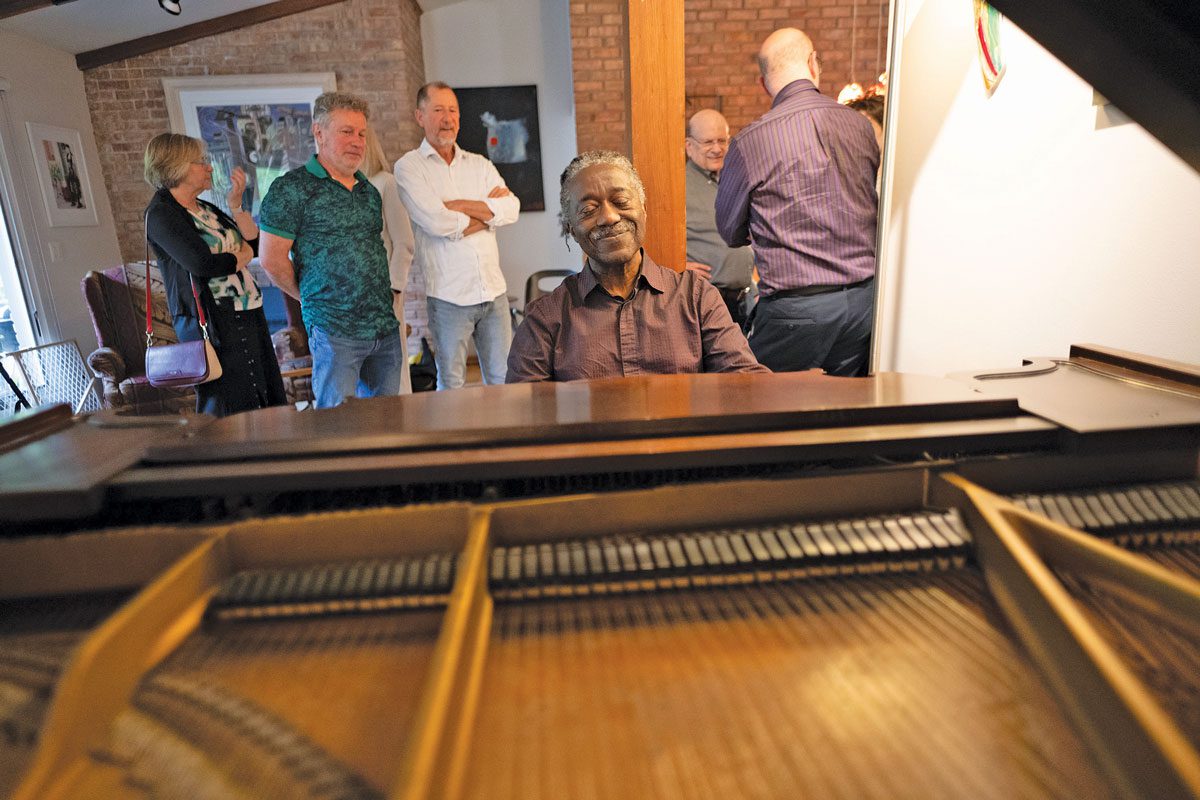
Herb Winful plays “Lift Every Voice and Sing” on a 1926 Steinway grand piano at a We Love a Piano event. The Ann Arbor tradition has inspired groups and gatherings of music lovers in other states. | Mark Bialek
Ron Bogdasarian, a retired physician, used to play piano only for himself. But sometimes, he says, “I imagined myself in a smoky piano bar where once in a while, someone would say ‘What’s that?’ And they would listen.”
These days, he plays in living rooms.
For more than twenty years, a group calling itself We Love a Piano, named for the Irving Berlin song from the Broadway revue Stop! Look! Listen!, has held monthly meetings at the homes of members who own grand pianos. Usually about a dozen people show up to play and listen; sometimes there are as many as twenty. Pianists may bring guests, like a cellist, violinist, or vocalist, to perform with them. Some people bring classical pieces, others play jazz. “Every time, we hear music we have never heard before,” says Bogdasarian, who has been involved since the start.
Although hosts rotate, no one is required to invite the group—some have too small a space or an upright. “You get to play on different grand pianos with a different touch and a different sound, and that in itself is wonderful,” says Bogdasarian.
The idea came from the late Sarah Savarino, then a retired flutist who’d played with the Flint Symphony Orchestra. She sold pianos at King’s Keyboard and taught piano when she moved to Ann Arbor. “Sarah was exceedingly outgoing,” Bogdasarian recalls. “Everyone who crossed her path became friends with her.”
Still, in 2003, when she began asking people to come together to play piano, not everyone was enthusiastic. Tom Denk, who owned the original Big City Bakery from 1990–1996, had played trombone in high school “and goofed around with guitar in college” but didn’t start playing piano until his mid-forties. When Savarino invited him, he declined several times, explaining he just didn’t play for other people. But, he says, she wouldn’t take no for an answer.
Denk reluctantly came to a session. “When I went there, I learned it’s not a recital. It’s not a concert. It’s not a competition. You can’t do anything wrong.” Sure, his hands still shake when he sits down to play, but he finds it a “great social group and one of the highlights of the month.” He brings desserts to every session.
Psychiatrist Harvey Falit started playing as a child, and his teen trio played gigs at a hotel in the Catskills for two summers. But as career and family intervened, he “pretty much gave it up.” We Love a Piano rekindled his love for the instrument.
“The opportunity to play piano with and for a bunch of supportive pianists, who themselves are enjoying improving their skills and listening to each other, is a unique pleasure,” Falit says. They feel free to make mistakes. “We all do,” he says. “The fact that the mistakes don’t matter is part of the pleasure here.” And in this supportive environment, everyone applauds.
Related: Playing with the Brain Plasticity Ukulele Collective (Apr. 2022)
Bogdasarian took lessons when he was a kid, but he didn’t practice much and soon quit to make time for sports. But all that changed when he was a teen and heard Duke Ellington for the first time. “I asked my mother if I could take jazz piano lessons, which I did for about a year before leaving for prep school,” he recalls. “I learned some jazz theory without really realizing it was being taught to me.”
Members may come for the social experience and the joy of playing and listening to music, but they also find they are sharpening their skills. Falit, for instance, says he started practicing again to prepare for meetings. Bogdasarian set a goal to play a song at every session: “That makes me work on something, not just sit down and play it and leave out the hard part.” But others take a different approach—like when Denk was working on Clair de lune, page by page.
“Tom said, ‘I‘m going to play page one,’” recalls Bogdasarian. “Page one ends right in the middle of a measure, and he just stopped. The next time, he started right in the middle of the measure and played page two.”
Over the years about fifty people have come and gone. Those who move away try to time visits to Ann Arbor when the group is meeting. Two people, one in California and another in Florida, have started groups modeled after this one, finding it a way to make new friends—and more music.