
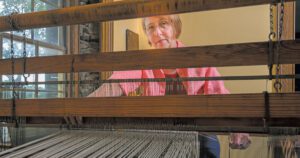
Doug Coombe
Barb Schutzgruber’s voice makes you feel like you’re crawling under a cozy, handmade blanket. It makes sense, given that for over forty years, she’s combined two traditional arts: weaving and storytelling.
“People will always tell stories in one way, shape, or form,” she says, observing “that although cultures may dress up our ideas a little differently for our own interpretation, we really aren’t that different at all.”
Schutzgruber, seventy-one, is the chair for the Michigan League of Handweavers 23rd Biennial Fiber Show, which takes place this fall at the Ann Arbor Art Center. The show will feature forty-five pieces by thirty-four artists, plus a posthumous retrospective for Millie Danielson, who recently passed at age 101 while still weaving tapestry.
Schutzgruber is also a member of the Ann Arbor Storytellers’ Guild. She has produced five audio recordings that can be found on her website and four other recordings on YouTube. Her recordings and book—Beyond the Sword Maiden: A Storyteller’s Introduction to the Heroine’s Journey, cowritten with Dorothy Cleveland—have won Parents’ Choice Gold and Storytelling World awards.
Related: “Live to Tell” (Jan. 2026)
Her path to becoming an artist is its own story woven with many threads.
Born in Brighton “back when it was a small town,” Schutzgruber (née Schutz) was the fourth of five kids. Her father taught at Brighton High School; her mother earned a degree in philosophy in the late 1930s, worked as department head for the Great Lakes War Manpower Commission, drove convoys from Detroit to Texas during World War II, and volunteered as a librarian for a local school. “My mother could organize anything,” says Schutzgruber. “After she got married, she moved from organizing everything in the outside world to organizing in our inside world.”
She grew up surrounded by a close family with many aunts and uncles—and stories. Her parents had an impressive collection of recorded folk tales on vinyl, but there were also the stories of her own family: their adventures and misadventures, their victories and defeats. At gatherings, her uncles regaled the family, and “didn’t let facts get in the way” of a good tale—including content that sometimes led her grandmother to remind them that kids were present. “They especially loved telling stories to creep out the kids, which is why I love scary stories to this day,” she says.
When she was six, Schutzgruber’s grandmother taught her embroidery. Always a “tactile person,” she loved using needles and colored threads to create visual art. A high school home economics class taught her the finer points of altering and fitting handmade clothing. But a particularly powerful set of childhood memories were family trips to Greenfield Village and Fort Mackinac, and particularly the reenactments of old-fashioned crafts. Watching the weavers, hearing the clicks of the shuttle, captivated young Barb. “Whenever my parents lost me on visits, they would just find the last demonstration area, and there I’d be,” she recalls.
Schutzgruber attended EMU, where she earned a BA and MA in children’s literature with an emphasis on folklore. In 1979, she and her then-boyfriend Terry Gruber moved to Ann Arbor for his job at Edison. The two tied the knot on February 29, 1980—a leap year wedding—and Barb combined the two last names into Schutzgruber. After a stint as a substitute teacher, she focused on raising her two children, Tristan and Andrea. And just like her childhood home, their house was filled with stories.
Schutzgruber’s love for stories led her to join the Detroit Story League. At storytelling performances in schools and libraries, she spun folk tales that frequently featured the fiber arts—and often a “helper” was involved. That helper appeared in real life in the form of Jean Gordon, a fellow member of the Story League and recently retired teacher, who told Schutzgruber about local classes where she learned to spin, weave, and make baskets.
“I took a workshop here and there weaving fabrics and then started doing basketry, which are very different skill sets,” she reflects. “With baskets you get instant gratification. I can finish a project in one day.”
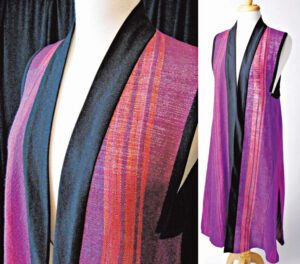
Schutzgruber enjoys using nontraditional materials. Her “Surround Sound” vest uses audio cassette tape as weft.
Over the years, Schutzgruber bought a loom and practiced her craft, using different yarns, wondering what she might do differently, but always learning something new. These skills led her to the Ann Arbor Fiberarts Guild and Michigan League of Handweavers. One of their many endeavors took place at the U-M Comprehensive Cancer Center. “For twenty years, we had looms in the lobby,” says Schutzgruber, “and weavers would take two-hour blocks one day a week where we would weave hats for the patients.”
It proved a welcome distraction for both patients and their loved ones. Because woven hats don’t stretch, the women had to be measured, leading to unique relationships.
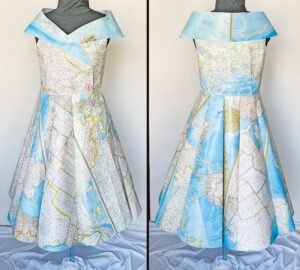
“Couture Cartography” was made from twenty-two National Geographic maps. The dress was part of the Paper Made II exhibit at the Fort Wayne Museum of Art.
Schutzgruber recalls conversations with international patients who were reminded of their grandmothers’ looms back home. Another time, a patient’s elementary school–aged son got on the loom, “making up his own patterns for over an hour and then called his older brother over to teach him how it worked. [The looms] provided a human connection.”
So did the hats. “The one I will always remember,” says Schutzgruber, “was the one woman who put her hat on and said ‘this is the first time I have felt pretty in two years.’” Unfortunately, Covid restrictions on people being in the waiting room ended the program.
These days, Schutzgruber has plenty of other activities keeping her busy. Using the large loom on the second floor of the Ticknor House at Cobblestone Farm, she weaves and demonstrates the loom for attendees.
And as for weaving tales, most recently, Schutzgruber attended the National Storytelling Network’s annual conference to deliver a presentation with Dorothy Cleveland called “Engaging the Listener Through Imagery.” She’ll also appear at the Ark’s Storytelling Nights on September 8.
“I emphasize female protagonists,” she says. “There are a lot of traditional tales where they are the main character, but you have to go into the old resources to find them. This has meant countless hours in the stacks at U-M graduate libraries—collections from the 1800s—finding some of these stories.”
Her repertoire includes about 200 folk tales where women use their skills at weaving, spinning, and dye work to get out of a tangled situation. Schutzgruber calls this the heroine’s journey. “Something happens that causes her to leave for a better life. Her life only gets a little better, so she must leave again, and so on until she gets to where she needs to be.”