
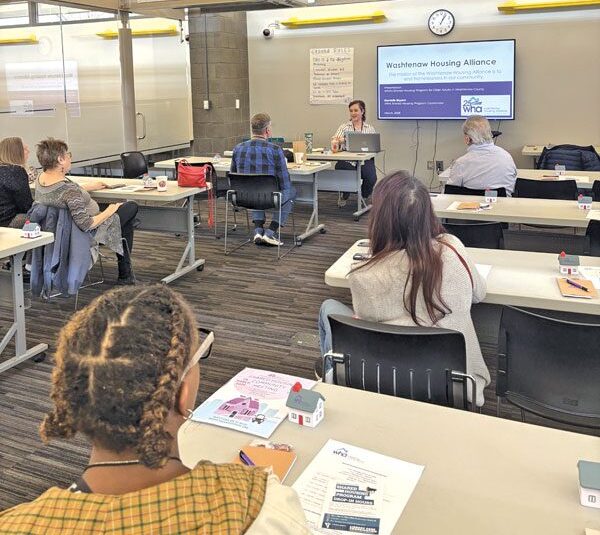
Home providers, home seekers, and community partners learned about the Shared Housing Program during a March meeting at AADL’s Pittsfield branch. Expanding access to affordable housing is a critical aspect of the program, but so is building relationships between community members. | Courtesy of Danielle Bryant
Sarah Russman’s daughter will leave their home in Ann Arbor this fall to embark on her freshman year of college and the new experience of shared living in a dorm room. Meanwhile, Russman is themself getting ready for a new shared-living experience, under a program that aims to address housing affordability and the challenges for older adults living alone.
The Shared Housing Program is partially modeled on the HomeShare Program, which Michigan Medicine operated until 2020 for U-M’s Housing Bureau for Seniors. The project was shuttered due to Covid-19–related closures and financial issues. But four years later, the Washtenaw Housing Alliance found that there’s still a need for reduced-rent housing and senior living support in the county, which has one of the most expensive housing markets in Michigan. Under the leadership of executive director Amanda Carlisle, the WHA obtained funding to repurpose the initiative to foster affordable, intergenerational living.
The Shared Housing Program pairs “home providers”—people who have a private, unused room in their home—with “home seekers,” including anyone looking for low-cost housing and expressing an enthusiasm for shared living. Funding for the program requires that one of the participants be over the age of fifty-five. Both parties undergo background checks and have several rounds of in-person meetings to discuss terms and expectations before they are paired.
Expanding access to reduced-rent housing is a critical aspect of the program, but so is building relationships between community members.
“Home seekers are looking for that affordability,” program coordinator Danielle Bryant says. “But they also are excited about intergenerational living. These are community members in Washtenaw County, these are folks that have lived here, shopped here, gone to school here, and so that holds such value.”
Stephanie Mecham says the promise of intergenerational living, and something beyond a landlord-tenant relationship, drew her to the Shared Housing Program. After receiving her graduate degree from U-M, Mecham found a job on campus at the Fine Arts Library. However, due to high housing costs in Ann Arbor, she moved to Ypsilanti and commutes to work every morning.
Mecham is working with the program and a prospective housemate on a service agreement that would include the cost of terminating her current lease, with a range of $750 to $1,000 a month for shared-living rent. More than that, she hopes to build a relationship with the housemate.
“She’s so cool and we’re very community involved, politically involved, and have a lot of the same shared values,” she says. “I’m really excited. Even if I don’t end up going through the process, I still met someone that I think is really cool.”
Mecham was also seeking a housemate willing to accept her two cats.
“I thought the cats or other things might restrict me, and they were totally nonissues,” she says.
Ensuring applicants would not disqualify themselves based on such criteria was one of Bryant’s main directives in helping to design the program. The arrangements are based on service agreements written to meet the needs of both providers and seekers, and the intake process allows for flexibility and personal preferences to be taken into account.
“I kind of removed the disqualifiers and gave that power to the home provider to make that final decision,” Bryant says.
While there is no standardized rent rate for providers to charge—and some may opt not to charge at all—agreements can include chores and quality time to compensate for the lower housing costs, a feature that interested Russman.
Russman heard about the program through their job as a social worker and attended one of the organization’s monthly office hours at the Ypsilanti District Library’s Michigan Ave. branch. These meetings serve as a space for potential program participants to share their motivations and questions about joining.
Concerns shared among the group ranged from general safety issues to daily miscommunications that may occur when delegating household responsibilities.
“Being in a more intimate setting, it was easy for us to have conversations about things that we might be questioning, or things that we feel like would hold us back from wanting to join,” Russman says.
Russman is an avid cook and believes that socializing continually is important for healthy aging; currently at the stage of drafting the agreement with a prospective housemate, they intend to include shared meals and time spent cooking together.
“I think that’s a beautiful thing that we could have an expectation around, you know, ‘let’s have Wednesday night be pasta night,’” says Russman.
While the current program focuses on anyone with the need for low-cost housing and older adults seeking companionship in the home, Bryant hopes the program can ultimately expand to develop databases of housing providers tailored to different populations.
By documenting the rebuilding of the Shared Housing Program, Bryant has already been able to guide other cities in Michigan through the process of replicating her agency’s efforts. She has been assisting officials from both Kalamazoo and Grand Traverse counties, and Grand Traverse recently received funding to directly support the opening of its own shared housing program.
Meanwhile in Ann Arbor, Russman and Mecham await their final matches, move-in dates, and weekly shared dinners.