
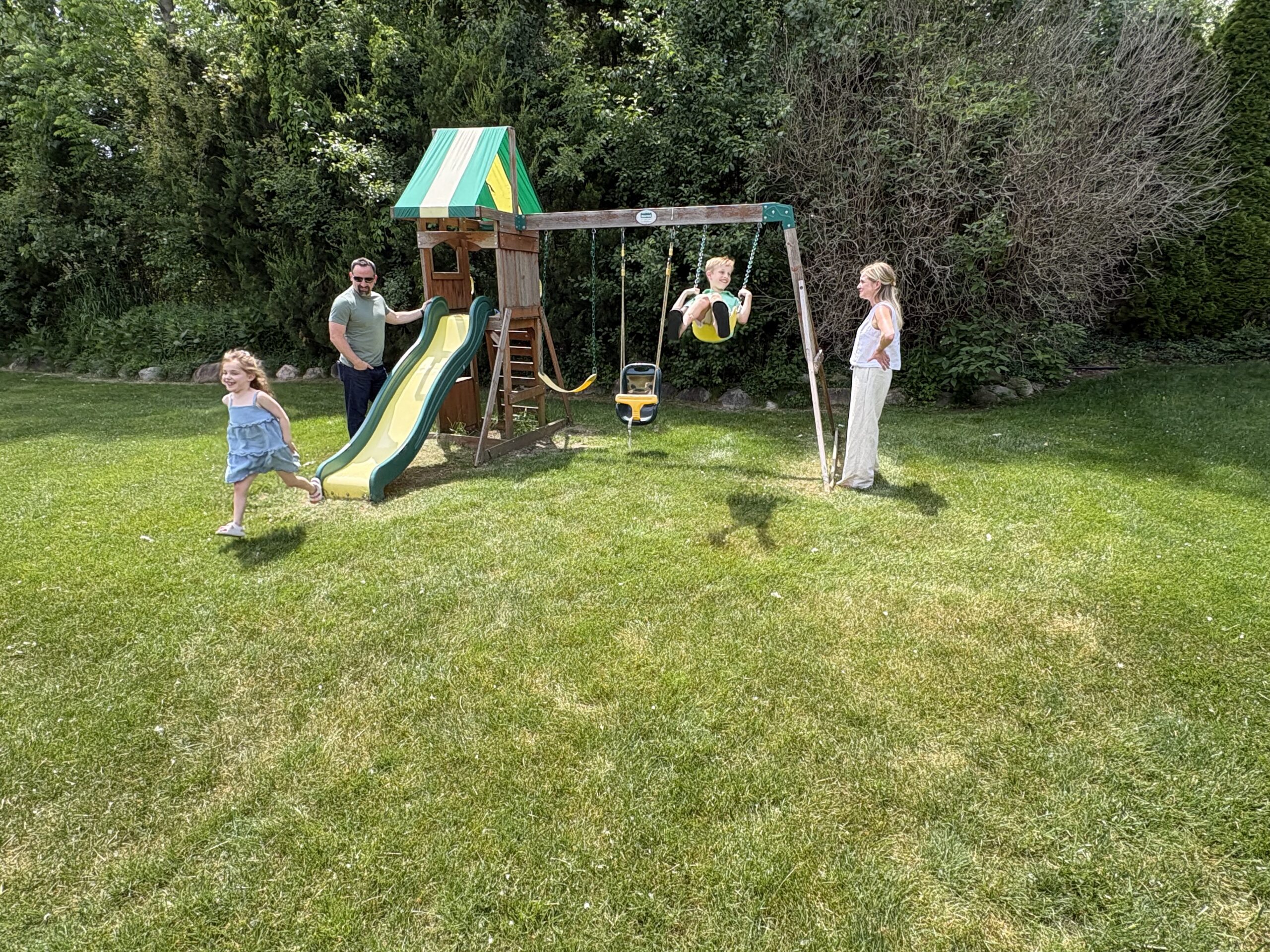
On a day when the smell of the Arbor Hills landfill is manageable, the Tenzillo family—Jenna and Jim and their children Luca and Mia—enjoy the warm weather in their backyard. | Ben Klayman
Jenna and Jim Tenzillo moved to Northville Township from Ann Arbor to shorten their commutes, but the move came with a trade-off: the smell of the Arbor Hills landfill, located just across the county line in Salem Township.
With the landfill and its owner, Miami Beach–based GFL Environmental, eyeing an expansion, Jenna Tenzillo and a group of nearby homeowners are seeking to convince the nine Washtenaw County commissioners who will decide the matter that the expansion to ninety acres is unnecessary, unsafe, and unfair.
Tenzillo acknowledges they knew about the landfill when they moved to Wayne County more than nine years ago, but since it was about two miles away and nearing its capacity they were determined to wait it out. Now, she doesn’t let her children—Luca, nine, and Mia, five—play outside when the smell becomes overbearing, out of fear of potential future health issues.
“We can tell when there’s a violation because we all smell it,” she says. “It smells like rotten eggs usually.”
While a final vote on an expansion is far off—at least twelve to eighteen months according to Washtenaw County Public Works Director Theo Eggermont—debate is well underway.
Opponents say the expansion is not needed, citing twenty-three years’ worth of unused capacity in the state, according to the Michigan Department of Environment, Great Lakes, and Energy (EGLE). The state’s sixty-five landfills disposed of more than 22.6 million tons of solid waste in 2025, down 6.35 percent from 2024. They also note Arbor Hills’ poor track record of environmental violations and odor complaints, and the unfairness that Washtenaw County and Salem Township benefit financially from the landfill, while nearby Wayne County residents bear much of the burden.
“This landfill is not a good neighbor,” says state senator Sue Shink. She cosponsored a bill that would bar landfills within one mile of dwellings, but is unsure whether it would stop the expansion.
Washtenaw County water resources commissioner Gretchen Driskill calls the battle over the expansion “another NIMBY thing,” referring to the “not in my backyard” attitude among residents who oppose projects near their homes.
Exacerbating the problem are Michigan’s high trash rate—in 2024 it ranked as the U.S. state with the third-highest waste per person according to environmental advocacy organization Full Circle Future—and extremely low tipping fees.
Flashback
Family vs. Trash: Taking the Zero-Waste Challenge (Jan. 2014)
GFL claims a bigger landfill is needed because the current version has less than six years of service left. The expansion would extend Arbor Hills’ life by eleven years, GFL officials said at a February 18 county meeting.
Without the expansion, Arbor Hills general manager Dave Seegert says, capacity would drop drastically for nearby landfills that would take on Arbor Hills’ trash. Arbor Hills handled 1.88 million tons of waste last year—the fourth most waste in the state among public landfills, according to EGLE data.
Eggermont adds that the landfill brings Washtenaw County over a million dollars in annual revenue that would have to be replaced if it closed. In addition to the county revenue, Salem Township’s 10,000 residents pay no local taxes, and landfill gas revenues have helped build a $27 million reserve fund.
While EGLE needs to sign off on any proposed expansion, it will likely rubber stamp any decision as long as it fulfills all technical requirements and the county’s materials management plan, EGLE district supervisor Gary Schwerin says. The best chance for opponents is at the county level.
“We just sit back and we let the locals decide if they want it and then we make sure that any design that comes in is consistent” with the plan, he says.
Two Washtenaw commissioners—Annie Sommerville and Ann Arbor mayoral candidate Yousef Rabhi—sit on the Washtenaw County Environmental Council, which voted unanimously in January to recommend voting against the expansion. No other commissioners have said how they will vote.
At the February 4 county meeting, however, commissioner Katie Scott called the council’s resolution “premature” and questioned calls to move the landfill expansion to a different site as potentially shifting problems to other residents. Commissioners Crystal Lyte and Caroline Sanders questioned why Northville Township homeowners bought houses close to the landfill knowing the issues.
Seegert disputes claims that the expansion would bring the landfill’s trash closer to Northville Township residents, citing a planned 1,000-foot setback. “I wish I could sit here and tell you this landfill is never going to stink,” Seegert says. “But that’s not realistic.”
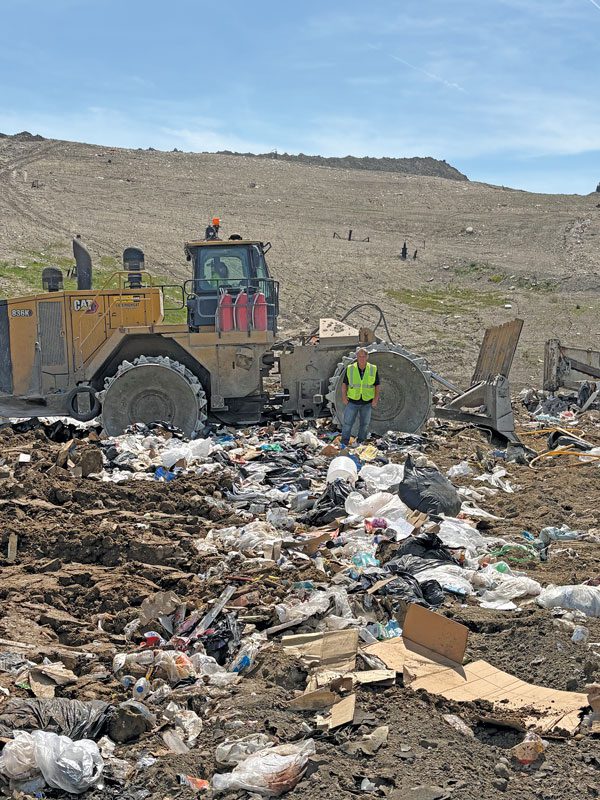
Dave Seegert, general manager of GFL Environmental’s Arbor Hills landfill, stands near a trash compactor at the site. | Ben Klayman
Seegert says GFL, which purchased the landfill in October 2020, has been tarred by the poor performance of the prior operator, Advanced Disposal Services. ADS abandoned efforts to expand the site in 2016 due partly to local opposition.
In March 2022, Arbor Hills settled with the state of Michigan to resolve odor and air quality complaints under a consent judgment that included fines, the installation of air monitors, and the funding of hazardous household waste disposal. GFL officials said those issues dated back to ADS. But residents still worry what an expansion could bring.
“It blows my mind that some of the commissioners can just say, ‘Well, they’re trying their best,’” says Jen Blaharski, a Northville Township resident who also owns a house across the street in Salem Township. “At some point, that doesn’t count anymore.”
Opponents point to over sixty environmental violations at Arbor Hills since 2016, resulting in more than $1 million in fines according to the Conservancy Initiative, a citizens’ group formed to fight the expansion initially sought by ADS. The group’s vice president, Dave Drinan, calls the landfill “a 400-foot monster.”
GFL officials at the February 18 meeting noted the reduction in EGLE air quality violations, from twenty-three in 2019 and 2020 to eleven in the years since. Drinan’s group, which tracks odor complaints and shares them with GFL and the state, said the complaint totals are far higher, totaling 4,208 since the end of 2022.
For the Tenzillos, the back and forth has been tiring.“If this passes,” Jenna Tenzillo says, “we’re probably going to move.”
They also continually polite the Johnson Creek with PFAS which flows through these neighborhoods and eventually into the Rouge system and beyond.