
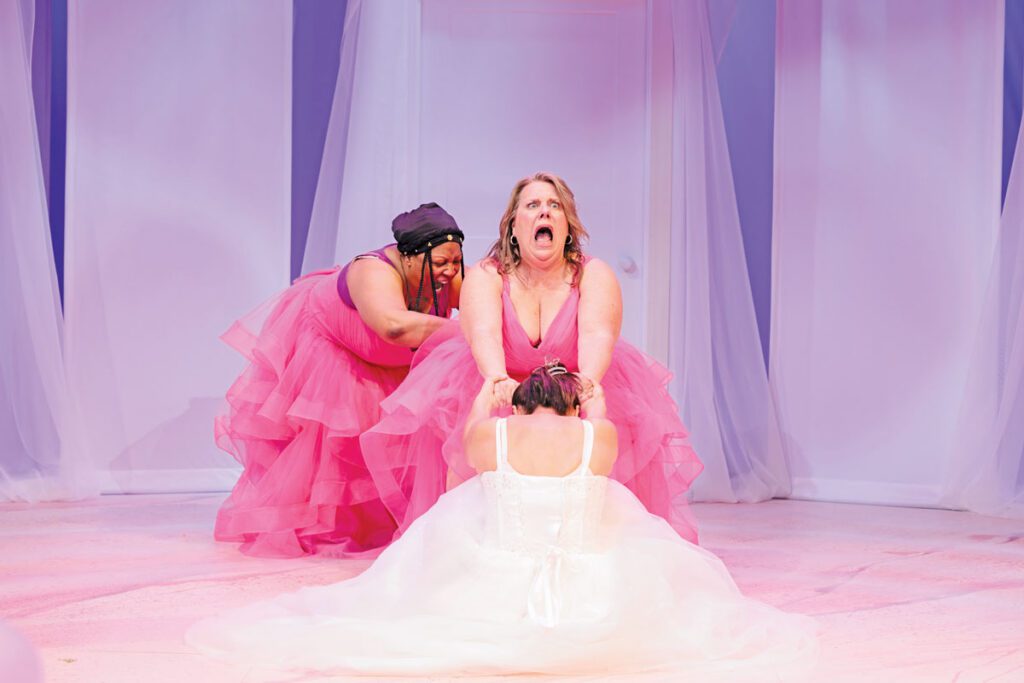
Emma’s Wedding(s) runs at the Purple Rose Theatre Company through Aug. 30. | Sean Carter
Carey Crim has written some excellent plays. Unfortunately, Emma’s Wedding(s) is not one of them.
In the play, a month into its world premiere at the Purple Rose Theatre Company, Emma is approaching her fourth attempt at forever while two close friends rail against the plan. Under the influence of psychedelics, the three women revisit Emma’s first three weddings. Will Emma change her mind about this one?
Emma’s already been through three divorces and isn’t the worse for any of them. Another isn’t likely to make a difference to her. What Crim really wants us to care about is Emma’s friendships. Will they stay strong, or will time and distance weaken them? The theme gets spelled out before the play ends.
Broad strokes are fun in a comedy, but recycled sitcom jokes at the expense of foolish ex-husbands are just too easy, and jokes about farts and a supermarket checkout machine that announces a condom purchase are not funny enough.
At one of Emma’s remembered bachelorette parties, a policeman responds to a noise complaint. Emma mistakes him for a male stripper and asks him to undress. The joke starts at the top and has nowhere to go—but it goes on. And on. Mistaken identity is a staple of comedy and farce and can be hilarious when it’s fresh—but here it’s overextended. And this isn’t the only situation that’s stale.
Related: Purple Rose in Full Bloom: Jeff Daniels reflects on his theater’s twenty-fifth anniversary
The play veers between comedy, farce, realism, and fable, and it ends with a twist that feels like a trick, an attempt to impose meaning where there hasn’t been any. One character faces a genuine crisis and is written realistically, reminiscent of Crim’s best work—she excels at drama. The other characters are cartoons, and director Kate Thomsen Savina hasn’t managed to unify the different elements.
The design elements upstage the play. They are functional and attractive, supporting the play’s themes. Wedding-gown white panels, separated at the top by bouquets, serve as doors and projection screens. Hot pink shirts define one character. The empty stage floor, dappled with lavender light, thrusts into the intimate space, leaving plenty of room for movement and props. Noele Stollmack’s subtle lighting design is so good it deserves a better play.