
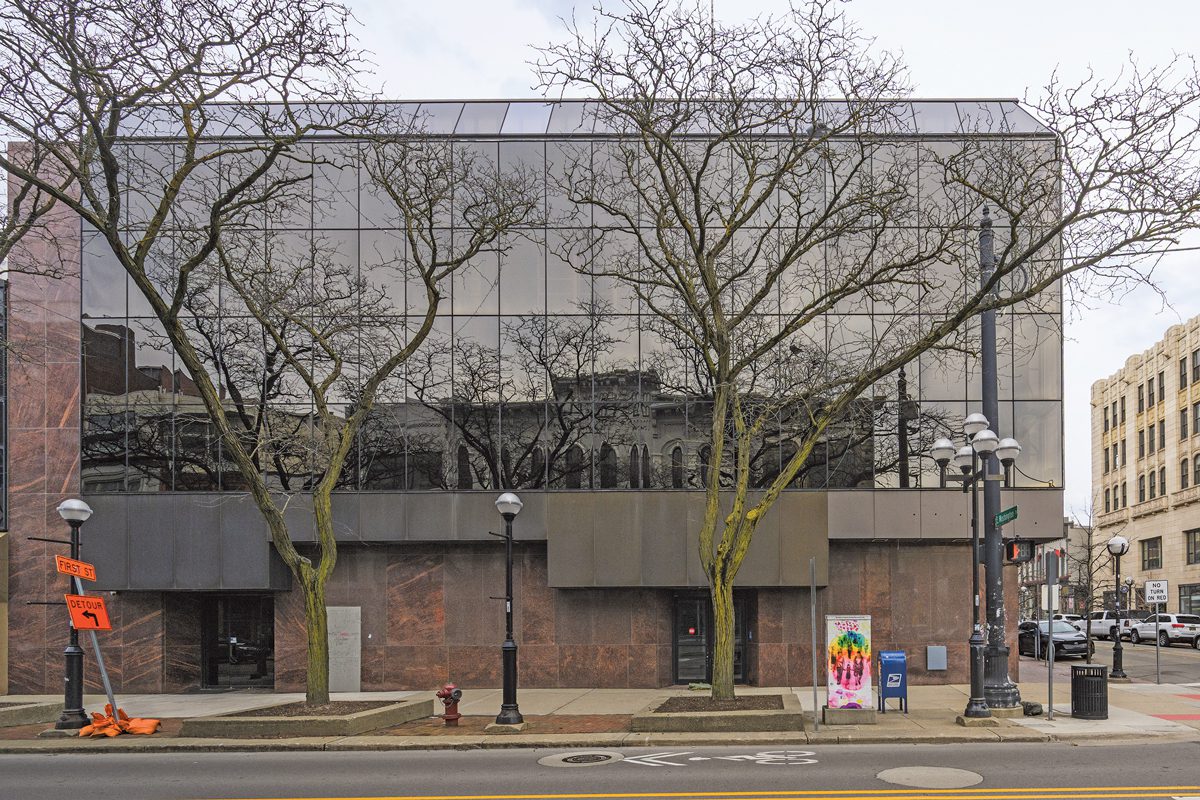
The Chase building, on the east side of Main, has been vacant for years, after the bank moved out and redevelopment plans fell through. | Doug Coombe
The west side of the block is a kaleidoscope of historic storefronts housing Vinology restaurant, Crazy Wisdom bookstore, and half a dozen other businesses. Across the street, the vacant stone-and-glass facades of PNC and JP Morgan Chase loom over the sidewalk like silent ghosts.
Ghosts, because as banking consolidated and moved online, both lost their purpose. Four years ago, Chase abandoned its five-story building at the corner of Washington for a small lobby in the Glazier Building at Main and Huron. Across Main, the PNC building was largely vacant long before the bank finally closed in January.
“Blank walls are death downtown,” planning consultant Dick Carlisle told the Observer four years ago. The Chase building in particular, he said, “kills that entire block” as a pleasant pedestrian experience. At the time, though, a turnaround seemed imminent: Neal Warling of commercial broker JJL reported that they were negotiating a purchase contract with a “developer-investor.”
Related: Down on Main Street (March 2022)
According to city records, REalta Capital and Hall Gratiot Partners bought the moribund bank later that year for $6 million. The following year, MLive reported, they presented a conceptual plan to replace it with a twenty-four-story hotel and apartment tower.
It would have been the city’s tallest building—but it never got off the ground.
REalta’s Steve Kalabat says they had an interested user, but it “unfortunately didn’t have the funding—not for a lack of trying.” Lenders will only finance a building if they’re confident its rents will repay their loans—and that’s been harder to do since the cost of construction materials and labor soared during the pandemic, followed by higher interest rates.
Kalabat also points to another obstacle: “When you try to underwrite a deal now for residential, and you look at what they’re charging in [property] taxes, it just starts to not make any sense,” he says. He didn’t share an estimate of the taxes on the unrealized apartment-hotel concept, but last year, the Vic Village South high-rise on South University paid $2.4 million—more than $500 a month for each of its 342 beds.
The willingness of wealthy U-M parents to absorb that kind of expense explains why Vic Village South is just one of a dozen student high-rises built and financed by national companies in the past twenty years. But lately demand seems to be softening. At move-in time last August, it was advertising “1, 2, 3, and 4-Bedroom apartments available!” Across campus, the just-opened Legacy at Washington and State was offering discounts of as much at $540 a month to fill its beds.
Related: The Meaning of the $3,100 Campus Studio (Sept. 2025)
On a much smaller scale, developer and landlord Ed Shaffran owns nineteen loft apartments downtown. He says that in years past, they “were always in high demand” and every one was rented. This year, three are empty.
Shaffran is the first to admit that he’s “not a big player in town,” but says he’s hearing from larger landlords that his experience is typical—that “the current vacancy rate for apartments in Ann Arbor is like 10 percent.” If that’s true, that would be more than double the average in the 2010s, according to a U-M report.
With five more private high-rises and two U-M dorms in the pipeline, Shaffran adds, he’s hearing predictions of “15, 16 percent vacancy” rates in coming years. One local landlord, speaking on condition of anonymity, says that his campus-area units are there already: 18 percent were vacant in March, reducing his income by $30,000 a month.
From his office on S. Fourth Ave., Shaffran had a front-row seat during the restoration and expansion of the derelict mini-mall across the street into the Montgomery Houze apartments. He told the Observer three years ago that it was “an unbelievably nice job,” but within a year of opening, unleased units were being offered as short-term rentals. Since then, the building has been renamed Exhibit A2 and appears to be functioning mainly as a staffless hotel.
Related: Makeover (Jan. 2023)
Other landlords also are turning to short-term rentals. This past December, MLive reported, Steve Kalabat spoke at a planning commission meeting about another REalta project, an office-to-apartment conversion of the former DTE building at 414 S. Main. Though it was more than 90 percent occupied, he said, they were requesting a zoning amendment that would also allow its use as a hotel or short-term rental.
As for the Chase building, Kalabat tells the Observer that they’re still working to redevelop it. “We are trying to do something a bit more ambitious than what you see on that street now,” he says. “I think the site deserves it.”
Developer/restaurateur Jon Carlson agrees. He and Greg Lobdell have done a series of historic restorations downtown, including the Vinology building, and their office is wedged between the two banks. Because the rest of downtown is a historic district, he emails, the east side of the 100 block “is the ONLY space [with the potential] ever to go vertical on South Main.”
Carlson thinks PNC’s closing could finally make that happen. Neal Warling, managing director at JLL Commercial Properties, was already listing some vacant space in the PNC building for rent at the time of the 2022 article. As of January, he emails, he hadn’t received “any direction regarding plans for the [building] going forward.” But once it hits the market, it will expand what’s possible on the block.
Carlson writes that his group has “run some numbers and met with some people” to look at what it would take to make a building financially viable. They concluded that the whole east side of the block “should be one developer that owns all the buildings and knocks them down and goes vertical,” he writes.
“We just don’t see how the numbers work to develop just one of the corners alone. Construction costs are so high right now, and you really need the entire site and a tall, dense building to make this work.”
The block would make an “amazing” site for a “residential hotel combo,” Carlson writes. While he’s “a preservationist at heart,” with the right developer, “this literally is the best location in all of Ann Arbor. It sits on two major corners and is so visible. …
“I love our little historic buildings on the rest of Main Street, but this could be magnificent if done correctly.”
When we moved to A2 in summer of 1987, Main Street was a dead zone. They tried closing off several blocks and inviting restaurants to put tables out on the street. It took a turn in the nation’s economy to make Main Street viable again. We’re headed toward another slump that could last a lot longer due to the traffic changes and decreased parking. People don’t walk to Main Street after working hours.
The main issue that’s hurting downtown businesses is the shift to remote work. Parking is abundant, and evening restaurant traffic is better than pre-COVID. Downtown visits (DDA) are up by 3m (annual) compared to 2017.