
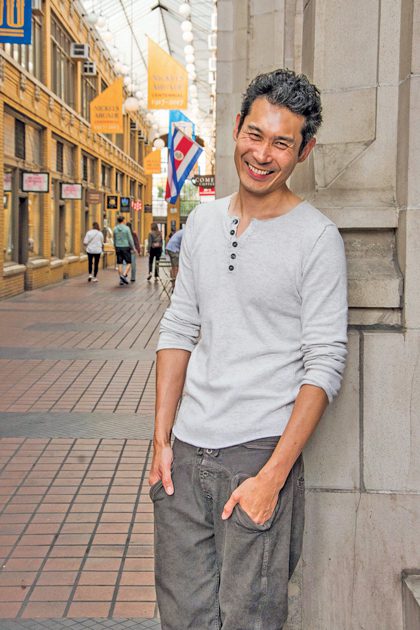
Filmmaker Trevor Zhou at Nickels Arcade, one of the locations for Ann Arbor, a project that begins shooting this spring. He calls the movie “a love letter to the town and the community.” | Erin Marie Miller
Ann Arbor native Trevor Zhou is no stranger to bringing his personal life into his films. Working as a flight attendant inspired Layover, a short about the dynamic but sometimes lonely experience of continuous travel. When a childhood teacher asked him what he wanted to be when he grew up, his answer was Superman; that moment turned into the short The Problem of Gravity. And when he was feeling homesick while on lockdown in California during the forlorn stretch that was quarantine in 2020, he came up with the idea for his debut feature film, Ann Arbor, set to begin shooting this spring.
“I always bring all of myself to every project I make. That way I can get the real kaleidoscope of human emotions,” he says. “Once my experience gets on the page and becomes a character, in that moment, it feels like street art in a way. I have created it, but it belongs to everyone now. They can imprint their own life onto the character. Once that happens, you have to let go of the you inside.”
Ann Arbor blends Zhou’s personal experience with classic coming-of-age themes: reconnection with old friends, the power of changed perspective, the fear at the heart of unmet potential. Its protagonist, Kendrick, returns home married, settled into a career, and raising a family. After a shake-up with his parents, he wonders what his life would be like if he had chosen a different path. He reconnects with his former best friend, Jane, who never left their hometown, and they take a walk through Ann Arbor, passing landmarks that include Zingerman’s Deli, Nickels Arcade, and the Big House.
“I created a map for my team and myself of all the locations our characters walk because it needs to be logical,” says Zhou. “One can literally go on the same path that they do.” (Well, once the movie is in theaters; for now, he’s keeping the full list of locations under wraps.)
Lawrence Kao will be playing the role of Kendrick. “I’ve never been to Ann Arbor so I’m excited to explore the city,” he says. “I’ll have a week beforehand to roam around the city and walk the streets so that I can talk to the locals and see how they live their lives. It’s much different than going online; it’s better to immerse yourself in a people and a culture.”
The film won’t be Ann Arbor’s first time in the spotlight: The Ides of March, Jumper, Whip It, The Five-Year Engagement, Trust, Youth in Revolt, and The Double have brought stars like George Clooney, Ryan Gosling, Hayden Christensen, Drew Barrymore, Emily Blunt, Clive Owen, Michael Cera, and Richard Gere to our wooded town. But since the 2015 end of the Multimedia Jobs Act, which incentivized film production in the state, newer projects have had to expand their efforts for funding.
“I’ve had meetings where production companies were on board but only on the condition that it be filmed out of state, and I knew I couldn’t do that,” says Zhou. “This movie is a love letter to the town and the community, and to film it anywhere else, then that wouldn’t be the case.”
Production companies have also been trending toward “safe bet” decision-making, funding movies based on existing intellectual property (IP). In 2025, seven of the top ten highest-grossing films were sequels or reboots. Of the remaining three, one was an adaptation of the video game Minecraft, another was an adaptation of the manga Demon Slayer, and the third, F1, was directed toward the fanbase of a sport that generates nearly $4 billion dollars annually.
“The questions that came up for me when I was pitching to large production companies or even mid-level production companies was, ‘Is this IP?’ And the answer is no,” says Zhou. “It was always a pass because that’s what is selling right now.”
In this new landscape that prioritizes potential return on investment, original stories like Ann Arbor that seek to appeal to emotions and experiences instead of popular references have become increasingly rare. But production has continued undeterred, supported by crowdfunded donations from private donors, students, alumni, local businesses, and a fundraiser at the Michigan Theater in November.
“We are always asking how we can better support local creatives and help them tell the stories of our community,” says Tara Calligan, the Michigan Theater’s director of marketing. “Original work all comes from somewhere and without it there is no evolution, nothing to push the art form forward. If original work disappears then we’ll be maintaining what is instead of imagining what is possible.”
As the Observer went to press, Zhou and his team were gearing up for filming: they hired NYC-based cinematographer Isaac Banks as director of photography on April 3, and were still in the process of casting for Jane. As they get closer to their shoot, they’ll start recruiting townie extras via their social media channels.