
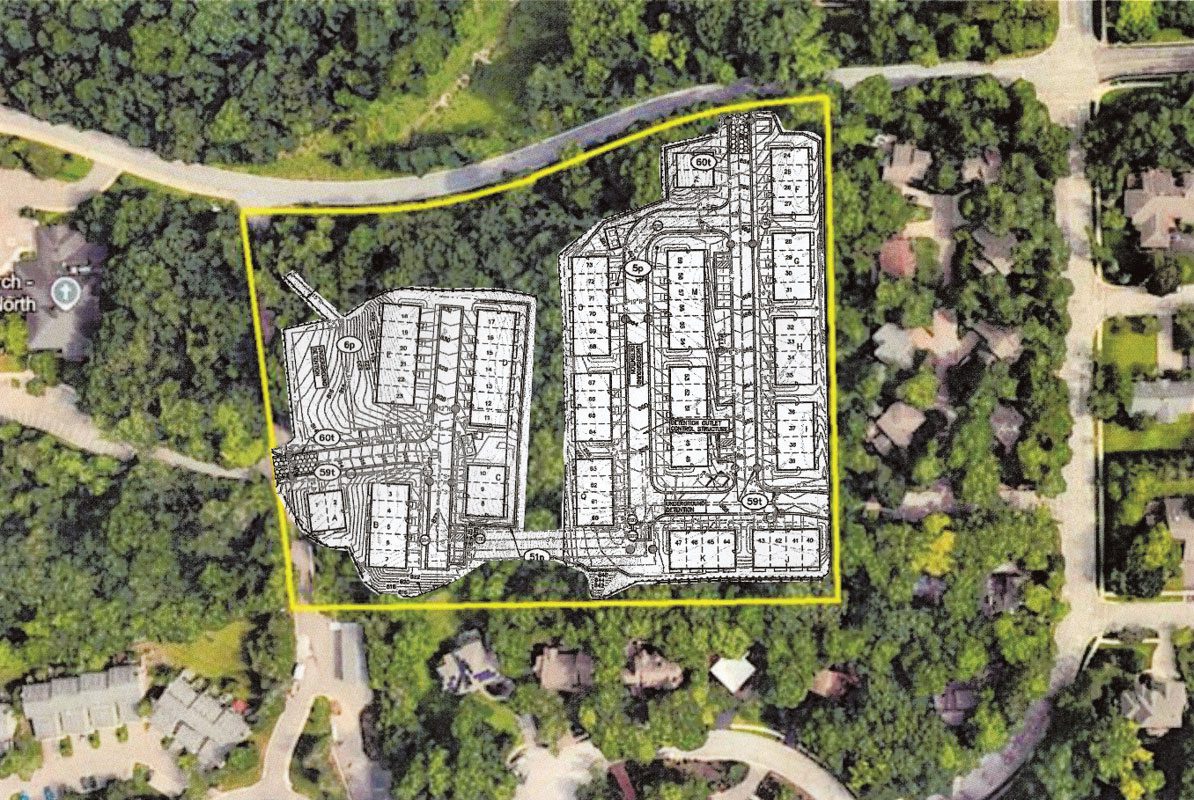
The $38 million townhouse project at 3420 Glazier Way would place seventy-five townhomes on eight tree-filled acres. The development would have at least 60 percent more housing density than nearby condominiums. | Courtesy of Daniel Johnson
Sheila Perlman logged into the online community meeting looking to make her opposition clear.
The presentation centered on the $38 million townhouse project at 3420 Glazier Way proposed by an affiliate of Troy, Michigan–based homebuilder Centennial Home Group. Perlman, like many of the five dozen neighbors who also attended the June meeting, was against the project, and she wanted to make sure the organizers knew.
“I don’t know if you’re getting the point that none of us here want this,” she said. “To come to our neighborhood with a project like this, it’s ridiculous and we’re all going to fight it.”
The eight-acre parcel in Ann Arbor Twp., just south of Glazier Hill Nature Area, was once a farm and remains home to hundreds of trees. Its owners, a family in Massachusetts, have an agreement to sell it to the Centennial affiliate. The plan is for Ann Arbor to annex the land and zone it R4B, a multiple-family dwelling district allowing a density of up to fifteen residences per acre.
Annexation would enable Centennial to access city sewer and water services, while adding potentially millions to the city’s tax revenue base.
The seventy-five townhouses would have at least 60 percent more housing density than nearby condominiums. Opponents say the development would also worsen traffic, require cutting down mature trees, and potentially expose nearby homes to problematic water runoff.
The backdrop for the tension surrounding 3420 Glazier Way is Ann Arbor’s recently adopted Comprehensive Land Use Plan, which allows more multifamily units on what are now single-family lots. City officials said last year the plan could enable up to 97,000 more housing units, arguing the greater housing density would allow more people who work in the city to live here.
Related:
Comprehensive Plan: What Happens Now? (Apr. 2026)
Small Town/Big City (May 2025)
Centennial declined to comment to the Observer, but in proposal documents filed with the city cited those same goals.
“The annexation and rezoning will align the property with the proposed new housing goals of the city of Ann Arbor and bring in additional tax revenues,” Centennial builder Stefano Mularoni wrote in his proposal. He also asserted that “This housing will be consistent in scale and stature to the existing homes in the area and will blend harmoniously with the surroundings.”
The Glazier Way Neighborhood Association disagrees. The neighborhood group, which recently formed to oppose the current construction plan, sent a letter in August to city planning officials protesting the project’s “jarring density, height, and scale in relation to the surrounding neighborhood.” It also cited a 2009 city planning document describing the Glazier Way site as suitable for a housing density of up to three to four residences per acre. The proposed development has a density of about eight residences per acre.
“We advocate for housing, but we don’t advocate for the density for that property,” says Nick Avrakotos, a member of the neighborhood association. Avrakotos, who once chaired a planning board in New York state, has lived for fifteen years on Watershed Dr. adjacent to the property.
The project’s architect, J. Bradley Moore, said at the June meeting that city officials told them the project’s housing density is appropriate.
There are still several steps before the project can proceed. Centennial’s proposal is already on its second iteration after feedback from city planners, and more modifications could occur. The city could push for further changes based on public feedback, even if all codes and guidelines are met, city planning officials say.
“We do take the community participation process seriously,” deputy planning manager Hank Kelley says. “We push applicants to understand and absorb the feedback.”
Once the plan is ready for Ann Arbor’s planning commission, it will be sent to the state to approve the annexation. After the approval and subsequent zoning, it faces a review by the city planning commission, and upon approval, it is then sent to Ann Arbor’s city council, which will have two readings and a public hearing before the final vote.
The entire process could last eight months or more, according to Mariana Melin-Corcoran, the senior city planner assigned to the project, easily pushing it into next year when a new mayor and new council members will weigh in.
Ann Arbor is a majority Democratic city, so winning the primary essentially assures victory in the general election. Washtenaw County Commissioner Yousef Rabhi mobilized the “Pause the Plan” vote opposing the land-use plan to defeat pro-growth incumbent Christopher Taylor in the mayoral primary. However, in the city council races two incumbents and two Taylor endorsees won, suggesting the council could still favor growth.
Related: Voters’ Message Is Clear—As Mud (Aug. 2025)
The issues around the Glazier Way project caught Rabhi’s attention this summer, although he says he has not decided how he would vote on the project. While he insists city officials and planners must listen to the community, he believes Ann Arbor has room for greater housing density.
“We’ve been sold this false conflict that often arises when it comes to development,” he says. “We can have a community that is growing and we can have a community that is preserving and respecting high-quality natural areas and trees.”
Sandy Aldrich, who will likely represent city council’s Ward 2, where the project is located, wonders whether the city could buy undeveloped property like this to roll into Ann Arbor’s Greenbelt program, an initiative that protects thousands of acres of farmland, open spaces, and natural areas surrounding the city.
“I would love to see in that area, if they do do a development, something that fits with the nature of all those trees,” Aldrich says.
But some neighbors just want the Glazier Way project to go away.
“I’m sorry. I have a real problem with this,” James D’Amour, a former city planning commission member, said at the June community meeting. “I would prefer this stop now before we go any further. This is not the best area to build. This is something that belongs over by Briarwood Mall.”