
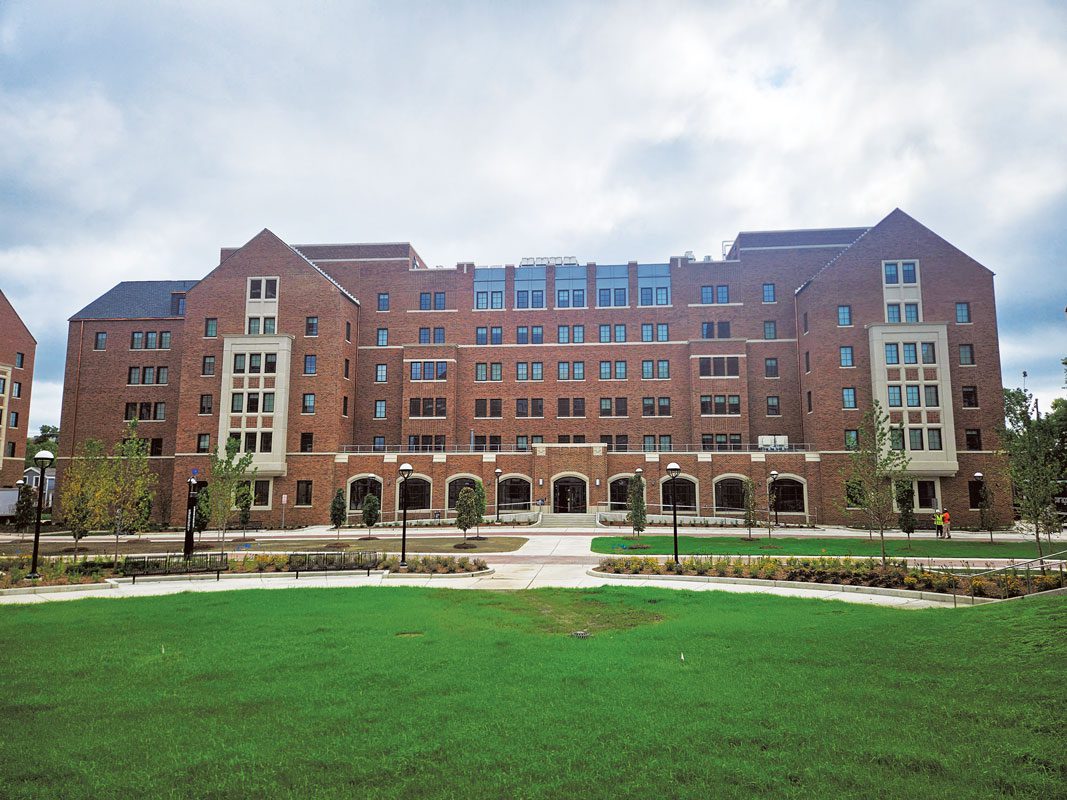
The five neo-Gothic buildings of Wolverine Village will house 2,300 students. For context, private developers have been adding an average of 700 housing units per year in recent years, according to city planning commissioner Brett Lenart. | Drew Saunders
By the time you read this, 2,300 U-M students will have settled in at Wolverine Village. U-M spokesperson Brian Taylor says the $649 million housing complex represents a 25 percent increase in university-owned housing capacity. In 2026, he adds, nearly 13,000 undergraduate and graduate students will live on campus—“the most ever.” How will this addition to the housing supply affect the affordability of Ann Arbor’s broader housing market?
Background: New Dorms at Last (Apr. 2023)
That all depends on the pace of enrollment growth and other projects in town. “You can add supply, but if demand keeps increasing, then you won’t see as much of an impact,” says Jennifer Hall, executive director of the Ann Arbor Housing Commission. “But 2,300 is a huge number.”
For context, private developers have been adding an average of 700 housing units per year in recent years, says city planning commissioner Brett Lenart. Meanwhile, the city is mobilizing funds from the affordable-housing millage passed six years ago toward its goal of building 1,500 homes for people earning up to 60 percent of the local median income by 2040.
A July report shows it’s slow going: Only 199 units are finished—in projects like Kerrytown’s Dunbar Tower—while 388 are under construction, 366 are trying to find financing, and 110 are in the “initial concept” phase. The remaining 487 are still TBD.
Background: Affordable Housing, at Last (July 2023)
Wolverine Village is a feather in the cap of the university as it navigates significant challenges, including Trump administration scrutiny of higher education, athletic department scandals, and opposition to its planned “high-performance computing facility” in Ypsilanti Twp.
Look northwest from the corner of Hoover and Division and you’ll see all five of the neo-Gothic dorm buildings rising several stories above what used to be a quiet low-rise neighborhood. The complex features a grassy internal courtyard, a sanitary zone for service dogs, and a tower rising from the middle of the largest building. The developers incorporated suggestions gathered from over 2,600 U-M students, and the buildings are outfitted with study rooms and gaming lounges—with a decor reminiscent of early 2000s Nickelodeon—as well as sustainability features and a bicycle repair room. The showpiece is the 800-plus-seat dining hall. Sunlight pours in through massive windows facing the courtyard; dining options include vegan, halal, and kosher.
As the Observer went to press, any potential impact of Wolverine Village on rental rates at student high-rises was still unclear. A studio at Avia Lofts, which was $1,600 per month in August 2025, now goes for $1,329. But at Verve, a studio that was $3,099 a year ago is now $3,299, and at Beekman and Broadway, a formerly $2,300 one-bedroom now goes for $2,650. Meanwhile, rents at Maple Cove haven’t changed, and they’ve increased by a mere $30 per month at Hoover + Greene.
Related: The Meaning of the $3,100 Campus Studio (Aug. 2025)
“As incoming class sizes continue to rise each year, the new dorms will hopefully stave off some of the competition for off campus housing by allowing more returning students to live in the dorms if they so choose,” SaraEllen Strongman, a U-M academic who also helps lead the local Neighbors For More Neighbors, writes in an email. “The new dorm is only one project, and it only serves a small piece of a section of the city’s population, but it’s a step in the right direction.”
That competition is just part of Ann Arbor’s broader tension over housing availability, which pits U-M students against others seeking affordable places to live in town.
According to Health for All Washtenaw data, from 2020 to 2024, 60.4 percent of Ann Arbor renters paid more than 30 percent of their household income on rent, compared to 51.1 percent nationwide. During that same time period, 22.8 percent of Ann Arbor households paid more than 50 percent of household income on rent, compared to just 14.7 percent nationwide.
Related: Squeezed Out (Dec. 2025)
Hall estimates that the housing commission gets thousands of requests per year for help with finding housing. When she first started her job, she says, “I would get maybe ten to twenty phone calls or emails a year from people saying they are desperately looking for housing. Now I get phone calls and emails almost every day … and that’s just me.”
Calls & Letters, November 2026: U-M’s Dorm Drought
In “Doors Open at the Big House of Dorms” (October), we reported that Wolverine Village was the U-M’s first new dorm in over half a century. This was incorrect; the North Quad residential hall opened in 2010. It was the first new dorm in over half a century—since the construction of Baits II and Bursley Hall in 1967. The article has been edited to omit the erroneous claim.
The article talks about costs of private student housing but doesn’t mention the cost of this new university housing. How does it compare?
Hi Ann! Great question: rates for undergraduate housing at U-M range from $8,107 per academic year for a room in an economy triple to $15,355 per academic year for a premium single. (Detailed rates can be found at https://housing.umich.edu/undergraduate-rates).
first new dorm in over half a century? Nope. North Quad and Munger Graduate Residences…