
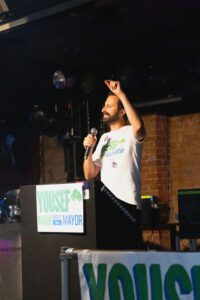
Yousef Rabhi celebrates his victory in the Democratic primary for mayor. Rabhi won handily over incumbent Christopher Taylor, but only one of Rabhi’s allies, Ryan Bartholomew, won his city council race. | Emilee Nazareth
On election night in 1957, when incumbent Ann Arbor mayor William E. Brown Jr. was ousted by Samuel Eldersveld even as most of the council candidates on Brown’s slate won, he offered this melancholy comment to the Ann Arbor News: “I worked hard for twelve years, and I guess the people decided I wasn’t good enough.”
Mayor Christopher Taylor woke up on August 5 feeling much the same way. “Of course, it’s disappointing,” says Taylor, whose first-ever election loss thwarted his bid to eclipse Brown’s record tenure. “But I’m proud of the work we’ve done over the past twelve years, I’m proud of the campaign, and this is the way it is. People had just had enough of me, I guess.”
Taylor was soundly defeated by county commissioner Yousef Rabhi in the Democratic primary even as two council incumbents, Cynthia Harrison and Jenn Cornell, and two other Taylor-endorsed council candidates, Sandy Aldrich and Aidan Sova, cruised to victory. This being a city dominated by Democrats, the primary was tantamount to winning the office; thirty-eight-year-old Rabhi is, barring some wild turn of events, now the mayor-elect.
Related: “Who’s in the Running to Run Ann Arbor?” (May 2026)
Yet in that split decision, the voters’ message is far from clear. Turnout was remarkably high—36,750 ballots cast is a modern record for a midterm primary—and high turnouts typically translate into a de facto plebiscite on some policy or issue.
But Taylor believes Democratic voting enthusiasm was more about fury over the Trump presidency and interest in the bitter U.S. Senate primary between Ann Arbor’s Abdul El-Sayed and congresswoman Haley Stevens. El-Sayed, who won narrowly statewide but had his second-best showing in Washtenaw County, endorsed Rabhi.
“It was easy for Abdul voters to move to be Yousef voters,” Taylor says. “I don’t think that fully trickled down to council. The previously unengaged Abdul enthusiast who came in, and I don’t mean to diminish their thought processes, but, they said, ‘Abdul’s my guy, I’m super-excited about him, he’s endorsed Yousef. I’ll go with him.’ Then you layer on that my twelve years as mayor, six years before that as councilmember, and I become the focal point for conspiracy theories and Nextdoor hate.”
The key debate between Taylor and Rabhi surrounded the pro-growth, pro-density push of the Taylor administration that culminated earlier this year with the unanimous passage of the new Comprehensive Land Use Plan. Taylor and the council assert they’ve fostered conditions to build more affordable housing; Rabhi charged it was all a gift to rich developers to cater to more well-heeled residents.
Prior to the election, Michigan Public notably framed the race as a “rebuke, or approving nod” to the CLUP.
Now, the chattering classes can’t say which it was. “The mayoral decision went one way, and the council decisions went another way,” says David M. Fresco, who writes a Substack blog about local politics and supported Rabhi. “I honestly don’t have any major theories for why that is. Maybe the longevity of being a three-term incumbent meant this mayor got more credit or more blame for the things that people liked or didn’t like.”
Not even Rabhi claims he’s vanquished Taylorism—given that he’ll face a council stocked with Taylorites. Instead, he says voters felt “Ann Arbor has become a place that is completely unaffordable, and we do need to focus on building housing that is affordable for the working people that make our community run.”
Does that mean unwinding the CLUP? “The Comprehensive Land Use Plan is passed. It’s done, it’s not something that is going to be before us,” he replies. “I am not going to be a rubber stamp for past decisions. I wasn’t there to vote on the comprehensive plan. There are some things that I agree with. There are some things that I don’t agree with, and I think each zoning decision is going to be reviewed with a fresh pair of eyes.”
Related: “Last Call on CULP” (Nov. 2025)
Rabhi also says he’ll spend the general election supporting the November referendum that’s the first step toward replacing DTE with a city-owned power utility. That was another fulcrum of his campaign; Taylor opposes that effort as a potential multibillion-dollar misstep.
The lack of electoral cohesion could vex Rabhi and the new council as they attempt to govern together. Rabhi has just one clear councilmember ally, fellow Democratic Socialist Ryan Bartholomew, who won his Ward 3 seat by the smallest margin of any of the city’s August 4 winners.
Bartholomew says he feels Rabhi’s triumph means “the city demonstrated it wants change.” Going through the races, he offers explanations: Aidan Sova had “a huge financial advantage” in his Ward 4 win over Dave Zeglin; Greg Monroe and Teesha Montague “started a bit too late” in their respective races against Jenn Cornell in Ward 5 and Sandy Aldrich in Ward 2. And in his own campaign, he says, voters told him they were fed up with City Hall being “very deferential to corporate interests and not really centering on the needs of their constituents.”
In the week after the election, all sides publicly insisted they’d try to work together. Rabhi says all the councilmembers he spoke to offered him good wishes and promised to work with him. Privately, though, there have been discussions among Taylor-aligned councilmembers of coalescing around a shadow mayor who can keep city administration focused on the priorities of the council’s majority, insiders say.
Former councilmember and CLUP supporter Kirk Westphal says he doesn’t know if a war is brewing at City Hall because Rabhi failed throughout the campaign to offer many details about his solutions for affordable housing so “we don’t know what he supports.” (Rabhi says he did offer specifics at voteyousef.com.)
“Will it be contentious? Maybe,” Westphal says. “The jury’s out as to how much Rabhi will support or slow down the zoning recommendations that are in the plan. At the end of the day, though, there’s still nine votes on council who either supported the plan or are aligned with people who supported the plan. The composition really hasn’t changed a lot logistically.”
Calls & Letters, October 2026: El-Sayed’s Strongholds
In “Voters’ Message Is Clear—As Mud” (Inside Ann Arbor, September) we erroneously stated that Abdul El-Sayed’s best showing was in Washtenaw County. He received 60.81 percent of the vote in Washtenaw County and 61.33 percent of the vote in Kent County. Thanks to Elli Algase for pointing it out.
The problem was that voters were not really sure about the politics on the council. They knew they didn’t wasn’t Taylor but probably had less information on which council members supported Taylor and which would have helped the new mayor to make the changes they voted him in to make. Stacking the council with his followers was a long term plan that unfortunately the voters didn’t completely understand.
This isn’t true. I’ve talked to multiple voters who went for Rabhi but a Taylor-aligned council candidate. Many of them liked both mayoral candidates, but ended up with a slight preference for Rabhi (often because he’s younger, charismatic, etc). If someone was strongly anti-Taylor, obviously they would’ve done the bare-minimum research to figure out who he endorsed and who he hadn’t. It wasn’t hard information to find.