
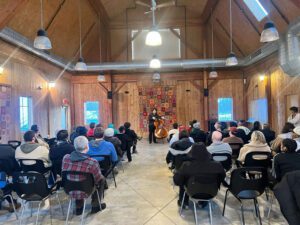
Unison Chamber Music Collective bassist Max Winningham performs his original composition, Manifestations, for an audience at Dawn Farm. | Photo: Doug Coombe
It feels like a film scene: Dust floats through the air in the Dawn Farm Community Barn, glowing in the sunlight. Two violinists, clothed casually, introduce themselves as Ally and Anda (“like Honda”).
They explain song origins and titles, sometimes pausing mid-piece to ask questions. (“Do you have thoughts about contrasting sections?”) They invite informal, authentic responses; the audience loses any reservations. Some hum along, shaking legs to the rhythm. Others toss a bag of candy around the room. Applause sandwiches each song. During Arches by Kevin Puts, a solo with a sound so full my ears trick themselves into believing I’m hearing multiple instruments, Anda’s bangs and fingers fly. In the audience—a whistle, a wow, an awed chuckle. “Thanks, I’m gonna take a break now,” Anda pants, plopping down in a chair. “It’s Ally’s turn.”
Ally plucks the Jeopardy! melody while an iPad loads sheet music for an audience member’s request of “Dangerously in Love” by Beyoncé, which Anda strums on the spot despite not knowing the song. The requester sings along with a huge smile on her face.
Since its founding in 2022, Unison Chamber Music Collective has hosted monthly concerts at five regular locations: Shelter Association of Washtenaw County, Salvation Army Harbor Light, the Women’s Huron Valley Correctional Facility, FCI Milan Correctional, and Dawn Farm, an addiction recovery center.
Related: “Modern Love: Behind the scenes at a recovery-friendly workplace” (Mar. 2025)
UCMC founder and executive director Allyson Cohen envisions a world where “everyone has access to exceptional musical performances and feels included and valued in classical spaces.
“I really wanted to bring music to people who have never been to Hill Auditorium to see a concert,” she says, “who would not even think to buy a ticket because they can’t afford it or because they don’t know what to wear.”
With Unison, Cohen envisions a long-term community that brings not just music but belonging. “If an organization visits one time, that’s not enough,” she says. “That’s almost doing more harm than good if you’re trying to build trust and encourage people to open up.” The concert series has allowed Cohen to get to know her audiences really well; last year, Delonis residents even attended her graduation recital at U-M.
Related: “When Home Isn’t There” (Feb. 2026)
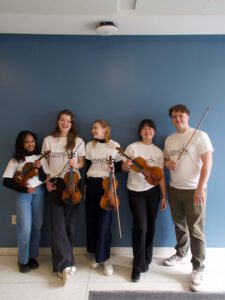 “When you do a Unison concert, you’re trying to present a very engaging and interactive experience—not just you bow, you play, you leave—which is normally what we do in a concert hall,” shares Frances Norton, operations manager.
Whether it’s a volunteer conducting the ensemble or a collaboration between Unison’s string quartet and the prison choir, Cohen tries to involve the audience as much as possible. “I’ll bring art supplies so the audience can write or draw alongside the performance. Or we’ll do a concert menu where we play a little sample of each piece and the audience chooses the order.”
Cohen does her best to honor requests. “The people who are incarcerated, they’ll tell me that they haven’t heard their favorite song in like fifteen years, which is crazy, you know?” A beloved song can move a person to tears—or rope Cohen into dancing with them at the back of the barn.
UCMC’s team recently grew to three people. “Ally’s been doing all of this by herself for years,” says Norton, who first joined Unison through their collaboration with U-M’s chamber music department. “Anytime I go to an event, it fills my cup up completely. It feels important, like this is what we’re supposed to be doing as musicians and artists.”
It can be easy to get wrapped up in the necessity of performing flawlessly in the competitive, high-pressure world of classical music. “Students have to put their head down and do the work,” says Matt Albert, U-M chair of chamber music “It’s really great for us to ask them to put their heads up, and open up their hearts, their ears, and really remind themselves of the world they’re in.”
Students may even learn from UCMC’s audience who, says Albert, “comes with an openness, ready to experience something different. Many of them need something to lower the nervous system, which can get so jacked up in their situations”—a common dysregulation Albert sees on campus too. “It’s hard to just pause and take a breath and remind ourselves there’s a reason why we’re doing all this and that reason is much bigger than the campus or the classroom.”
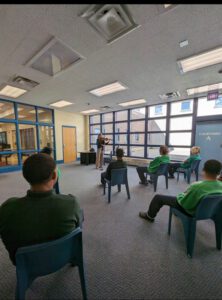 Through the U-M partnership, Cohen hopes to mentor the next generation of concert artists. Each semester, six student groups get to perform their own Unison concert. “One group of freshmen asked the audience to throw out adjectives,” Cohen recalls. “Then they played the same snippet angry, then happy, seeing if the listeners could feel the difference.”
She hopes to give students a kinder, holistic approach to classical music, one that can drive people to connect instead of compete with one another.
“Working with Unison and being motivated by something overwhelmingly positive instead of executing something as perfectly as you possibly can, it just feels much more rewarding to me,” shares Norton. “I feel like that’s the artist’s purpose.”
Cohen doesn’t view UCMC’s work as outreach or service. “It’s changed my life, what my priorities are, and how I live my life day to day because I feel, in many senses, freed from the definition of artistic excellence in conservatories,” she says. “There are more important things than being perfect, whatever that means. It’s much more important to be yourself, be human, and use that as your primary strength as a musician.”