
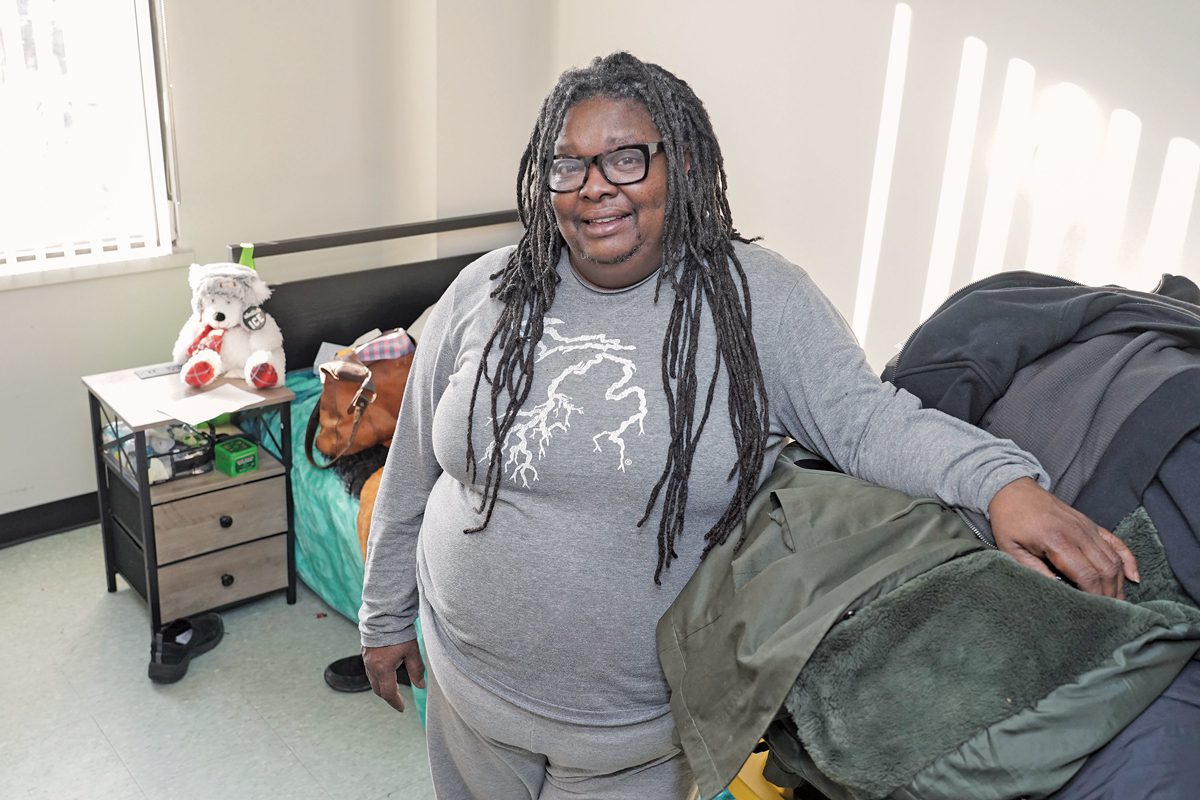
Deseree Myles is one of the hundreds of people in Washtenaw County experiencing homelessness. Between 2022 and 2025, homelessness has increased 77 percent countywide. | J. Adrian Wylie
“I’ve been through a lot of things in my life,” Deseree Myles, a Delonis Center resident, says. “I am sixty. I had two children, a son and a daughter, both deceased. I have three grandchildren, one deceased. … I’m here trying to go to school.”
Myles says that she came to Ann Arbor to participate in Washtenaw Community College’s ten-week surgical technology program. Hailing from Louisville, Kentucky, Myles says she stepped off the Amtrak in Ann Arbor already experiencing what she describes as “a homeless situation,” and turned to the Delonis Center with nowhere else to go. She’s one of hundreds of people in Washtenaw County navigating homelessness.
A recent report by the Washtenaw County Continuum of Care (CoC), a major player working to coordinate local efforts to end homelessness, paints an urgent picture: as of December 2025, at least 842 people in the county are experiencing homelessness—a 42 percent increase since 2024.
A report released in late July also provided Washtenaw residents with a sobering perspective on homelessness in the county: the numbers have increased by 77 percent since 2022.
A Look Back: Homeless Count (March 2015)
It’s no secret that Ann Arbor and the surrounding area are experiencing a housing crisis. Students lament the costs of off-campus housing, local businesses are losing workers due to rent increases, and there are waitlists for affordable housing units.
But the housing crisis is just one of the underlying causes of homelessness in the county. According to the Ann Arbor Area Community Foundation, Washtenaw County is the most economically divided county in Michigan and ranks forty-fourth out of nearly 3,000 counties nationwide for economic disparity. Coupled with massive anticipated federal funding cuts, the number of people experiencing homelessness is continuing to grow, and the resources to help them are shrinking.
Andy LaBarre, County Commissioner and board appointee to the CoC, says that the scope of the problem, in Washtenaw County and beyond, boils down to macroeconomic American policy failure.
“This is a systemic, multigenerational disinvestment in homelessness services from the federal government,” he says.
LaBarre explains that the county receives roughly $7.5 million each year from the U.S. Department of Housing and Urban Development (HUD). Under the Trump administration, in addition to broader restrictions on how those funds can be used, LaBarre says the county is facing an immediate $432,000 gap between what HUD has promised and what it has paid.
Longer term, new federal caps limiting how much HUD funding can go toward permanent supportive housing and rapid rehousing could leave a $3 million to $4.9 million hole in the county’s housing system.
LaBarre says that, as a result, they’ll have to scramble in the next few months to coordinate a county response to fill as much of that gap as possible, and to squeeze as many resources, services, and money out of the existing CoC system as is permissible under HUD regulations.
“The challenge at this point is to quickly fill the immediate hole [$432K] with a county loan or grant,” he writes in an email to the Observer. “The challenge in the next several months is to come up with a comprehensive fix on the total hole HUD has created. That $3M–$4.9M is the funding that we will look for from the county, feds, state, municipalities, and philanthropic.”
Without federal funding, countless county initiatives will halt, including services provided by the CoC and the Shelter Association of Washtenaw County (SAWC). As a result, LaBarre says, there will be fatal consequences.
“People will directly die because of these Trump policies,” he says. “There’s no ifs, ands, or buts. They will kill people. It’s a question of how many people will Trump’s policies kill and how much can we mitigate it?”
Nicole Adelman, Executive Director of the SAWC, mirrors that grave sentiment. She says that as a result of federal funding cuts, an “unbelievable amount of people across the state will return to homelessness.”
Adelman and LaBarre won’t stop trying, though. In response specifically to unmet mental health needs, a contributor to the rising population of people experiencing homelessness, LaBarre stresses the existence of a 24/7 mental health crisis line (734–544–3050), which allows for a social worker and a sheriff’s deputy to respond to relevant emergencies.
LaBarre says it’s a constant battle to make sure people are aware of the line’s existence, and that the biggest criticism they’ve received regarding mental health resources is that there just aren’t enough.
“Sort of everybody understands that it’s a structural issue, where, in Washtenaw County, we go above and beyond with what we fund … and it is still not enough to meet existing need,” he says.
Related: An Afternoon with Community Mental Health
Adelman says that in addition to its residential program, the Delonis Center offers temporary shelter, case management, and income assistance to people experiencing homelessness.
Myles says that she didn’t have any belongings when she came to the Delonis Center, and that most of what she owns today has been donated.
“When you look at the blankets on my bed, someone donated me those because I love Disney and, you know, gave me a teddy bear because I need a hug,” she says. “But I don’t have any clothes. I don’t have any shoes. I’ve yet to buy some. I have a nice coat because someone bought me that before I came here.”
She adds that the staff at Delonis give her the “encouragement to soar.”
“They don’t know what it is I want, but I want something,” she says. “But to be able to look at me and say, ‘you can achieve it.’”
Myles says she sees Delonis and the shelter it provides as a stepping stone toward her professional and personal goals rather than a permanent resting place.
“You have to have your own personal common interest to make here,” she says. “You can either be sociable, which I’m really not. … I’m really on a mission, so I can’t be distracted.”
Outside of its residential services, the Delonis Center also partners with local organizations to provide basic needs and health care services to the Washtenaw County community. Food Gatherers serves meals twice a day at the center, and Michigan Medicine aids their recuperative care program, where people experiencing homelessness and acute medical problems can be accommodated for the duration of their medical care.
Related
Ann Arborite Paula Dana: Running the Community Kitchen
These partnerships are integral, but funding is still necessary. Adelman says that they receive public and private foundation funds, and that their work wouldn’t be possible without help from the city government and Ann Arbor residents. But they’re always looking for more sustainable funding, especially as they plan to expand. Adelman says that the organization hopes to open another facility, this time to better serve those on the east side of the county.
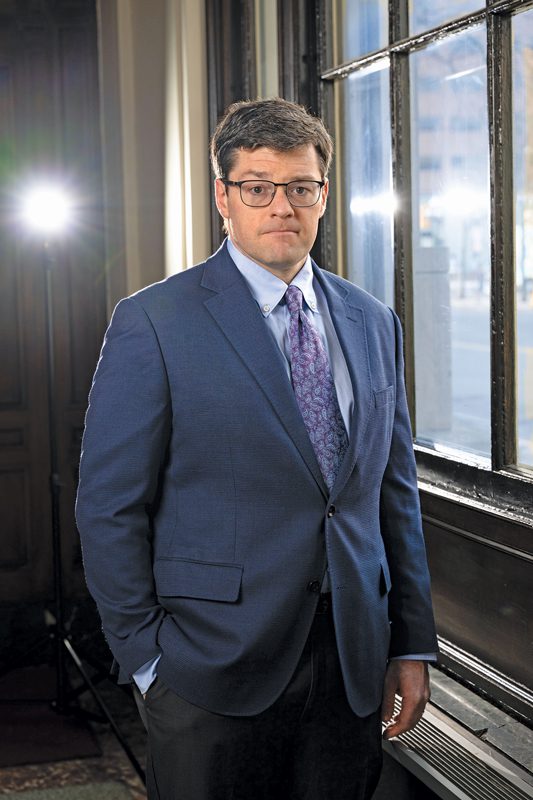
County Commissioner Andy LaBarre says restrictions on HUD funding will halt essential county initiatives, with life-threatening consequences for people experiencing homelessness. | Mark Bialek
Countywide initiatives offer solutions, too. LaBarre authored the county’s 2017 Mental Health and Public Safety Preservation Millage, approved by voters by nearly a two-to-one margin, which generates $15–$18 million annually for prevention, crisis response, stabilization, and diversion services.
Since funds first became available in 2019, several million dollars have been directed to Washtenaw County Community Mental Health and external providers to address mental health needs intertwined with homelessness.
LaBarre says that another percentage of the millage’s funds, which go to the sheriff’s office, have to be spent on housing people experiencing homelessness with the hopes that it prevents them from returning to the carceral system.
“We know one of the biggest drivers of individual behavior is economic position,” he says. “So we know if we don’t connect some folks who are returning citizens to housing resources, we’re just sort of asking them to re-enter the system.”
In November of 2024, nearly 70 percent of Washtenaw County voters approved an eight-year renewal of the millage; with the expansion, the funds will continue to support the county’s needs until 2034.
For some Washtenaw residents, the path into homelessness doesn’t stem from rising rent or a lost job; it’s the realization that staying at home might not be safe anymore.
Christine Watson, executive director of SafeHouse Center, sees that moment every day.
SafeHouse Center is the county’s only comprehensive agency serving survivors of intimate partner violence and sexual assault. They operate a twenty-four-hour helpline, offer counseling and legal services, and run an emergency shelter for people fleeing abuse.
“If you were to call us, and you’re in immediate danger, and you need to get out, we could offer you to come into our shelter,” Watson says. “It’s 24/7, so it doesn’t matter when you call us; we will get you in. But it’s not a permanent housing solution.”
They have nineteen bedrooms available for people in need: each family or individual is guaranteed a private room. Watson says some survivors stay only a few days before moving in with friends or relatives, but others stay months. Right now, Watson says, the average stay is about 120 days, and some families remain for six months or longer.
Not because they want to, but because there’s nowhere else to go.
“In order for survivors to leave, there has to be housing available in the community,” she says. “And that’s where we really struggle.”
Watson says the majority of people who enter SafeHouse do so because they don’t have a backup plan. She adds that leaving abuse can mean stepping directly into housing instability.
“I don’t think being a survivor automatically makes you homeless,” she says. “But it feeds into it. It’s one of those vulnerabilities that can tip someone over the edge.”
And demand for services has only grown. More survivors are seeking legal protection orders, counseling, and shelter beds. At the same time, SafeHouse’s funding, about 60 percent of which comes from the federal government, has become less reliable or been slashed altogether.
“It means fewer grants, fewer resources, and more competition,” Watson says. “And when one provider in the network loses funding, it affects all of us, because we’re all serving the same people.”
Still, like the county’s homelessness and mental health leaders, Watson frames the work as collective, that a good portion of their funding and support comes from the community. SafeHouse coordinates with hospitals, police, prosecutors, and other housing nonprofits, relying heavily on volunteers and local donors to keep 24/7 services running.
“We’re built by this community,” she says. “And we’re supported by this community so that we can support the community.”
At the county level, LaBarre is working toward the same goal: they’re going to continue to piece together funding, attempt to open another bed, answer another call, do whatever it takes.
“We should always do better than last year—but right now, survival is the goal,” LaBarre says.
For people like Myles, the impact is personal. She says that the Delonis Center, its staff, and the Ann Arbor community itself have encouraged her to continue chasing her goal of completing the surgical technology program she came here for, offering real-time support and guidance throughout the process. But, more than anything, Myles says she’s living for her children and grandchildren.
“Sometimes tragedy happens. It makes you look at what you need to do to get yourself adequate to live the rest of your life,” she says. “One of the things my daughter told me before she died was that, ‘Mommy, you have to live.’ So I’m really trying to live.”
Related: Life on the Streets