
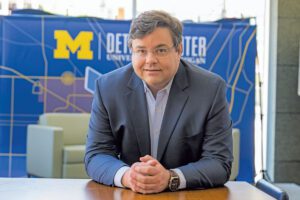
“Our vision is to help this region become one of America’s top economies, where people stay and thrive,” says Scott Shireman, executive director of the U-M Center for Innovation in Detroit. | Photo: Doug Coombe
A new initiative spearheaded by U-M and the Detroit Regional Chamber aims to generate a renewed age of economic prosperity for southeast Michigan.
Known as the Ann Arbor–Detroit Innovation Corridor, the strategy proposes to link the research prowess of Ann Arbor and the manufacturing power of Detroit, à la the technology-driven economies of places such as the Silicon Valley, Boston, and Austin, Texas.
“Our vision is to help this region become one of America’s top economies, where people stay and thrive,” says Scott Shireman, executive director for the U-M Center for Innovation in Detroit.
The Corridor encompasses six “innovation districts,” including UMCI and a planned district on U-M’s North Campus, two Henry Ford Health/MSU research centers, Wayne State’s TechTown Detroit, and Michigan Central, the former train station redeveloped by Ford Motor Company.
The initial plan was introduced at the 2024 Mackinac Policy Conference and is further detailed in a 2025 report commissioned by the Detroit Regional Chamber and U-M and written by urban studies theorist Richard Florida.
According to the report, southeast Michigan already has the two essential ingredients to thrive as an economic hub. The first is a world-class university (or two) that support research and innovation—in this case, U-M and Wayne State University. The second is robust manufacturing infrastructure, of which Detroit has plenty. The role of the Innovation Corridor is to connect the dots.
“With its leading-edge R&D, world-class talent clusters in design, engineering, and advanced manufacturing, and the ability to actually manufacture complex products at scale, the Detroit-Ann Arbor Innovation Corridor can forge a new and more holistic model for industry-transforming innovation, generating jobs for much broader swaths of its community while avoiding the pitfalls of becoming another ‘Silicon Somewhere,’” asserts the report.
Given the region’s history as a global automotive hub, the report identifies investment in advanced mobility as the most promising avenue for expansion—everything from autonomous and electric vehicles to vehicle sharing to two-wheeled vehicles and even aircraft.
Even before the report’s release, U-M had established a presence in Detroit with a center in Midtown for U-M students, faculty, and staff, and with the Marygrove Learning Community, a partnership with Detroit Public Schools Community District that offers prenatal support all the way through graduate school programs.
That presence will grow with the 200,000-square-foot UMCI, which is currently under construction and slated for completion in 2027. It will house interdisciplinary graduate degree programs such as urban technology and urban planning, undergraduate courses and certificates that allow students to experience urban Detroit, and new workforce development programs.
“The university does two things really well,” says Shireman. “We produce excellent talent and develop knowledge through research. That’s a big part of attracting industry to the region.”
What it doesn’t do as well is convince its graduates to stay in the region. In the report, Florida points out that one out of three U-M grads leaves the state within five years. That brain drain is primarily driven by bigger salaries and more opportunities in coastal cities and larger urban areas. Along with improving investment in R&D, supporting innovative business start-ups, and developing attractive and affordable neighborhoods, one of the Innovation Corridor’s primary goals is keeping young talent in the region.
The Detroit Regional Chamber’s efforts to improve investment in start-ups and support business innovation are already producing results, says Glenn Stevens Jr., the chamber’s chief automotive and innovation officer. In 2025, the research and policy advisory organization Startup Genome ranked Detroit number twelve globally for its start-up ecosystem.
“We have a city in Detroit that is definitely on the upswing, and we have a city in Ann Arbor with a world-class institution,” says Stevens. “Globally and nationally, people are coming here to see what’s going on, and they’re actually blown away by what they find.”