
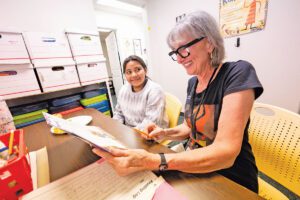
Volunteer Mary Cronin tutors a student at the Family Learning Institute. The nonprofit offers individualized lesson plans to improve reading skills. | Mark Bialek
On a July afternoon, a boy wearing glasses and a big grin walks through the door of the Family Learning Institute, a nonprofit tutoring organization for low-income families that’s tucked in the back of a strip mall on South Industrial. He strides down the hall, stops at a snack table to grab potato chips and a granola bar, and chooses a couple of reading games that he delivers to his tutor, Laurita Thomas.
“I see you picked the popcorn game,” Thomas says, smiling at the young student, a rising third-grader. “If that is fun for you, it will be fun for me too.” A retired U-M administrator and grandmother of nine, Thomas has volunteered at FLI for eight years. As she works through lessons in the boy’s purple folder, he sounds out and writes the letters for the words “fox” and “top.”
“You got it!” Thomas says.
When the boy started the free weekly program last fall, recalls FLI academic director Mary Collins, he was so shy, he’d hide in a corner, and he could recognize only a few words and letter sounds. But by the following spring, he’d become an eager student and had advanced a grade level in reading.
 FLI is one of a constellation of Ann Arbor–area literacy programs aiming to address disparities in reading proficiency among economically disadvantaged students.
The gap is wide: Results from the 2025 Michigan Student Test of Educational Progress (M-STEP) show that 60 percent of Washtenaw County’s third-graders categorized as economically disadvantaged—including those who qualify for free or reduced-price meals, whose families receive food aid, and foster children, among other categories—scored in the lowest level for English Language Arts, compared with 26 percent of all students. Narrowing such disparities requires interventions with individual students that schools may not be equipped to handle on their own.
“We’re working hard at doing that extra piece that is hard to get done during the school day,” says FLI executive director Sharine Buddin.
Students are typically referred to FLI by school staff or families. After a parent or guardian signs a release form, an academic director from FLI works closely with the student’s school to create an individualized lesson plan. Students are assigned a trained tutor who remains with them throughout the program.
“This is their place,” Buddin says, and the kids know, “that is my person.”
FLI served more than 150 students last year at its center and through before-school, after-school, and virtual programs at select schools. In the 2026–27 school year, Buddin expects they will again serve Dicken Elementary and Ann Arbor STEAM; Holmes and Erickson elementaries in Ypsilanti; and Project Literacy at Ypsi’s Parkridge Community Center.
Buddin came to FLI after retiring from a thirty-year career as a teacher and principal in Ypsilanti Community Schools. She’d planned to stay at FLI for five years, but she’s been there for twelve. “There’s still so much to be done,” she says.
“Our community needs to be aware that there is still a great need and just try and get involved in any way they can. Our children need us.”
Time to Read “Is a Luxury”
Nationally, student performance on elementary school reading tests is just now beginning to recover from pandemic-era declines. But educators are confronting persistent disparities in academic performance along socioeconomic lines. Across the state, things look similar to Washtenaw County: nearly half of Michigan third-graders categorized as economically disadvantaged scored in the lowest tier in ELA in the 2025 testing cycle, compared with just 20 percent among non-economically disadvantaged students.
In Washtenaw County, the groups working on literacy see firsthand the impact of economic challenges. Families at FLI and similar programs often face barriers to attendance, including reliable transportation. Buddin says one mother who doesn’t own a car saves money to order rides via Uber, ensuring her child doesn’t miss a tutoring appointment.
“There’s a stereotype that parents don’t care,” says Kathy Wyatt, who leads the Literacy Coalition of Washtenaw County. “That’s just not true.” She explains that adults in low-income households often work the evening or night shift in the service or food industries and have inflexible schedules. They may have limited time to read with their kids and can’t oversee their homework. An older sibling, grandparent, or neighbor may handle child care.
“Time is a valuable thing,” says Wyatt. “It is a luxury to have the time to read to your kids. If you’re poor, you don’t always have that luxury.”
Additionally, for many families, literacy is a generational challenge. Parents with low literacy skills cannot read to their kids until they get help themselves. Washtenaw Literacy, a nonprofit that offers free tutoring to people ages sixteen and up, estimates 88 percent of its learners live below the poverty line, and 61 percent of those are parents. In Washtenaw County, one in eight adults understands information at or below an eighth grade level, according to the organization.
Chronic absenteeism (“Out of Class,” Mar. 2026) in Ann Arbor–area schools can also be tied to poverty, and affects test scores and literacy rates. “When you are struggling to put food on the table or to put gas in your vehicle … or unable to make the repairs on your car, all of those things impact your ability to engage and connect,” says Dawn Linden, Ann Arbor Public Schools assistant superintendent for teaching and learning. “And when we think that doesn’t touch kids, we’re crazy.”
For families who experience food insecurity, the effects of hunger on children’s learning can be profound, including poor concentration, decreased academic performance, behavioral issues, and illnesses. One of the largest line items in Governor Gretchen Whitmer’s $502 million 2027 school-aid budget extends statewide funding for free breakfast and lunch for K–12 students, regardless of income.
One County, Two Stories
Results from the M-STEP for 2025 showed that 56 percent of AAPS third-graders met or exceeded proficiency standards in ELA. The score marked the lowest recorded in that category since 2015. AAPS is working to turn it around with a new curriculum, teacher training, and extra support (“Ann Arbor’s Reading Challenge,” Aug. 2026).
However, in Ypsilanti Community Schools, just 19 percent of third graders were proficient in ELA last year (“Learning Lag,” Oct. 2025).
“Our county has two stories that are happening at the same time,” says Washtenaw Intermediate School District superintendent Naomi Norman. “One story is we’re very exceptional, like truly exceptional. We have kids performing at some of the highest levels. They are very advanced in their reading. And then we have a group of kids that is really struggling.”
It’s a gap that shows up in health equity, income, and housing data, with Washtenaw County ranked as the eighth most economically segregated metro area in the U.S.
Third-grade proficiency is lowest in the City of Ypsilanti, Ypsilanti Twp., and Superior Twp., according to Washtenaw County’s Opportunity Index. Of the nine AAPS elementary schools that receive Title I funding—federal funds to serve students from low-income families—and offer third grade, eight have lower proficiency rates than the district average.
Worth noting is that in Ypsilanti, third-grade M-STEP ELA scores have increased 8 percentage points since 2019, the last year before the Covid-19 pandemic disrupted testing. Assistant superintendent Carlos Lopez attributes the increase to “a multitiered system of support for every level.” Struggling students get intensive support, and those who are two to three grade levels behind are assigned a Title I interventionist.
Lopez highlights Ypsilanti Community Schools’ literacy-based curriculum—HMH Into Reading, reinforced with Orton-Gillingham Phonics First—as well as continuous assessment.
They’ve also put policies in place that partner with families to crack down on absenteeism. If a student misses class, an educator calls the family within twenty-four hours. “Within forty-eight hours, that child has to be in that seat,” Lopez says. School representatives may also conduct home visits to determine other supports the school can provide to ensure the student comes to school on a regular basis.
“Your zip code does not define lowering standards,” says Lopez. “… We’re going to build those scaffolds that the student needs to be able to meet those expectations.”
“You are a reader! You are a writer!”
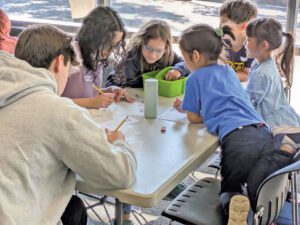
Students enjoy an 826michigan Wee-Write program at AADL’s Pittsfield branch. Program manager Megan Gilson says the nonprofit’s “completely analog” method of writing out ideas longhand is important to their approach. | Terance Gordon
Outside of school district initiatives, other literacy nonprofits are focusing their outreach on students whose families live in poverty. These include Children’s Literacy Network and 826michigan.
CLN started in 1991 as a book-giving organization, and expanded in 2016 to include an early-literacy intervention program. The nonprofit partners with schools, mostly in Ypsilanti, that have the lowest test scores, and provides trained volunteers who read to students in preK through third grade. CLN also offers evening programming for families, and has given out thousands of new books.
“Getting books into kids’ hands is one of the most controllable and effective kinds of steps you can take to raise readers,” explains Kristin Giant, who leads CLN out of a small office packed with books and boxes inside the New Center on N. Main.
She says that for “many of the kids we work with, the first book they receive, brand new, is from us.”
When she considers the literacy crisis, Giant believes that “pointing fingers doesn’t get us closer to a solution. I think lifting up the people closest to kids will always get us closer to a solution … [including] advocating for teachers and advocating for the working class, because if these parents had more resources, they would have more time and they would have less stress, and we can’t forget that.”
For more than twenty years, 826michigan has created a “community of writers” through its free programs for kids in grades K–12. The nonprofit is housed within EMU’s College of Education (“Onward Robots,” Aug. 2025) and works with teachers in training as well as community volunteers at Title I schools in Ypsilanti, Detroit, and Ann Arbor.
Programs include in-school writing labs where students experiment with different writing strategies, Wee-Write story programs at library branches in its three service cities for the youngest learners, writing field trips, teen leadership labs, and longer term small-group workshops that culminate in students authoring a professionally published book.
“A lot of the efficacy is around reshaping that young person’s identity,” says executive director Megan Shuchman, “and boosting their confidence to help them understand, ‘You are a writer! You are a reader!’”
“Children are natural storytellers,” explains 826michigan program manager Megan Gilson. “I think we do a good job of connecting their love of creating stories to the physical process of writing and building the competence.” She says the group’s “completely analog” method of writing out ideas longhand, on paper, is important to their approach, and develops handwriting skills, too.
The solution “is definitely not a computer program. It is definitely not more Chromebooks for every kid,” Shuchman says. “It is definitely more person power to support kids individually. It is definitely about reminding ourselves that we all learn best when there’s a self-driven interest involved.”
Back at the Family Learning Institute, two brothers arrive and turn in their summer book reports. They choose prizes from a sparkly gold box, including a book, sunglasses, and a bunny Pez candy dispenser. More volunteer tutors arrive, sign in at the front desk, and prepare to meet with their reading students.
As Thomas’s student nears the end of his ninety-minute session, he visits the “writing room” to work with Donna Ramsey, a retired Bach and Ann Arbor Open School teacher. Today he’s finishing a story he started the prior week about his “dream water park,” and he draws a colorful picture of his “tornado slide.”
When his parents arrive to pick him up, he appears, waving his writing project—and grinning widely.
Next month’s theme: College literacy in the age of AI.
Literacy Organizations in Washtenaw County
“Volunteer, donate, and call your legislators to support literacy initiatives.”
—Kathy Wyatt, Literacy Coalition of Washtenaw
826michigan: 826michigan.org
Ann Arbor District Library: aadl.org
Children’s Literacy Network childrensliteracynetwork.org
Educate Youth educateyouthypsi.org
Our Community Reads ourcommunityreads.com
Peace Neighborhood Center peaceneighborhoodcenter.org
The Family Learning Institute familylearninginstitute.org
Washtenaw Community College wccnet.edu
Washtenaw Literacy washtenawliteracy.org
Washtenaw Promise washtenawpromise.org
Washtenaw Success by Six washtenawsuccessby6.org
Ypsilanti Community Schools ycschools.us
Ypsilanti District Library ypsilibrary.org