
These days, James Angell is known primarily for the building on State St. that bears his name, but he holds another distinction: the longest-serving U-M president. Angell led the university from 1871 to 1909.
That record is almost certain to stand, no matter whom U-M’s regents select to fill yet another vacancy in the university’s top job.
In April, the community was shaken when the regents’ choice for president, Kent Syverud, announced he would not take office due to a cancer diagnosis. He had been scheduled to assume the job on May 11. For now, president Domenico Grasso continues to lead U-M’s 68,000 students across the three campuses and about 50,000 faculty and staff at the university and hospital.
Related: Syverud Steps Up (Jan. 2026)
After Syverud’s announcement, speculation shot through the state that former Detroit mayor Mike Duggan might have the inside line. Duggan, who has bachelor’s and law degrees from U-M, had just halted his independent bid for governor, citing weak poll numbers and fundraising support. But nothing has come of that publicly.
At press time, the job remained unfilled as the U-M search committee planned to begin interviewing candidates with executive search firm Spencer Stuart again overseeing the efforts. U-M hasn’t stated the cost of the search that resulted in Syverud’s selection or what Spencer Stuart is charging for the resumed effort. But given the extra time, it’s likely to exceed the $300,000 that U-M spent to recruit Santa Ono, who left the university in May 2025.
Whoever takes the position will face a tumultuous atmosphere, with uncertain federal funding, an ongoing investigation of the athletic department, bitter political debate, and questions about the role that universities should play in American society—not to mention the prospect of conflict with U-M’s publicly elected regents, like the ones that led to the departures of MSU’s president in May and Wayne State’s president last year. Both lasted barely two years in their positions.
You’d be forgiven for asking: who would want this kind of job?
As it turns out, plenty of people do, says Brendan Kelly, who became president of Eastern Michigan University on April 1. Along with his duties at EMU, Kelly serves as the executive head of the American Association of State Colleges and Universities’ New Presidents Academy. Each year, the academy offers tutorials and support to develop twenty to forty potential college presidents.
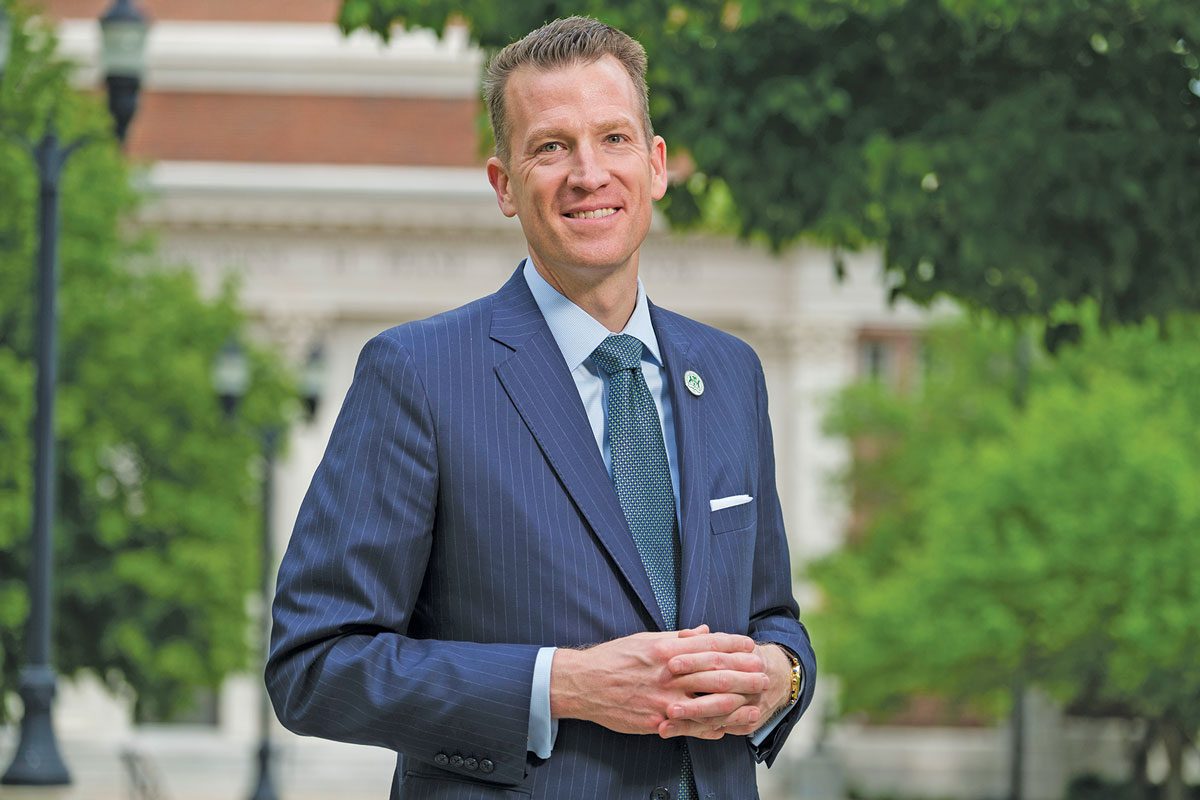
Brendan Kelly became president of EMU on April 1. He leads an academy that develops aspiring college presidents. The job of a president, he says, is “impossibly hard.” | Charlotte Smith (Courtesy EMU)
Presidential candidates typically fall into two categories, Kelly tells the Observer. Some are standout academics and administrators who are noticed by their university’s leadership. Others are business and political leaders outside academia who have run major companies or served in Washington and are ready for a change.
Examples include Mitch Daniels, the former governor of Indiana who spent ten years as Purdue’s president and is about to return as its interim president, and Sonny Perdue, the Georgia governor who announced his retirement in June after four years as chancellor of his state’s university system.
Kelly, who holds two EMU degrees and previously led the Arkansas State University System, doesn’t sugarcoat the responsibilities. “When I say these jobs are hard, they are impossibly hard,” he says. “These are just incredibly complex organizations in a really unstable environment.”
Flashback: The Coleman Era (June 2014)
Some university presidents try to be visible by amping up their social media presence, posing for selfies with students, akin to college mascots. That doesn’t impress Kelly. “If you think your job is to be really popular and keep your job, I hope you are in it for the shortest time possible, because that’s not leadership,” he says. “It’s just not the environment we’re in now.”
Former U-M provost Teresa Sullivan, who served as president of the University of Virginia from 2010 to 2018, and the following year as interim provost at MSU, says things have changed significantly for presidents this decade. One difference is in intercollegiate athletics, a cultural pillar but also a major financial burden at U-M due to its multimillion dollar commitment to offer scholarships and payments to athletes under its Name, Image and Likeness program. Another is the soaring cost of health care at universities, like U-M, that operate major medical systems.
Related: Sports for Sale (Oct. 2025)
Beyond that, “the country is more politically polarized right now,” and elected officials are scrutinizing everything that happens on campus, Sullivan says. “Both parties want to assume that a university is one pole or another: ‘Is this [college] president a Republican or a Democrat?’”
Philip Hanlon, who was U-M’s provost before serving as president of Dartmouth from 2013 to 2023, says social media is amplifying presidents’ challenges.
It “allows unfiltered, unsubstantiated opinions to be broadcast to a large number of people,” he says. “When you’re sitting in the president’s role, it can feel very personal and like a direct attack. It’s impossible to debunk the various rumors.”
Along with pragmatism and thick skin, Hanlon says today’s college presidents need specific skill sets. He advises potential leaders to “be curious about everything that goes on at the university. Don’t just say, ‘I’m a physicist and physics is closest to God.’”
He adds that leaders should understand everything from benefits packages for newly hired employees to the infrastructure that keeps the university functioning.
“At the end of the day, there are two pieces to the job,” Hanlon says. “One is the technical part where you make decisions. The other is the pastoral part. You have to bring your community along, and learn how to do that.”
“You’re the president of everything,” adds Sullivan. “Whatever your field is, that’s not enough. Someone who says, ‘I don’t have time to keep up,’ then this isn’t for you.”
Despite the pressure, the past and current presidents believe the academic world still is an attractive place.
“I’m a big believer in higher ed. I believe in the role great universities play in unlocking the potential of young minds, and research and discovery,” Hanlon says.
Kelly at EMU says presidents will often be put in positions where there are no good options,“and you have a whole lot of people who are unhappy as a result of that. But that is your day to lead.”
If tough days come with the job, so do some generous paydays. Before he withdrew from the presidency, Syverud was to receive a base annual salary of $2 million, plus retirement benefits and housing, according to the University Record. (He has since been appointed as a tenured faculty member at the law school and a special advisor to the Board of Regents; he will receive standard benefits, but his salary will not change.) At MSU, former president Kevin Guskiewicz earned just over $1 million, and was due for a raise that would have doubled that.
This article has been edited since it first appeared in the July 2026 issue of the Observer. Domenico Grasso’s title was corrected, and Syverud’s position with the university was clarified.