
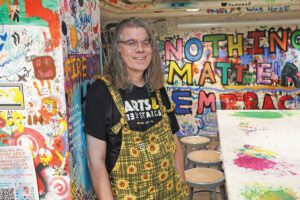
Photo: J. Adrian Wylie
Like most kids of a certain age, Scott Beal hated poetry.
“Not only did I hate poetry, I was vocal about it,” he says “My English teachers knew that I hated poetry, because I made no secret about it.”
Beal felt poetry was treated like “a secret code that only your teacher knows the answer to … but you’re not smart enough to figure out.” Language was fun to him—musical and playful—but the vagaries of academic poems left him annoyed and impatient. “Poets don’t just come out and say what they mean. They say ‘these curtains are blue’ but what they mean is ‘I’m so sad.’ As a young person, I was like, what kind of jerk writes like that? Just tell me you’re sad, you know?”
It was a keen observation—and a little sarcasm—from his ninth grade English teacher that changed his thinking.“For someone who hates poetry,” the teacher wrote on an essay he’d penned about a Robert Frost poem: “you’re not bad at writing about it.”
A seed was planted.
making a lane change making a phone call
making a decision everything we make takes time
but happens fast
—from “East Ohio Truckstop,” in The Museum of Americana, 2012
Skip forward to his senior year in high school and that seed was given a shot of Miracle-Gro, hand-administered by the cool new kid, of course. She “had come from a different school system, where they had poets come to their pep rallies,” says Beal, “and so she would carry around with her books by poets voluntarily, not as a homework assignment, which flummoxed me. ‘What do you mean you’re choosing this stuff?’”
Beal’s new friend not only shared her books, but also her cassette tapes of poets reciting and performing their work: Anne Waldman, Allen Ginsberg, poets who were using language in ways that were “electrifying and unexpected.” He read and felt and heard different intentions from these writers—poems that weren’t just capturing “idyllic, heroic exploits of the past” but instead were about contemporary life and the humans living them. “I felt really supercharged by what was happening in the language in those poems, and I wanted to try it.”
Beal tried it, started “taking it seriously,” and just kept going.
What started as curiosity became deep scholarship, carrying him through U-M’s undergraduate and MFA writing programs in six consecutive years. He credits his momentum to timely prizes, supportive teachers, and strong rapport with his workshop instructors. “It’s easier to get invested in something when you are given some confidence that you have a talent for it, right?”
He had some early success—winning a chapbook contest and publishing within a few years of graduating, writing consistently. But between being newly married, taking a business writing job, and having two children, Beal experienced an unanticipated break from poetry. He describes this time as a “crisis of faith,” wondering if he was only ever a product of his educational environment, unable to successfully put the “right words in the right order” for poems as well as for proposals and contracts.
Sometimes I fear
I am only doubt and that is why radiance
and raptors pass through with little resistance
but wind.
—from “Lost Letters,” in EKL Review, 2020
Beal benefited yet again from the support and encouragement of his mentors, this time former U-M professor (and one of his “favorite poets on Earth”), Alice Fulton. Fulton advised him to reconnect to his poetry by reconnecting with the poetry community: a local writing group of MFA and PhD students who met over happy hour mussels and wine at the Earle.
A member of that writing group pointed Beal toward the Neutral Zone’s Volume Summer Institute, teaching at weeklong poetry camps for local teenagers. Like so many of these moments—these breadcrumbs that are a poet’s feast—the move changed his life.
The love he had for teaching as a grad student amplified beyond the university: Beal taught at Volume for the next fifteen years. Summer camps led to year-round rotations of workshops, which in 2006 attracted the attention of the newly founded Dzanc Books. He spent the following fifteen years as their writer-in-residence at Ann Arbor Open School before taking on his current range of roles as a lecturer with U-M’s Sweetland Center for Writing, director of Lloyd Scholars for Writing and the Arts, cohost of the Skazat! monthly online poetry series, and coeditor of the literary journal Public School Poetry.
“Writing and art are the things that give me joy and give my life color and interest; things that I devote myself toward making and celebrating in so many ways,” says Beal. “So now I have a profession that allows that to be the central thing that my profession is built around. That’s really exciting. I like working with young people and getting energy from them, and hopefully giving some back.”
Now in his early fifties, Beal gives back in other ways too—continuing to perform his work at venues across the country, and through the occasional songwriting set (with some “poems sprinkled in”) at local favorite Ypsi Alehouse. He lives in Ypsilanti, a couple blocks from his longtime partner, Cat. His newest collection of poetry, Stegosaurus Moon, was published in June by Dzanc Books.
When asked how he prefers to describe his academic work, and his poetry in particular, Beal pauses carefully before answering.
“There are all kinds of ways in which we are cut off from a full experience with the world, and I think one of the things that I really treasure is kindling those moments of recognition about just how freaking weird it is to be alive, and how magical that is.
if the wadded paper wiping the counter
and the bowl of frosted wheat mean
I’ve come downstairs and begun a day
in the world
then there’s the world
of yesterdays and all the lost keys buried.
—from “Alarm,” in Vinyl, 2017
“Writing so much can feel like a solitary, lonely pursuit, and I think there’s a lot of mythology around the lone genius writer, but I think it’s really community that makes so much art happen and makes it sustainable.”