
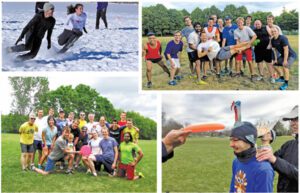
Neither snow nor heat nor holidays stop players from showing up for weekly games organized by HAC Ultimate, which has been meeting regularly for forty years. Extreme cold, though, can be an obstacle. “At ten below zero,” says longtime member John Arkison, a disc that hits the ground “shatters—like porcelain.” | Photos: Courtesy of Tom Litow
On an oven-hot, brutally sunny Sunday, the athletic fields at Fuller Park are alive with several concurrent games of Ultimate Frisbee. In each game, two teams of seven players sprint and dive up and down the field, throwing a disc through the air as they aim to catch it in an end zone to score a point. HAC Ultimate is meeting again, just as they have every week—rain or shine, sun or snow—for decades. “We play in any weather,” says longtime member Tom Litow who manages the Google Group that is HAC Ultimate’s current online presence.
Though, “at ten below zero, the discs start breaking,” adds John Arkison, another longtime member who is HAC Ultimate’s “embedded reporter,” documenting each meeting in the Google Group, including its conditions and anything interesting that happened. “If you step on it, or it hits the ground, it shatters—like porcelain.”
While Litow didn’t play during the recent wildfire smoke, he writes in an email, “I would be surprised if at least a few of the younger, immortal players didn’t show.”
The game that would become Ultimate Frisbee was in born in 1968 at Columbia High School in Maplewood, New Jersey, when students Buzzy Hellring, Jonny Hines, and Joel Silver (now a Hollywood producer) cobbled together the rules for a new team sport played with a Frisbee, based on a similar game Silver learned at summer camp, which was itself based on football. The first Ultimate Frisbee games were held in the school’s parking lot—and games are still played there every week, according to a 2025 New York Times article.
These days, Ultimate Frisbee (the sport is officially called Ultimate, to avoid copyright issues with the Wham-O corporation) is as legitimate a sport as any other, with millions of players—from recreational get-togethers to school teams to professional leagues—in the U.S. and abroad.
The Ultimate scene has grown a lot in Ann Arbor, too. There are recreational Ultimate teams for students in the Ann Arbor Public Schools, and for community members through the nonprofit Ann Arbor Ultimate. “Part of [the popularity] is just it being better known,” says Litow. “And part of it is that there’s something about Ann Arbor culture. It would be nice to say that we were part of that.”
According to veteran group member Charles Griffith, HAC Ultimate has been meeting since at least 1985. It was originally affiliated with the Homeless Action Committee, which fought for affordable housing in Ann Arbor. (Its advocacy led to the creation of Avalon Housing.) Its earliest membership included local activists Judah Garber and Gus Teschke.
Teschke “was a political guy,” says Griffith, and HAC Ultimate had a political bent in those earliest days. “He got pushback from people that didn’t want to make it political, especially when somebody did disagree. It started controversy, where [some members said,] ‘Hey, guys, we just want to have fun and play.’”
Even after the actual Homeless Action Committee dissolved in the late 1990s as its members shifted to other organizations, the name of the Ultimate club stuck. Competitive games met, and continue to meet, on Tuesday and Thursday evenings at Burns Park. Its more laid-back Sunday iteration, currently at Fuller Park, originally met on Mitchell Field.
Observer staff have long been tickled by a detail in the monthly HAC Ultimate calendar listing: “overly competitive players will be politely asked to leave.” The stipulation dates back to Teschke’s leadership; HAC Ultimate has always aimed for inclusivity. “One thing that always bothered me is arrogant players, people who walk on the field and believe they’re better than anybody else,“ says Litow. “You can walk on the field [with HAC Ultimate], and it’s mellow. People aren’t gonna be crazy.
“Well—some people are,” he says, laughing. “But they’ve been spoken to.”
There are no referees in Ultimate—ever. Instead, it’s governed by the so-called “spirit of the game,” the shared responsibility for fair play and mutual respect. And although Ultimate involves teams of players moving toward opposite score zones, it is not a contact sport. All this makes for an easy, friendly atmosphere.
New members tend to discover HAC Ultimate through word of mouth, the Observer calendar (ahem), or an internet search for “pick-up Ultimate in Ann Arbor.” People will drop in from all over the place, including abroad. “One guy came here from Germany and stayed here,” says Arkison.
You may have noticed the term “veteran” pop up a lot thus far, and it’s true that the group has a passionate older membership. But HAC Ultimate is all-ages, and anyone can drop in. When asked about the age-mixing, longtime player John Wright spontaneously quoted Shakespeare (Antony and Cleopatra, Act IV, Scene VIII):
What, girl, though grey
Do something mingle with our younger
brown, yet ha’ we
A brain that nourishes our nerves, and can
Get goal for goal of youth.
Eventually, a group of younger players drift into the shade. One is Matt Dunwoodie, originally from Cincinnati, who first came to HAC Ultimate when one of his U-M classmates discovered it online. “He and I came and joined together, and just stuck it out.” Dunwoodie graduated in 2011. “I suppose that makes it, like, fifteen years I’ve been playing with these folks.” He laughs. “Scary thought.”
Claire Masters, a Purdue undergrad from Northville, was back in the area for the summer. “I was just looking for a group to play with,” she says. “I was really nervous, but … everyone was instantly really engaging. They seemed really happy to have me out here.” Ari Hart, a first-year medical student from the D.C. area, agrees. “It’s hard to find a way to meet people that’s normal,” says Hart. “But Frisbee, in general, is a welcoming kind of community.” Alyse Guenther works for U-M but will soon be taking time off to travel. “But I know that when I leave Ann Arbor, if I come back for even just a little bit, and I’m here on a Tuesday, Thursday, or Sunday, I can reunite with a lot of people that I really like,” she says.
The devotion to the sport and joy in the community at HAC Ultimate can take on an almost spiritual dimension—in fact, Teschke and some of the other veterans have held solstice gatherings.
“It was like a little ceremony before the game started,” says Griffith. “It brought in elements of nature. The pseudo-spiritual part was that we were worshiping the sky disc.” The group attached little fireworks to an old Frisbee and let it spin around, then had a snack. “That was our communion.
“It was all tongue-in-cheek, of course,” he continues. “But I joke sometimes with my friends—this is my church, ‘cause it’s a Sunday morning. I do feel like I’m communing with something that I love, that brings me joy.”
Litow agrees: “There’s something about being on the field that’s magical.”