
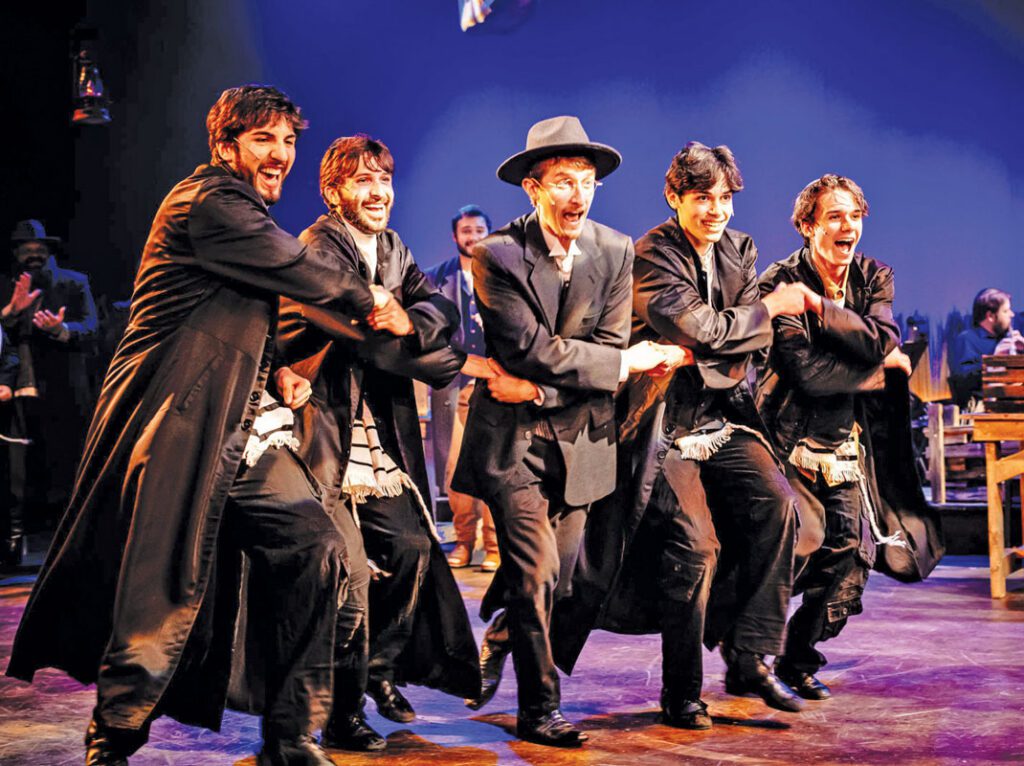
Fiddler on the Roof runs at the Encore Musical Theatre Company through July 19. | Michele Anliker
The musical Fiddler on the Roof opens with the protagonist Tevye saying, “Each one of us is a fiddler on the roof trying to scratch out a pleasant, simple tune without breaking his neck.” He’s referring to the people of his Jewish village in fictional Anatevka, Russia, in 1905, but the sentiment still rings true today, eloquently expressed in the Encore Musical Theatre Company’s current production, directed by Dan Cooney. The 1964 musical features music by Jerry Bock, lyrics by Sheldon Harnick, and a book by Joseph Stein, and runs at Encore until July 19.
Tevye is a humble dairyman and the father of five daughters. Life is hard, but he loves his family and community. The classic opening number, “Tradition,” sets the scene and culture: the father is the breadwinning master of the house, the wife is the homemaker, sons learn trades, and daughters learn to be wives and mothers and hope the husbands selected for them by their fathers will make them happy, or at least not miserable. The system isn’t perfect, but the system works—or at least it did.
Now that way of life faces threats both internal and external: Tevye’s eldest daughters yearn to marry for love. A pogrom under the tsar is looming, threatening to wipe out their entire village.
Encore’s talented production team and cast of singers, dancers, and musicians bring the rich culture of Anatevka to life, creating a distinctive yet relatable world for modern audiences.
Related: Encore Theater’s Next Stage: The community theater kicks off its summer season in a new location
Daniel Eli Friedman is perfectly cast as Tevye. He leads the production with an endearing balance of cheek and charisma, capturing the essence of a humble man clinging to tradition amidst growing chaos. Erit Gill gives another standout performance as Yente, providing strong comic relief as the matchmaker with the power to direct the futures of girls throughout the community, an object of both hope and fear.
The dancing, with choreography by Jenny Florkowski, was another highlight. I particularly enjoyed the impressive jumps and turns of a trio of Russian officers. The cast also nailed the show’s iconic head-balancing bottle dance, no easy feat.
Rachel Lauren’s lighting design is powerful. A simple backdrop alternates between evening sky blue and sunrise/sunset orange—alluding to the recurrent and dependable cycle of life that is the backbone of a community based on tradition, captured in one of the show’s most iconic and haunting songs, “Sunrise, Sunset.” The cast lit in silhouette against the blue backdrop as they leave the village is an impactful closing image.
The minimal set, designed by Sarah Tanner, features a distinctive, abstract riblike overhang that hovers throughout the show. Per the director’s note—which I read after the performance—it’s meant to symbolize the looming pressure and tradition under which the community lives. While it’s a remarkable piece, I found myself distracted trying to understand its meaning, wondering if it was a nod to a Jewish symbol or tradition with which I was unfamiliar.
Fiddler on the Roof has stood the test of time, and Encore shows us why. As our culturally divisive zeitgeist pits those with traditional values and religion against those who seek a different path, Fiddler invites us to question the role of tradition in our modern lives. Is it a valuable part of history to be preserved or an impediment to progress? What are we willing to sacrifice to preserve our culture, and is it worth it? There are no easy answers, but Encore’s timely production reminds us they are questions worth asking.