
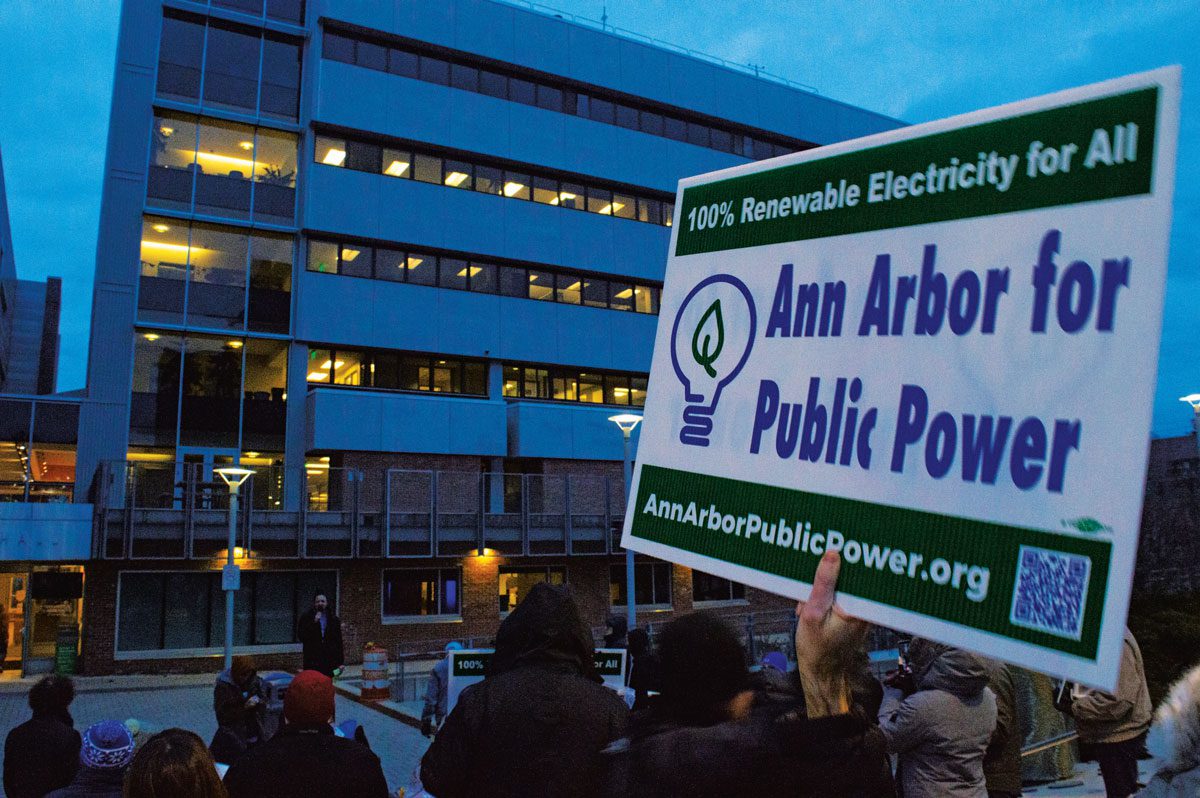
Supporters of public power rally outside city hall in March 2025. Ann Arbor for Public Power was integral in getting the municipal energy utility proposal on the ballot; a DTE-funded group unsuccessfully sued to have it removed. | Nicholas Finn
Nationally, there’s been plenty of buzz surrounding Michigan’s U.S. Senate and gubernatorial races in the November election. But at home, voters will find an equally impactful proposal on their ballots that may determine Ann Arbor’s energy future.
Proposal E would amend the city charter to create a municipal electric utility run by a nine-person governing board, with five elected members and four appointed by city council. The elected members would run for office in 2028.
DTE would continue to provide electricity until a subsequent election, when voters would be asked if the city should acquire the utility’s assets, such as power poles, lines, and transformers. In the long run, the board would set rates and fees with an eye toward equity, and move toward renewable sources of energy.
Background: Should We Divorce DTE? (Feb. 2023)
About 15 percent of Americans, more than 55 million, get power from municipally run utilities, according to the lobbying group American Public Power Association (APPA). While there are nearly 2,000 communities served by public power companies, including big cities like Los Angeles, San Antonio, and Nashville, the majority are small towns with fewer than 4,000 residents.
In Michigan, more than forty communities—such as Lansing, Traverse City, and Chelsea—have municipal power companies. If Ann Arbor eventually adopts the concept, it would leapfrog Lansing as the largest.
DTE is clearly determined to thwart it. In late summer, a group funded by the regional utility giant—the Ann Arbor Responsible Energy Coalition (A2REC)—filed a lawsuit and a subsequent appeal aimed at blocking the proposal on the November ballot. It lost both times.
Jill Wilmot, DTE’s director of corporate communications, tells the Observer in a statement, “The proposal to take over Ann Arbor’s electric grid will cost the City of Ann Arbor nearly $1 billion on day one, leading to skyrocketing costs for Ann Arbor businesses and residents.”
She adds, “Last year, DTE delivered the best electric reliability Ann Arbor has experienced in nearly 30 years. It’s proof that DTE’s five-year, $270 million plan to modernize Ann Arbor’s electric system is working. We will remain focused on our work and will continue to deliver the reliable, affordable, clean energy future Ann Arbor deserves.”
A May 2026 post on DTE’s Empowering Michigan blog contradicts Wilmot’s claim, stating instead that 2025 “was the most reliable year for DTE customers in nearly two decades.” And Brian Geiringer, who leads the local advocacy organization Ann Arbor for Public Power, contends there’s no basis for the $1 billion number, adding he was gratified to see courts side with the ballot proposal. “In the future, there’s going to be a time when the city of Ann Arbor and DTE will be in a legal struggle, so it’s great to know that’s something where Ann Arbor can come out on top,” he tells the Observer.
Related: Power Down (Sept. 2023)
The struggle was outlined in a text that some Ann Arbor voters received in early September. It came from Clear Insights, a survey research group, asking them to participate in a short survey that turned out to be a long series of questions about the ballot proposal. (Clear Insights did not respond to the Observer’s request for information about who commissioned the poll.)
First, it asked for their perceptions of DTE, A2REC, Ann Arbor for Public Power, and other advocacy groups involved in the proposal push.
Then it raised issues it said were drawn from the public discussion, such as, “There is a nationwide shortage of skilled line workers and engineers and no guarantee that we can hire the experienced people we would need to join a brand-new city utility. Ann Arbor would be competing for talent it has no track record to attract, while residents’ service hangs in the balance. Do you agree or disagree with that?”
Another question asked, “This proposal would put the city roughly $1 billion in debt, which could lead to additional millage on property owners to pay for it. Ann Arbor residents should see a new line on their property tax bill to pay for a government takeover of the power company. Do you agree or disagree with that?”
Justin Schott, who leads the Energy Equity Project at U-M, says the questions overstate what Ann Arborites are voting on in this round. “They want to quash it before it becomes reality,” Schott says of DTE. “It’s really important to frame it as a preliminary step that establishes the process of how the city might move forward.”
He says the proposal carries “zero financial obligations” since the governance board would be made up of volunteers and no funds have been committed to a feasibility study, which would determine the cost of a switch.
The ballot proposal coincides with increasing anger toward DTE and other utilities over higher rates, unreliable service, and their support for data centers, like Oracle and Open AI’s “The Barn” currently under construction in Saline Twp. and the “high-performance computing facility” proposed by U-M and Los Alamos National Laboratory in Ypsilanti Twp. “There’s a lot of skepticism and a lot of frustration,” Schott says.
When Ann Arbor for Public Power was launched in 2020, data centers were not part of the conversation, says Tony Reames, a U-M associate professor of environment and sustainability. “But in the current environment, it will prompt people to pull away” from DTE, he says.
Nevertheless, Reames says it is hard for residents to take on the major players. “The relationship between citizens and big utilities is like David and Goliath,” he says. Through April, DTE contributed $1.8 million to fund AAREC.
But, he adds, the municipal energy utility proposal represents voters seeking “greater control and a renewable focus. We’ll do it over time, and we’ll take the public along at every step. It’s a really manageable approach.”
He thinks Ann Arbor’s Sustainable Energy Utility is serving as a stepping stone. In 2024, Ann Arbor voters approved creation of a plan that allows residents to opt in to supplement their power from DTE and receive renewable energy. The pilot program is underway in the Bryant neighborhood, and it is expected to be rolled out across the city.
Shoshannah Lenski, A2SEU’s executive director, says the project would continue while voters determine the eventual shape of a municipal power program. “These would likely operate as two entirely separate entities,” she tells the Observer.
Says Reames, “You wouldn’t be able to do [the MEU] without Bryant. It allows for new, potential relationships between people and energy.”
Related: Shoshannah Lenski (March 2023)
Calls & Letters, November 2026: Other Opponents of Prop E
Two readers argued that our coverage of Prop E (“On the Ballot in November: A New Power Structure,” October) failed to fully capture the opposing perspective.
“While I acknowledge that I write this as a skeptic of the proposal, my concern is that the article (by only quoting a DTE official in opposition) implied that the debate was essentially between DTE and advocates of municipal power,” writes Pete Mooney. “I think there is a real controversy involving folks in the community with no financial stake in the outcome. For instance the outgoing mayor opposed Proposal E in his campaign, and current councilmembers Erica Briggs and Jen Eyer have come out against it on social media.”
Danny Maier writes that the article “ignores the evidence against a potential power takeover—the expensive unsuccessful efforts of Boulder and Pueblo, Colorado. Nor did the article mention the opposition of our local International Brotherhood of Electrical Workers—no friend of DTE—which points out the major difficulties and enormous expenses of trying to start a power company from almost zero. … The best investment would be investing in the city-run Sustainable Energy Utility voters already approved.”
Calls & Letters, November 2026: Give the A2SEU Its Props
To the editor:
I am truly grateful for the Ann Arbor Observer’s coverage of local issues, including its recent piece on the ballot proposal E our community faces in the upcoming election (October 2026).
But I was disappointed that the A2SEU was characterized as a “stepping stone” and described as merely a “program.” That framing understates what the A2SEU is and what it is already accomplishing.
The A2SEU is a public electric utility. It is providing solar energy to Ann Arbor homes today, with plans to expand quickly in the months and years ahead. It was created by Ann Arbor voters to give our community another way to produce, distribute, and use clean, locally generated energy, and its work is already underway.
That status was further recognized on October 1, when the A2SEU became a member of the Michigan Municipal Electric Association, the statewide trade association representing Michigan’s municipally owned electric utilities.
The A2SEU should be understood on its own terms. It is not simply a preliminary step toward some future utility, nor is it a temporary initiative. It is Ann Arbor’s municipal electric utility, operating now and building toward significant near-term growth.
Shoshannah Lenski
Executive Director
Ann Arbor Sustainable Energy Utility