
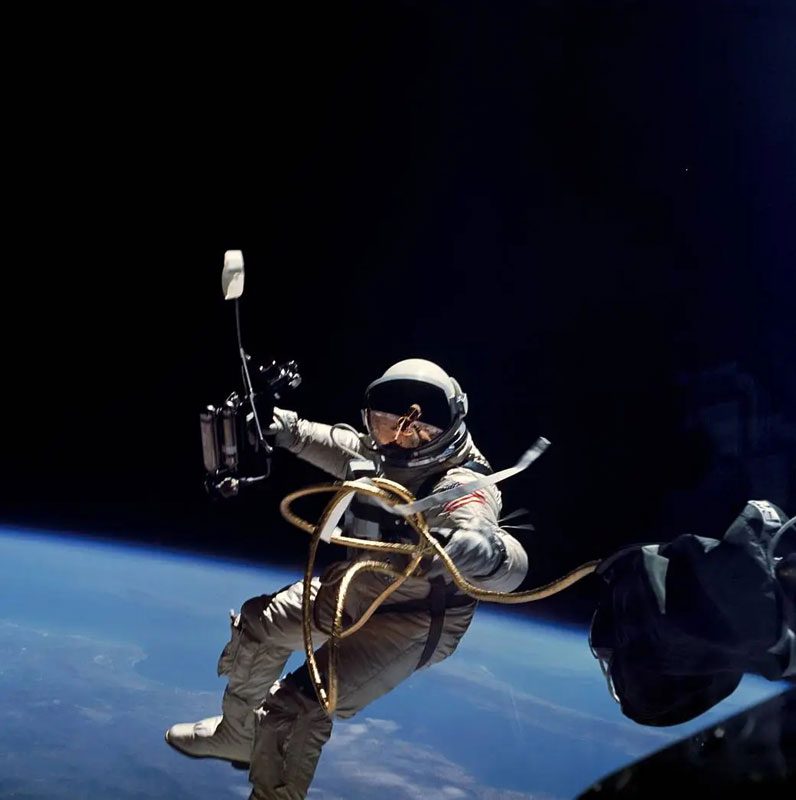
1965’s biggest news was [U-M grads] Jim McDivitt and Ed White (above). Their Gemini IV mission featured the first U.S. spacewalk, and even though White apparently had a hard time getting out of the hatch, NASA had an even harder time getting him back inside.
Were any of those Apollo-era folks Ann Arborites, and is there a U-M connection to Artemis as well? Yes and yes! We don’t have exact numbers—for example, do we count the whole company or just the people whose names we see on letterheads and patents?—but here’s an overview of how people from our corner of the world worked, and continue to work, on getting people into space … and, more importantly, back home.
One of the first contributors you can find is, unsurprisingly, a U-M professor. But Paul Fitts wasn’t a rocket scientist. Instead, he was a psychologist who, in 1959, began working on the inner space of outer space: “Isolation will be one of the biggest problems [an astronaut] will have to cope with during his voyage,” reads a 1959 Michigan Daily article, which then quotes Fitts as saying, “We haven’t been able to simulate complete isolation in the lab.” And this before smartphones!
Ann Arbor’s aerospace experts weren’t sitting idly by. Concurrent with Fitts’s research, professors Wilbur Nelson and Richard Morrison were busy developing a fiberglass rocket to launch people and payloads up and out. Their idea didn’t go anywhere, though, and Morrison got a bit snippy about that. Their rocket, which they called the Rambler, was, Morrison told the Daily in 1960, considered a “poor cousin” and snubbed by NASA in favor of “richer” relatives. Morrison may have had a point about better-connected institutions getting the grants they hoped for, but still, fiberglass? We’ve launched a lot of rockets since the 1960s, and that still seems like the wrong material for the job.
Things did move ahead in other areas, though, all the way up to the Keweenaw Peninsula, where U-M proposed a rocket launch site. Making an even bigger splash in 1962, two U-M grads—Jim McDivitt and Ed White—joined the astronaut corps as part of NASA’s Next Nine, a group that included Neil Armstrong.
In 1963, senator Phil Hart pushed for a space center near Ann Arbor, but NASA chief James Webb—and U-M officials—said the chances of that were slim. According to then–U-M president Harlan Hatcher, Webb felt the industry in the Detroit metropolitan area was not sufficiently developed to handle the spin-off from the laboratory. So even though Michigan governor George Romney (Mitt’s dad) also pushed for it, it never happened.
There was better news for the U-M/UP connection, though, and the Keweenaw Peninsula location got the go-ahead under the direction of Wilbur C. Nelson, chair of the U-M aerospace department. Between 1964 and 1971, rockets focused on weather research launched from a site about nine miles east of Copper Harbor—but only in winter, so as not to endanger shipping.
1965’s biggest news was McDivitt and White. Their Gemini IV mission featured the first U.S. spacewalk, and even though White apparently had a hard time getting out of the hatch, NASA had an even harder time getting him back inside. Both Houston and McDivitt had to get firm with him, coming as close to yelling as these too-cool-for-school astronauts ever did, with Gus Grissom telling Ed White, “Get back in!” more than once. (This reminds me of my dog, as does White’s response: “This is the saddest moment of my life.”)
Meanwhile, local industry was gearing up to provide instrumentation for the Apollo missions. The most prominent were the Apollo Lunar Surface Experiment Packages, built by Ann Arbor’s Bendix Corporation. ALSEP included more than a dozen experiments, though for the first moon landing NASA was naturally reluctant to commit to deploying instruments that would take more than ten minutes to set up. So, they stuck to just a couple. The Passive Seismic Experiment Package was a clear success: it recorded both the thud of discarded equipment from the landing craft and Neil Armstrong rolling over in his hammock. Armstrong and Aldrin also set up Laser Ranging Retroreflectors, and these have been used to measure the earth-to-moon distance ever since. (Spoiler: the moon’s leaving us! But it’s a gentle breakup, as it’s heading away at about the rate your fingernails grow, or an inch and a half a year.)
Complete ALSEP packages got sent up on subsequent missions, including the quintessentially Michigan Apollo 15, which featured not only an all U-M crew of Dave Scott, Al Worden, and Jim Irwin—creating the most exclusive U-M alumni chapter ever—but also a car.
Bendix played a role in that as well, as they were one of four companies who bid to make a lunar rover. But even though they built a fully functioning prototype, and even though they attempted to butter up James Webb by issuing him the first lunar driver’s license, and even though their moon buggy could go from zero to ten mph in fourteen seconds, and even though Bendix was the best-received bid … in the end they were beat out by a GM/Boeing collaboration. And not even a Michigan-based division of GM, but a group out of California. Why? Money. The GM/Boeing car was supposedly going to be cheaper, so that’s what NASA went with. And GM did deliver, though at about twice the original cost estimate. (You’re shocked by this, I’m sure.)
The lunar rovers and all the other research gear are still up there, though funding issues shut down the active experiments in 1977. However, the LRRRs are still used to measure the distance to the moon … and by extension, continuously prove that the general theory of relativity is correct. So, any time you run across an Apollo skeptic, remind them that scientists have been bouncing lasers off these Ann Arbor–built and astronaut-placed reflectors for over fifty years.
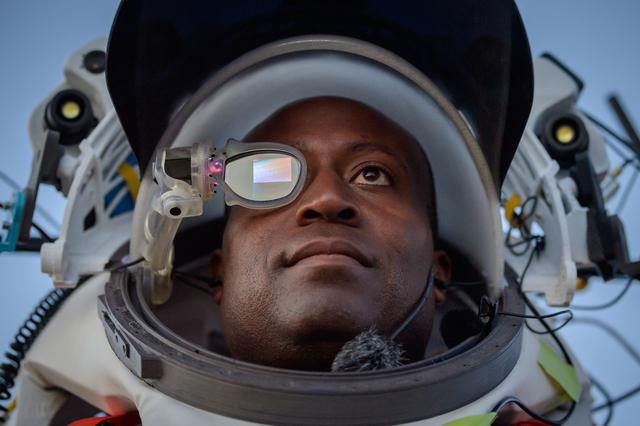
NASA astronaut and two-time U-M grad Andre Douglas, pictured above during an advanced technology run in the San Francisco Volcanic Field in Northern Arizona, says some of the best times of his life happened in Ann Arbor. | NASA/Josh Valcarcel
Just kidding … life’s too short to argue with Apollo deniers. Look ahead to the Artemis missions instead! Artemis II, completed in April of this year, included new solar radiation forecasts via Michigan Engineering. These forecasts improve awareness of dangerous space weather so astronauts have more time to prepare for solar storms and other hazards.
Artemis III does Ann Arbor one better—it will send two-time U-M grad Andre Douglas (he graduated with an MS in mechanical engineering and an MS in naval architecture and marine engineering in 2012) into space for a shakeout mission reminiscent of Apollo IX. Scheduled for 2027, he and his crewmates will test rendezvous and docking between the Orion capsule and versions of commercial Human Landing System spacecraft in anticipation of returning humans to the moon on Artemis IV.
Douglas came to U-M through the Coast Guard’s advanced education program, which sends officers to school with the expectation that they’ll return to the service.
“I heard a lot of great things and it turned out to be a really good pick,” Douglas says of U-M. “I learned a lot, but I mean, the community and the network and the camaraderie has been fantastic [and] also that technical rigor.”
Douglas’s first role at NASA was software development for the Double Asteroid Redirection Test, a planetary defense mission to, as he puts it, “move the orbital period of an asteroid that was surrounding another asteroid.” In other words, divert an asteroid on its way to hitting Earth. (As space nerds like to say, the dinosaurs didn’t have a space program, and look where it got them.)
That experience has served him well in the Artemis program. “When we fly Orion, for Artemis II, III, IV, beyond, it’s a highly automated vehicle. And so the beauty of it is we are trying to really have humans in the loop with the [software] automation. … So it’s very important to understand how the software works to be able to fly Orion, but understanding how to write software for spacecraft was a good skill [to learn] from an engineering side and test and validation side.”
When asked if he’s doing any of that programming himself, he laughs and says, “I wish!”
That’s because astronauts are busy people—the Observer only had about ten minutes with Douglas, which his public affairs liaison allowed to stretch to eleven as he talked about his time in Ann Arbor.
“Man, first thing, I miss all of it,” he says. “Some of the best times of my life there. The people were great. The food was great. The atmosphere. Football is awesome.
“And if I came back, I’d love to teach a class, talk about space exploration, share everything that I’ve learned along the way. I’d love to be a part of the community. It’s just fantastic. Every time I hear Michigan, there’s a smile. There’s this …” Here he pauses, trying to find the right word. “It’s just very, very awesome.”