
Head coach Dusty May picked up the No. 1–ranked player in the transfer portal in graduate forward Yaxel Lendeborg, and nabbed three other high-end guys in junior guard Elliot Cadeau, sophomore forward Morez Johnson, and junior center Aday Mara.
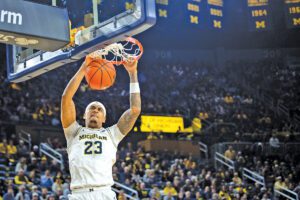
Graduate forward Yaxel Lendeborg came to Michigan by way of the transfer portal. | Grégor Campredon
“I think everyone would rather us just come in and sign a bunch of freshmen and lose and try to grow it organically,” May said in a February 2 press conference. “But our job from day one was to win, and so we brought in a balanced class.”
Related: Turnover Trouble (Nov. 2025)
No amount of analytical modeling can predict with certainty what a new group of basketball players will do on the court—it might get close, but the new adage, “basketball isn’t played in the spreadsheets,” ultimately rings true. The “spreadsheets” predicted Michigan was going to be good, but the opening weeks planted seeds of doubt.
The Wolverines opened the season with a 121–78 rout of Oakland, but the blowout victory of a mid-major program—a very good mid-major program, even—didn’t push the jury toward a verdict. And the following two games didn’t provide much reassuring evidence.
Michigan barely escaped Little Caesars Arena with an 85–84 victory over Wake Forest, and then it needed a second-half comeback to take down Texas Christian, 67–63. It’s hard to be mad at a 3–0 start, but not many talking heads were ready to put them anywhere near the contender tier. Perhaps, some thought, the transfer-heavy squad might not mesh after all.
That’s when the Wolverines embarked on an entirely dominant stretch of basketball.
They won their next ten games by an average of 34.5 points, scorching every team that dared step on the court with them. They weren’t just beating up on bad teams, either. Michigan beat then–No. 12 Gonzaga by 40 points, and beat then–No. 21 Auburn and then–No. 24 USC by 30 apiece.
The verdict was in: Michigan is a national championship contender, and the transfers are at the front of it all.
Every little thing was dominant. The Wolverines boasted the best defense in the country combined with a breakneck offensive pace that simply wore teams down before 10 minutes even elapsed.
The utter dominance wasn’t sustainable, and they eventually came back down to Earth. Off of the win over USC, the Wolverines struggled against a poor Penn State team and lost their first—and only—game of the season against Wisconsin. But beating then–No. 5 Nebraska at home and then–No. 7 Michigan State in East Lansing has solidified Michigan as one of the best two teams in the country.
Naming the “best” players on a team is a largely subjective activity, but by most metrics, Michigan’s four best players are its four transfers: Lendeborg, Johnson, Mara, and Cadeau.
Related: Sports for Sale (Oct. 2025)
Because of this, the program has received criticism from those who value the traditional continuity of college rosters, much to the ire of May.
“I know people outside of our tribe will call our guys these derogatory names, ‘mercenaries’ and whatnot,” May said. “We have a group of guys that love playing with each other. They appreciate Michigan, and when you see how connected they are, I don’t know how you would classify them as guys playing just for money when they all sacrificed a great deal of money to do what they’re doing together.”
Their reasons for entering the program can never be known for sure, but here’s what can be: They don’t look like they’re playing only for money. They play with an intense amount of passion, joy, and togetherness. And while the roster might not be built like the championship-level teams of the past, you can’t argue with results.
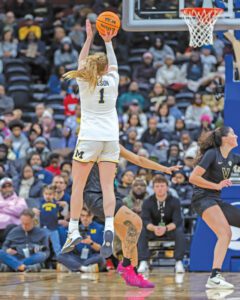
Sophomore forward Olivia Olson has been with the Wolverines since she was a freshman. | David Wilcomes
The Michigan women’s basketball team, however, has taken a different approach to achieve a similar end. Head coach Kim Barnes Arico has her team sitting at No. 6 in the AP Poll as the Observer went to press, as the Wolverines have gone an impressive 22–4 overall and 13–2 in the Big Ten thus far this season.
While the men have reloaded heavily using the transfer portal, the women have relied on continuity and internal development.
Last year, a trio of freshmen burst onto the scene. Guards Mila Holloway, Syla Swords, and Olivia Olson led Michigan to a very solid season. Ultimately, the Wolverines were bounced from the NCAA Tournament in the second round, but with a star-studded young core remaining with the program, the best was yet to come.
The star trio has developed well together this season, and the squad has taken another leap. While Michigan might not be national championship favorites, they’re certainly on the cusp of being true contenders.
Three of the Wolverines’ four losses have come against top-5 opponents, and they were all three-point losses. They lost their first against No. 1 UConn by a final 72–69, and a comeback against No. 5 Vanderbilt fell just short, also ending in a 72–69 loss. Then in conference play, another late comeback attempt fell three points short, 69–66, against No. 2 UCLA.
While they haven’t been able to break through the ceiling just yet, the Wolverines are still quite young and are already showing the ability to hang with the top echelon in women’s college hoops. They have their eyes set on winning it all this year, certainly, but with their culture of continuity and development, they could be at the top of the field for several years to come.