
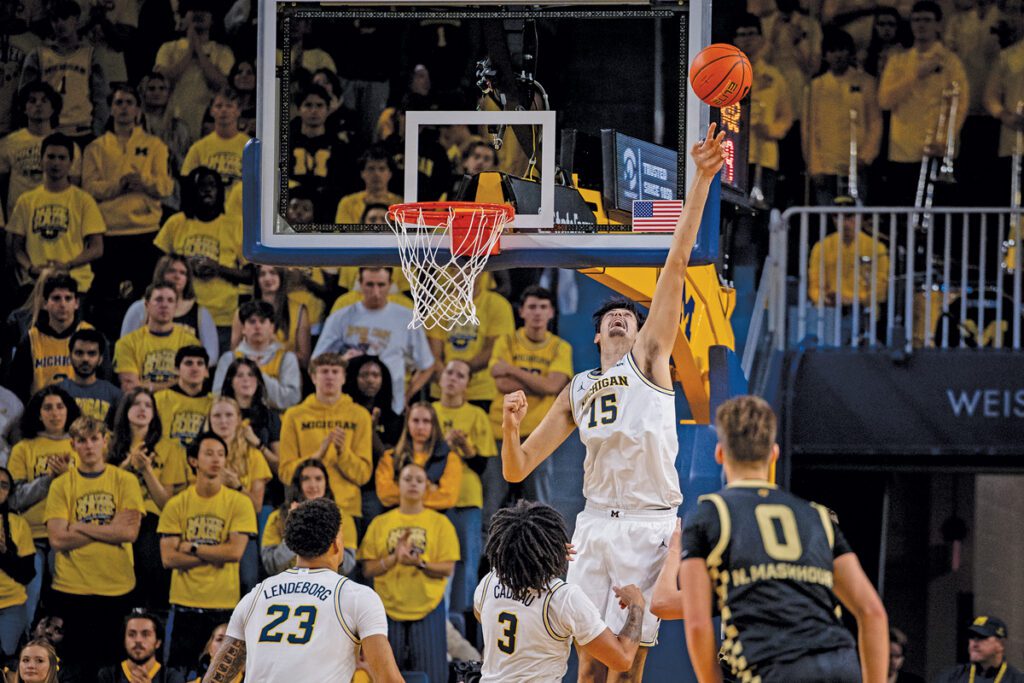
Aday Mara goes up for a rebound in the Oakland season opener that Michigan won 121–78. Mara is one of four transfers that will form the core of this year’s team. | Marc-Grégor Campredon
In 2023, Michigan men’s basketball set an unenviable record: most losses in program history. In the spring of 2024, athletic director Warde Manuel gave coach Juwan Howard his walking papers, and found himself mired in a different sort of athletic contest: national post-NCAA grabathon for the hottest available coach. Michigan won when Dusty May—who had turned a moribund Florida Atlantic University program into a national powerhouse—inked a five-year deal with the Wolverines.
As is typical with coaching transitions, most of Howard’s squad scattered to the winds: five of his primary players transferred and three graduated. By the time the dust settled, May was left with Nimari Burnett, Will Tschetter, and six players he found in the transfer portal. Basketball is a game of synergy; bringing in players who don’t know each other, have never played together—and doing so in limited time—is courting disaster.
But from game one, May’s patchwork team established themselves as more than the sum of their parts. The Wolverines finished 17–6 in the Big Ten, won the Big Ten Tournament, and ran it out to the Sweet Sixteen in the NCAA, losing to national runner-up Auburn. By season’s end, Michigan was rated number 21 in the country in fancy-stats algorithm KenPom.
The current college basketball world is nothing if not fluid, and five of May’s transfers either graduated or left the program for other schools. Two freshmen also transferred, thrusting May into the portal world again.
And, again, it seems like he’s delivered. He landed much-sought-after power forward Yaxel Lendeborg (University of Alabama at Birmingham), plus the starting point guard from North Carolina, Elliot Cadeau. He replaced two departing seven-footers with estimable centers Aday Mara (7’3″, UCLA) and Morez Johnson Jr. (6’10”, Illinois). Johnson is able to switch onto smaller players off a ball screen—a rare asset. Mara, less mobile, has advanced big-man skills and the unusual ability to pass out of the post.
The four transfers will form the core of this year’s team, along with a handful of holdovers: guards Roddy Gayle and Burnett and forward Tschetter.
May also won a major recruiting war for true frosh (and five-star) combo-guard Trey McKenney. The Orchard Lake St. Mary’s grad got offers from every major school in the country, but he’s local (Flint) and has grandparents who attended U-M. Plus, May landed top-100 frosh and long-range shooter Winters Grady.
So, how has this latest iteration of the Wolverines fared so far this season?
Michigan opened against a well-coached but smaller Oakland team, winning 121–78 and setting several program records. This team can rebound the ball, and they can pass it, remarkably, from all five positions on the court.
Not only can May transform transfers into teams, he can also do the impossible and share honest opinions with the media without throwing his players under the bus or insulting the questioner. When asked, after a turnover-filled exhibition event, if “maybe, just maybe, you should slow it down,” May responded without animus, “I think we need to play faster.” That’s what they did against Oakland—and they turned it over a mere eight times.
But that might have been a fluke. In a nailbiter of a game two against Wake Forest, Michigan had sixteen turnovers. May tried to play three bigs for chunks of the game, which seemed clunky. But Mara did what few thought he could, playing thirty-seven minutes, running the court hard, and racking up eighteen points, thirteen rebounds, six assists, and five blocks.
Wake Forest pressured the Michigan guards, and the Wolverines shot just 4–25 from the three-point line. But guard Roddy Gayle Jr. scored one when it counted, sinking the tying 3-pointer with just 1:44 left in regulation and sending the game into overtime, where Michigan eked out an 85–84 win.
If game two was a nailbiter, game three against Texas Christian University was a facepalm. The Wolverines’ turnover rate was an ignominious 31.4 percent—nearly double the national average of 17.8 percent. Horned Frogs coach Jamie Dixon blitzed the U-M perimeter, turning the game into a WWE SmackDown. Nevertheless, Michigan prevailed. As the Observer went to press—wrapping right around tip-off of the Middle Tennessee matchup at the Crisler Center—the Wolverines were 3–0 for the season.
Further distinguishing himself, May doesn’t deflect or minimize, which only encourages the media to try to back-door the answers he might be reluctant to express. “Aren’t the high expectations for this team difficult for you and your staff?” he was asked after Oakland.
“I do think it’s reassuring that people outside of your locker room believe in your guys,” he responded. “They believe in your team, and so, yeah, I don’t mind it at all.” Droll? Well, yeah. What may seem difficult to many is reassuring for May.