
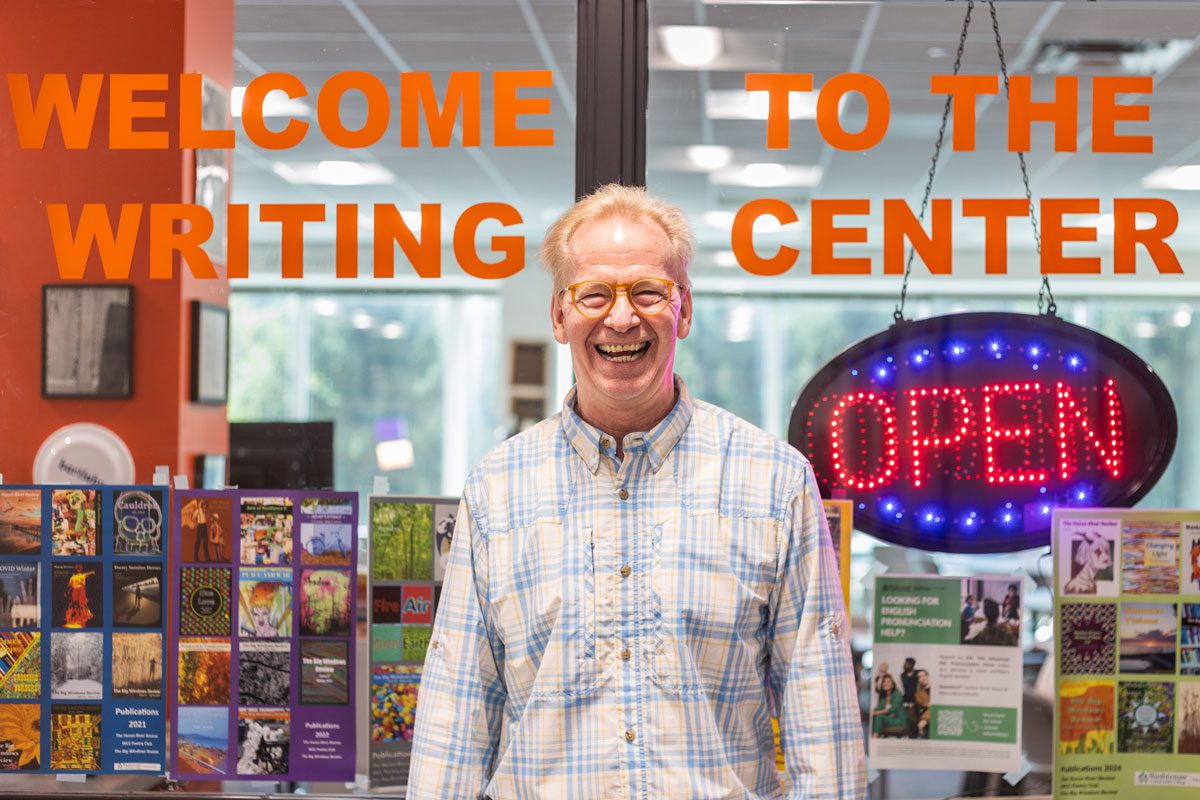
“In some ways, the humble essay can kind of teach us … to slow down some and think about why you feel this way,” says Tom Zimmerman, who directs the WCC Writing Center. | Annie Comperchio
Part three of a series on literacy in Ann Arbor. Read parts one and two.
U-M history professor Derek Peterson has noticed a difference in his students’ reading habits in the past several years. “Getting them to sit down and read a whole book is a real challenge,” he says. “Some of them do—and Michigan students are smart, generally—but very often they want to rely on AI summaries, instead of actually doing the reading for themselves.”
Peterson points out that AI isn’t the only culprit. “More generally, attention spans are shorter, willingness to sit down and grind through a text is much less than it was ten years ago.”
Nationally, a decline in students’ literacy skills, and their ability and willingness to read long texts, is showing up on tests and in the headlines. Results from the 2024 National Assessment of Educational Progress show that just 35 percent of America’s high school seniors were proficient in reading—a 5-percentage-point decline from 1992, when the test was first administered. About half of eighteen-
to-twenty-four-year-olds identify as nonreaders, according to a 2020 National Endowment for the Arts survey. A July cover story in the Atlantic even went so far as to declare that “The End of Reading Is Here.”
A June Chronicle of Higher Education article—entitled “My Students Can’t Read”—outlines several reasons students are arriving on campus unprepared for the rigors of college reading and writing: generative AI, Covid pandemic disruptions, the prevalence of smartphones and increased screen time, and K–12 Common Core reading instruction and standardized testing, which emphasize excerpts of texts over long-form reading.
“I think we live in a world with a hundred thousand distractions, with information bombarding us constantly with misinformation, with algorithms,” says Ann Blakeslee, an EMU English professor who leads the university’s writing center, its Writing Across the Curriculum program, and YpsiWrites, an organization that supports community writers of all ages. “So, it’s a hard world to navigate, and these are young minds that have to kind of develop the capacity and the ability to manage all of this. And that’s a lot to ask of them.”
Persistence Pays Off
“The way we learn and the way we grow is through struggle,” says Blakeslee. “If something takes away that or removes that, then it mitigates or lessens the learning or the growth.”
But, Blakeslee continues, in order to persist through struggle, students need to feel engaged. “We need to do a better job as educators tapping into what they care about, and giving them meaningful questions to ponder, problems to solve … so it’s partly on us.”
U-M English and linguistics professor Laura Aull thinks the issue may have been around longer than the genesis of AI. College-age literacy, she says, “has always been a real challenge … and it has always probably needed to be slower than people want it to be.”
She explains that college literacy includes a combination of disciplinary knowledge, specialized knowledge, and denser academic texts. When students don’t have enough cognitive bandwidth to parse and synthesize these texts, they may struggle with their writing. Or, she says, “they’ll feel like they were a good reader in secondary or high school, right? And suddenly they’re like, is this even in English? This is really hard.”
She describes literacy as a spiral, not a line, with points on the spiral where students may feel like they’re going backwards.
“It’s everyone’s responsibility to teach literacies,” Aull says. “Every discipline’s responsibility to say, ‘This is how we read and write in my discipline. I’m going to talk to you pedagogically and slowly about it.’”
Writing as Community
Tom Zimmerman, who directs the WCC Writing Center and has taught English for four decades at both the high-school and college level, says he recently joked with students in his English composition class that they’ve probably written more than any generation that precedes them. Even if it’s “with their thumbs on their phones” in an informal way, he is confident they know how to express themselves.
What students often need help with, Zimmerman says, is “developing their ideas, adding details, grammatical and sentence structures, [and] turns of phrase and transitions.” He says this “comes subconsciously to most of us just through our reading.” However, he notes that fewer students are reading books for enjoyment, “where you would automatically pick up some of the techniques, some of the moves they make rhetorically.”
Zimmerman says that many students still “self-identify” as students of the pandemic. “They tell me, ‘I was a Covid middle school kid, you know, I missed a lot of stuff.’”
More than they might think. Zimmerman explains “a lot of the learning is the offhand stuff, the stuff between the lecture notes.” Face-to-face interactions with instructors and peers boost skills that Zoom classes can’t.
College writing centers, like those at WCC, EMU, and U-M, offer collaborative support to help students develop those skills. It can come from faculty or other students; this year, EMU introduced its “Drafting Buddies” program, where students show up to write as accountability partners, and at WCC, student tutors help guide their peers.
“If you’re trying to think big picture about how can we design classrooms so that students don’t feel like they need to rely on AI, it’s just setting up environments of collaboration like this,” says Dylan Orsolini, who worked as a WCC Writing Center tutor last summer. “… Most students will turn to that before they turn to the plagiarism blender.”
Writing matters, and so do the skills that it teaches—for school, for future jobs, and for bigger life decisions, Zimmerman explains.
“In some ways, the humble essay can kind of teach us … to slow down some and think about why you feel this way,” he says. “You think this, but why do you think it? And that makes for a better society. That means we’re talking, you know? That’s huge. That’s not just a humble essay anymore, that’s a very important essay.”

Tutors at the WCC Writing Center share what they love about teaching and their students. “If you’re trying to think big-picture about how we can design classrooms so that students don’t feel like they need to rely on AI, it’s just setting up environments of collaboration like this,” says Dylan Orsolini, who worked as a WCC Writing Center tutor last summer. “… Most students will turn to that before they turn to the plagiarism blender.” | Annie Comperchio
“Using the Escalator Instead of the Stairs”
“It happened so quickly that you look back and realize you were a frog in a boiling pot of water,” says U-M political science major Lucy Langerveld (who writes for the Michigan Daily and the Observer) about genAI. “You just didn’t realize it was going to become what it is.”
Langerveld knows students who will generate a summary from a fifty-page reading to help them study for a test, “or they’ll have Chat [ChatGPT] explain it to them.” A few of her friends use AI to write emails as short as three sentences.
Aside from STEM or coding classes, where she thinks GenAI has its place, Langerveld is skeptical about the new technology. “If you never have to struggle to get the answer you’re looking for or struggle to create your own ideas,” she says, “I just don’t think you’re an interesting or well-versed person, or able to do the whole myriad of things we need literacy to do in our lives.”
Glenn Hedin, a U-M history major who also writes for the Michigan Daily, says AI use is “very prevalent” at U-M. “To some extent it’s even pushed by U of M administrators,” referring to U-M GPT, the university’s customized genAI services. He says in classes where laptops are allowed to be open, “like half, minimum, of people will have ChatGPT open, or will switch between it and another tab.”
Background: Chatbots Go to College (Aug. 2023)
Hedin notes that his peer group is “broadly anti-AI.” There are still students who are interested in reading “sixty pages about the Turkish War of Independence,” he laughs. But among a swath of the student population, “There’s an awareness that like it is taking your job even as you use it … there’s a lot of people who are, ‘I have to use it as much as possible to maximize my productivity.’”
Derek Peterson, who chaired U-M’s faculty senate last year, calls genAI a “five-alarm fire for higher education.” Last November the group passed a resolution calling for “GenAI-Free Zones” on campus. “The idea behind the resolution was not so much that we would act as policemen and policewomen who were enforcing limits on AI, but rather to appeal to students’ best angels,” he says.
Peterson believes when students arrive at class with an AI-generated summary of a book, that it’s “a lost opportunity for them morally, ethically, and intellectually. It also, of course, is a pedagogical problem for me as a teacher.”
Laura Aull, who wrote the forthcoming book, AI English: Humans, Machines, and the Future of Writing, thinks educators have a responsibility to foster critical AI literacy with their students. She explains that the research to date shows that people don’t want to read AI-generated text. “People are hungering for a human presence in writing.”
“This is an opportunity to say we value things like creativity, adaptation, failure,” she adds. “We value those enough to prioritize human reading and writing, which is not going to feel efficient.”
Varied approaches to AI use exist among U-M writing instructors, according to Monroe Moody, who directs the university’s English department writing program. In 2022, Moody created a course for Sweetland Writing Center called “Writing with ChatGPT,” when the technology was first introduced to the public. The point of the course, which was offered three times, “was actually to dispel the myth that large language models are sort of magic or sentient.”
This semester, Moody is teaching two courses asking students not to use AI at all. “When you’re using ChatGPT, you’re sort of using the escalator instead of the stairs. And what’s important is working the muscle of thinking.
“That is what I say to students,” Moody says. “That I’m interested in writing as a tool for thinking, and I don’t want them to short-circuit that process by reaching for AI.”