
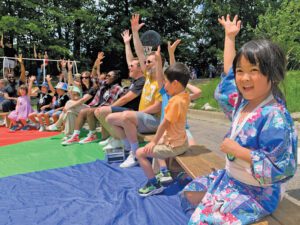
U School Director Ryan Brown (in yellow) leads a graduation ceremony. | Courtesy of U School
The classrooms of the Ubuntu School are warm and inviting, with soft fairy lights netted across the ceiling and students’ artwork and self-reflections displayed on the walls at child height. A swirling nebula streams through a projector onto the indoor gym wall as students take turns building spacecrafts and cosmic obstacle courses using tunnels, plastic gems, and tumbling mats.
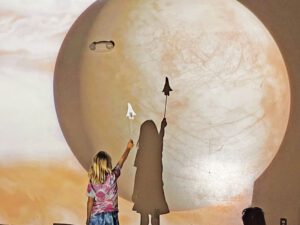
A student plays with shadows. | Courtesy of U School
But these are kids, after all, and kids can have big feelings. Like the time Brooke and Ani, ages four and five, were playing a game they created called Equestrian Girls. But what to do when there are two equestrian girls and only one horse to ride? After some arguing and a few tears, the children found their patience power and had a thorough conversation with their teacher (me, actually—I was an assistant teacher at the U School from 2016 to 2017) about what felt fair and fun to them both. They ultimately decided to ask me to set a timer so each equestrian girl got ten minutes with the horse.
This is the U School approach: a philosophy of constructive conflict resolution, developed by U School leadership, blended with the Reggio Emilia approach, eco-justice, and play- and place-based education.
The philosophical concept of Ubuntu boils down to “I am because you are.” This emphasis on the empathic link between the individual and the collective group is one of the four core elements of the U School’s unique Skillful Togetherness Curriculum. The other three are Lexicon, Plans for PEACE and Conflict, and Mindful Parents & Educators.
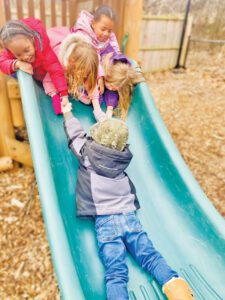
Four playmates help a fifth on the slide. | Courtesy of U School
“We are very proud of this social emotional/soft skill/executive function development tool that has been developed right here in Ann Arbor,” writes founder Ryan Brown, an educator and parent hailing from South Africa, in an email to the Observer.
In 2020, the staff of the U School cowrote and published The U School Lexicon: A guide for speaking truthfully and usefully with children & other humans, a home-grown language tool available to parents, educators, and the community. Teachers and students at the school read from the book during their morning circle meetings, use storytelling to work through familiar scenarios of conflicts, and practice collectively reaching satisfying resolutions.
“We have a different way of communicating with children at the U School, a way of speaking that diminishes the ‘us vs. them’ culture that represents much of the adult-to-child relations I have witnessed in our society,” Brown writes in the book’s preface. He explains that the lexicon should be utilized in peaceful moments most of the time, so when conflict arises, students have the tools to verbally and nonverbally communicate their emotions and find solutions together.
Adorning the walls of every classroom are posters with the Ubuntu PEACE Plan (Play and Be Safe, Everything Gets Respect, Awareness of Your Surroundings, Communicate with Each Other, Experience the Fun!) and Plan for Conflict—a constant and caring reminder that conflict is a normal aspect of life and that students have the power within themselves to find creative and compassionate pathways back to fun.
But Skillful Togetherness isn’t just for students. The U School extends these learning opportunities to parents as well.
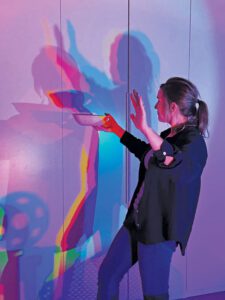
Art studio teacher Lauren Roy does a lesson on color and light. | Courtesy of U School
“They are not alone in parenthood. There is a reason for the expression, ‘it takes a village to raise children,’” says Lauren Roy, the U School’s pedagogy coach and art studio teacher. “Many caregivers have shared values and seek connection with their child, but what does it look like in their day-to-day practice?”
The U School’s Mindful Parents & Educator class helps to answer that question by sharing mindfulness techniques. In the interactive Lexicon Circles workshops, parents and caregivers learn more about Skillful Togetherness to ensure that the ethos goes beyond the school’s perimeter.
“If our relationship leans more to correction than connection, distrust forms,” Roy observes. But by embracing conflict as a natural part of being a human, and giving students, teachers, and families the tools to constructively work through it, the U School fosters strong community connections.
“Humans feel connected when they know and can trust you are in it for their fun,” says Roy. “When problems arise and humans securely know you’re on their team, they can trust you are there to help bridge back to the fun.”