

(Left) Samantha Hamrick of Aventura offers up a Calimocho Aventura. She’s also the creator of the España Verde, whose inspiration was her grandfather’s cookouts, as well as his love of bell peppers. (Right) Giancarlo Aversa poses with two of Peridot’s most popular cocktails, the Nod and This Old House. Aversa says the Nod is part of a mentor’s legacy. | Doug Coombe
Mark Wilfong thinks you’ll probably disagree with the way he makes his old-fashioneds. The owner and chief bartender at Hidden King follows a classic method of mixing a spirit with sugar and bitters, but it’s taken him several years to dial in the recipe, and he needed the help of some friends along the way.
Cocktails can seem simple—in a gin and tonic, the name is also the ingredients and the recipe—or exceedingly complex (fat washing, anyone?). But all across Ann Arbor, regardless of what a menu tells you about a drink, there’s a secret ingredient to most of the greats you won’t see listed.
It’s not the spirits or liqueurs, the homemade syrups, the tinctures or herbs. The best cocktails are steeped with stories that illuminate the lives of Ann Arbor’s bartenders, the city’s past, and new ways of creating connection across a bar.
At Hidden King, that takes the form of a yearslong odyssey and a community of regulars shaping what ends up in the glass. At Aventura, it’s a grandfather who ate bell peppers obsessively and slipped them into anything he could. At Echelon, it’s a no-waste commitment and the memory of a cooling rhubarb pie. And at Peridot, it’s an Ann Arbor cocktail lineage that runs through Alley Bar, the Last Word, and the bartenders who shaped the city’s drinking culture.
There are personal stories in many of Ann Arbor’s great cocktails, and the secret ingredient isn’t always secret—it’s just hard to fit on the menu.
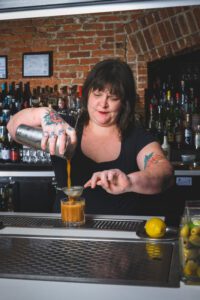
Samantha Hamrick makes a Calimocha Aventura at Aventura. | Doug Coombe
The España Verde at Aventura is green, vegetal, and punchy. It’s made with blanco tequila, gin, a Chartreuse-like herbal liqueur made in Chelsea, and a maceration of citrus and green pepper. It’s summer-sippable on a patio but with enough bite to make sense alongside the tapas coming out of Aventura’s kitchen. But before the drink became España Verde, it was something else for its creator and bar manager Samantha Hamrick: a lawn dart at her grandfather’s cookout and the rediscovery of a classic cocktail by the same name during the craft cocktail boom of the early 2010s.
España Verde – Aventura: tequila, summer gin, green herbal liqueur, ancho chili liqueur, bell pepper & citrus oleo saccharum, mezcal rinse, orange bitters, salt. Grandpa’s obsession, dangerous lawn games
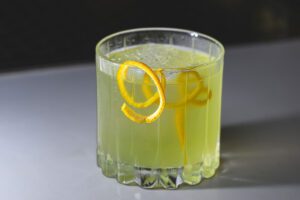
The España Verde | Doug Coombe
Hamrick remembers the cookouts her grandfather would host in the summer quite vividly. There were bell peppers—her grandfather ate them nonstop—and there were lawn darts. Yes, the kind with weighted metal tips that would arc like spears through backyards before we collectively realized that was probably not the safest family pastime.
“This lawn dart has so many backstories to it,” Hamrick says. Learning about it “just took me back to my childhood. My grandfather was always eating bell peppers by themselves, encouraging us to, and then was always finding a way to sneak them into dishes.”
At Aventura, she wanted to turn that memory into something more connected to the authentic Spanish theme of the restaurant.
“When I started here, I was like, I’m figuring out a way to put a lawn dart on the menu. It’ll pair well with this food,” she says.
The solution was oleo saccharum, a syrup made by macerating citrus zest with sugar to pull out the oils. Hamrick makes hers with bell pepper, lemon, and lime, letting the mixture sit until it becomes glossy, fragrant, and full of citrus oil and the vegetal pepper notes that call back to charred shishitos, green sauces, and weekends with grandpa.

Giancarlo Aversa and the Nod outside Peridot. | Doug Coombe
Giancarlo Aversa’s drinks carry a long memory of Ann Arbor. He came to town as a U-M student in 1998, and while school didn’t quite become the thing that kept him here, bartending did. From a formative early job at Good Time Charley’s to his current career as managing partner at both the Last Word and Peridot, Aversa has carried the same basic lesson with him along the way: pay attention to what people want, give them something they’ll enjoy, and make the room feel good.
That history and that lesson is layered into Aversa’s the Nod, one of Peridot’s most popular cocktails.
The Nod – Peridot: gin, melon liqueur, aloe liqueur, fortified wine, cantaloupe, cucumber, habañero, lime. Alley Bar nostalgia, a mentor’s legacy
On the menu, the Nod reads as something refreshing and easy to like: cucumber, melon, lime, a little heat, a touch of salt. But the drink reaches back through Aversa’s own Ann Arbor history, connecting to the Osborne, a cocktail that has been on the menu at the Last Word since Aversa was on the team that opened the bar in 2012. And from there, it reaches back further still, to a cucumber melon martini he loved years ago when it was made by his mentor Robbie Schultz at Alley Bar.
“I love pulling from experience and past knowledge,” Aversa says. “Let me take another crack at it. It worked so good the first time—why wouldn’t I try it again?”
It’s a nod to another bartender and another moment in the city’s drinking history. It’s also a reminder of the intimate nature of Ann Arbor’s bar scene. A drink that began in one era of the city can reappear years later, reworked for a different restaurant and a different palate.
For his nod to that history, Aversa muddles cucumber and adds Midori for color and melon flavor, cantaloupe syrup, ginger, lime, salt, and a little habanero for low heat. He says it’s refreshing, approachable, and like all cocktails with a story, “it offers a little bit more than what it reads.”
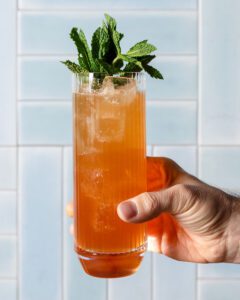
Echelon bar manager Max Schikora says the Rhubarb is the “most personal” cocktail currently on the menu. “Growing up my grandma made rhubarb pie, rhubarb jam, rhubarb jelly, rhubarb pancakes—rhubarb everything.” | Taylor Higgins
Cocktails at Echelon are developed under an unusually tight relationship between bartender and chef. Bar manager Max Schikora said he often sources his drink ingredients directly from the kitchen. That means finding creative ways to use local carrots (he presses them into a syrup), what’s left of roasted beets, or the fat trimmings from a thick Wagyu steak.
Schikora describes it as part of the restaurant’s larger commitment to zero waste and intentional use of ingredients. For Father’s Day, beef fat from the kitchen was smoked, rendered, and used to fat-wash rye whiskey for an old-fashioned; afterward, the whiskey-washed fat returned to the kitchen to brush steaks.
“It’s upcycled, downcycled, and then recycled again,” Schikora says.
The Rhubarb cocktail carries a different kind of story.
Rhubarb – Echelon: white rum, amaretto, smoked rhubarb amaro, rhubarb syrup, lemon, seltzer, mint.
Grandma’s larder, kitchen collaboration
“For me, the most personal thing on the menu right now is the Rhubarb,” Schikora says. “Growing up my grandma made rhubarb pie, rhubarb jam, rhubarb jelly, rhubarb pancakes —rhubarb everything.”
To turn that memory into a cocktail, he doubled down on rhubarb: mixing white rum with Zucca, a smoked rhubarb amaro from Italy, and a rhubarb syrup. He describes the drink as strong but balanced, approachable but not overly sweet. Most importantly, he says, it does not hide the rhubarb under strawberry.
“Strawberry is kind of a cop-out, in my personal opinion,” Schikora says. “I love it. But I want to show off this ingredient I love so much. I don’t want to hide it.”
In addition to collaboration with the kitchen, Schikora’s process also depends on another form of teamwork. He’s sober, which means he does not taste his cocktails in the way many bartenders do. Instead, he relies on the palates around him—other bartenders, managers, coworkers.
“I don’t drink these drinks,” he says. “I’ve got to rely on the people closest to me.”
At first, that was difficult. Letting other people tell him whether a drink worked required trust. But over time, he says, it changed the way he creates.
“It has turned out to be quite a blessing,” Schikora says.
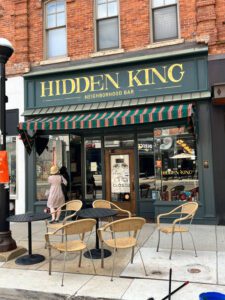
Hidden King on Main. | Amy Sumerton
The old-fashioned is one of the most familiar cocktails in the world, and everyone has an opinion on what makes a good one. At Hidden King, owner Mark Wilfong spent years avoiding putting one on his menu, hesitant to start arguments or quibble over particulars.
Related: “Peaceable Kingdom to Hidden King” (Apr. 2023).
Mix sugar and water in the glass or use a simple syrup? How much sweetness? Stir with ice to dilute the liquor or straight up so it opens your salivary glands? Muddle in an orange? Small choices make a big difference.
“I didn’t have an old-fashioned on the menu because, for a minute, I was trying not to do it,” Wilfong said. “Then I found people want to argue about it. In Europe, they argue about the Negroni. Here, they argue about the old-fashioned.”
Not Your Old-Fashioned – Hidden King: whiskey, sugar, bitters. Regulars with opinions, a recipe made by community
The breakthrough, according to Wilfong, came when he embraced the chorus of voices and enlisted a few to help dial it in. One of the people who helped him get there was his friend Phil Attee, a product developer at Ann Arbor Distilling Company who Wilfong describes as an analytical chemist by training and a distiller by profession.
“Phil kept telling me to do it,” Wilfong said. “Phil introduced me to new techniques and those really let us do an old-fashioned our way.”
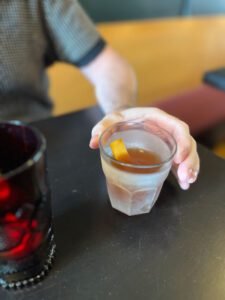
The Not Your Old-Fashioned. | Amy Sumerton
He calls it “Not Your Old-Fashioned,” a name that works as a disclaimer and a joke. The old-fashioned at Hidden King uses rye instead of bourbon, and it’s pre-batched and kept in the freezer—all choices Wilfong knows some cocktail purists will object to.
“We’re leaning into the objections now,” he says. “Because it’s so controversial to so many people and it’s a personal thing. It’s not yours, this is how we do it. We even have a catchphrase about it being pre-batched and frozen: ‘It took two days to make it happen this quickly.’”
With just three ingredients, the Not Your Old-Fashioned is the simplest drink written about here. But it is also the most complex. It carries a personal obsession, just like Hamrick’s España Verde. Similar to Aversa’s the Nod, it reaches beyond one bartender to a wider community of influence. And like Schikora’s rhubarb cocktail, it depends on trust.
And you won’t see any of that listed on the menu.