
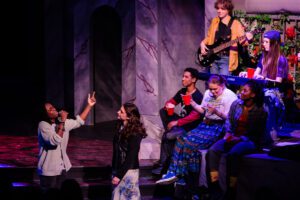
(Left) In PTG’s Hamlet (2026), Randy Vince, one of five actors who played the titular role, raps to Ophelia over Radiohead’s “Creep.” | Sean Carter Photography
This was not your grandmother’s Shakespeare. Pioneer Theatre Guild’s recent production of Hamlet delivered the unexpected—a Shakespeare/Radiohead mashup in the form of a genre-defying musical prologue.
Who could have imagined that this intentional anachronism would make perfect sense? But it did. In a nod to the iconic “To be or not to be” soliloquy, the prologue featured the titular prince crooning a karaoke version of Radiohead’s 1992 debut hit, “Creep.” And the lyrics—“What the hell am I doing here?”—perfectly illuminated Hamlet’s famous existential plight, although, one could argue, perhaps not as eloquently as Shakespeare’s classic phrasing.
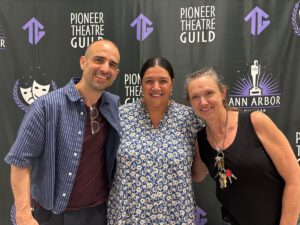
Pioneer Theatre Guild advisors (L-R) Quinn Strassel, Jayme Kelmigian, and Mysti Plummer | Courtesy of PTG
The prologue also introduced the audience to the show’s inventive casting, where a diverse group of five students collectively portrayed the lead role of Hamlet. Quinn Strassel, Pioneer Theatre Guild co-advisor, explains: “The audience gets to experience what Hamlet’s perspective might be if Hamlet is a woman, or a person of color, or queer. We had different identities expressed through that role.”
PTG’s reimagined Hamlet embodies exactly the type of theater program Strassel wants for students: “Theater is better when everyone is invited to the table.” And in Ann Arbor Public Schools, high school students have an open invitation. They can participate in the after-school theater program at any AAPS high school, not just the one they attend.
“We make it really welcoming,” explains Jayme Kelmigian, co-advisor to PTG, along with Strassel and Mysti Plummer. The audition process is especially accessible. “You don’t have to have any experience; we make sure students know that coming in. [For musicals], we teach them the dance combination and the song cuts … because if you’ve got kids that have twelve years of voice lessons and others who don’t know how to read a page of music, that’s an unfair advantage. So, we try to provide the tools they need to be successful.”
Working in the Wings
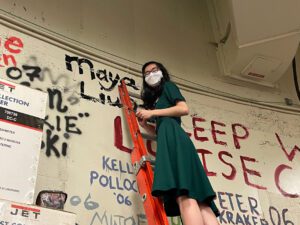
Maya Liu paints her name on the wall. | Courtesy of Huron Players
Maya Liu was no stranger to the audition process, having performed with local youth theater groups from the age of six. But at Huron High, she discovered just as much magic backstage as under the lights.
Joining Huron Players as a freshman, Liu learned the fall show was to be The Two Gentlemen of Verona. Since she’s not a huge fan of Shakespeare—presumably never having seen Hamlet serenade Ophelia with a karaoke British prog-rock number—she looked for a role in the production that did not involve the thorny challenge of speaking the Bard’s lines. Liu joined the run crew, which operates a show’s technical aspects during performances, and discovered there were many hats she enjoyed wearing offstage. For The Two Gentlemen and in subsequent productions, Liu went on to learn costumes, lighting, and eventually stage management.
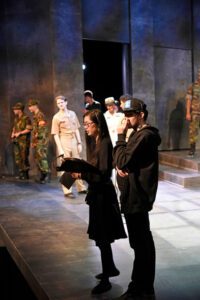
Maya Liu asst. stage manages U-M’s A Few Good Men (2025). | Peter Smith
Fast forward to May 2026, when Liu graduated from U-M with a degree in theater design and production and a concentration in stage management, which she describes as the “central switchboard of a production.” From running tech rehearsals to maintaining the promptbook (a master record of the entire show) to calling light and sound cues in real time, the stage manager makes the controlled chaos of live theater run like clockwork—or at least look that way to the audience.
At Huron, Liu worked in technical roles for the non-musical productions, and also continued to nurture her love of singing by performing in musicals such as Cinderella. As president of the student board during her senior year, she wanted Huron Players to be for others what it had been for her: a place where anyone could walk in and find their footing. Liu describes working to recruit new participants, which was challenging following the disruption of the pandemic: “We were very intentional creating a culture where everyone could join in, whatever their interest, on stage or off. If you want to drill ten screws into the set and call it a day, that’s fine.”
At U-M, Liu stage-managed productions across several departments, eventually specializing in operas. And, in what she calls a “side dish” to stage management, she gained experience creating and operating supertitles, the real-time translations projected above the stage that allow the audience to follow along with an opera’s lyrics.
Now that the proverbial fat lady has sung and Liu is a newly minted college grad, she will next take on summer work as a production assistant for The Egyptian Helen at the Bard SummerScape Opera in New York’s Hudson Valley.
Comparing Apples to Oranges
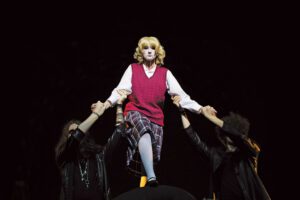
Ellie Gaylord of Huron Players in Ride the Cyclone (2026). | Courtesy of Huron Players
Ann Arbor’s high schools brim with talent—and not only when it comes to the students. Each program has advisors who bring extensive theater and teaching experience to the table. And some cross-pollination has only upped the game. PTG’s Strassel was a visionary force at Community High School, leading Community Ensemble Theatre for eleven years before transitioning to Pathways to Success, where he built the performing arts program from the ground up. He has taught at all of the AAPS high schools and now splits his time between theater programs at Pathways, Pioneer, and Slauson Middle School.
Even the most experienced advisor is still working with the stage they’re given. And the schools’ theater spaces bring their own drama. Since the high school buildings vary in shape, size, age, and condition, each has unique strengths and constraints. But creative minds rise to the occasion. So it should be no surprise that productions run the gamut from Community’s creatively staged, intimate performances at the Craft Theater (a space CET describes as “humble” on its website) to Pioneer’s full-scale musicals in its expansive Schreiber Auditorium, which tend to have 100-plus students making up the cast and crew. Skyline has the newest building (circa 2008), with two fully equipped, flexible performance spaces.
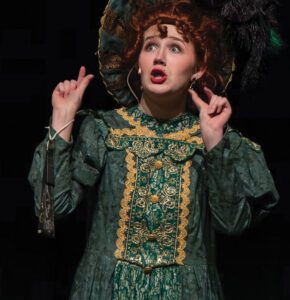
Eleanor Wing as the evil stepmother in Skyline Theatre’s Cinderella (2026). | Courtesy of Skyline Theatre
Skyline Theatre advisor Kristine Stephens describes the learning opportunities that the school’s different spaces offer. A large stage creates more separation between the performers and audience, requiring more dramatic facial expressions and voice projection. But in a smaller blackbox theater, the actors need to be ready for their closeup, so to speak.
“The acting is harder for teenagers,” she explains, “because you have to be really emotionally connected to your character so that it comes off as realistic, so that when the people are sitting right in front of you, they believe your story and can connect to the characters.” These differences made Skyline’s auditorium suitable for its recent production of Rodgers and Hammerstein’s sweeping musical, Cinderella. Its smaller blackbox space is perfect for next year’s Twelve Angry Men, which takes place entirely within the confines of a cramped jury room.
The programs at each school have active student boards, while varying in the degree of leadership that students take on for productions. “Huron Players is proudly a student-led drama club,” says advisor Drue Gray. “Students are heavily involved in every aspect from producing and directing, marketing and fundraising, to technical design.” Pioneer Theatre Guild’s three co-advisors produce the shows and lead technical aspects, while also recruiting external partners to direct most shows and to mentor the student technical crews.
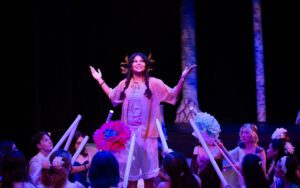
Jasmine Jennings as Puck in CET’s A Midsummer Night’s Dream (2024). | Margie Morris
The smaller schools offer unique opportunities as well. (There’s no such thing as a small role, right?) Community Ensemble Theatre is beloved for its inclusive “no cuts” policy, while at the same time striving for excellence and mounting inventive, ambitious productions such as Fahrenheit 451, Cabaret, Pippin, and Natasha, Pierre & the Great Comet of 1812. At Pathways to Success, performing arts classes during the school day take the place of after-school productions, and facilities that include a recording studio and green screen video studio empower students to develop creative projects.
Cherished Connections
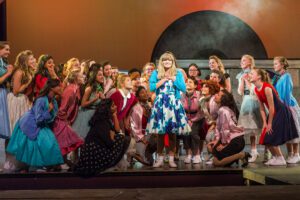
Nadina Hassan as Sandy in PTG’s Grease (2015). | Myra Klarman
A Skyline student at the time its theater program was still getting established, Nadina Hassan was drawn in by Pioneer Theatre Guild’s tradition of large-scale productions. At PTG, she enjoyed featured roles in four musicals—most memorably Sandy in Grease and Sarah Brown in Guys and Dolls—while making lifelong friends. And while many of these friends were her castmates, others were actually her directors and choreographers, who were U-M musical theater majors at the time. Through an informal relationship with U-M’s acclaimed School of Music, Theatre & Dance, PTG musicals are usually directed by these rising stars.
Hassan’s directors for Guys and Dolls, Grease, The Little Mermaid, and Rock of Ages are now professional actors and also her friends, mentors, and even colleagues. After graduating from Skyline in 2016, Hassan went on to study musical theater at Baldwin Wallace University in Ohio, and eventually moved to New York City to pursue an acting career.
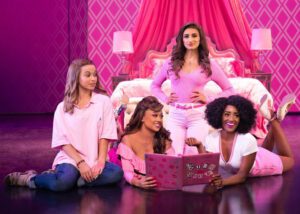
Hassan as Regina George in the Mean Girls
national tour (2022). | Jenny Anderson
Starting off with a bang, her first professional role post-graduation was in the national tour of Mean Girls. Playing queen bee Regina George, Hassan shared the stage with Will Branner, a U-M grad who had directed her in PTG’s Rock of Ages. “We get to champion each other now as colleagues,” Hassan says of these continued friendships, “which is really fun.”
After wrapping the Mean Girls tour, Hassan went on to perform in an off-Broadway musical, We Live in Cairo, which follows six student activists during the 2011 Egyptian revolution. Referencing her Colombian and Egyptian heritage, she notes that the meaningful experience allowed her to “merge the worlds of one of my cultures and my art.”
And now? Hassan’s current gig is a household name: Hamilton. Performing in the national tour in the dual role of Peggy Schuyler (“and Peggy,” for those in the know) and Maria Reynolds, she has found some serendipity. Her Hamilton debut, in Chicago, was in the same theater where she first marveled at a performance of Hamilton as a high school student. And, Observer readers, you may have seen her second tour stop, in a cherished near-hometown spot: Detroit’s Fisher Theatre.
Although Hassan has come a long way from the Pioneer stage, she loved her time at PTG. And she urges students who might be hesitant about theater to give it a try, onstage or off. “It is just like a big, big team sport. So, I would learn everything you can about it, if it’s of interest to you at all, because I guarantee you’ll fall in love with some part of it. I definitely did.”
“The Reason I Come to School”
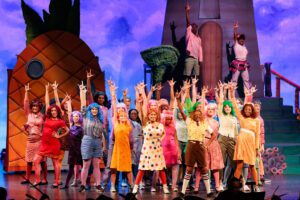
The cast of PTG’s The SpongeBob Musical (2025). | Sean Carter Photography
As Mean Girls cleverly illustrates, and as we all know, high school can be a challenging time. For students who might feel out of place, theater programs offer something that hallways and academic classrooms rarely can: a place where being unique and different is embraced. Emily Wilson-Tobin, Community Ensemble Theatre advisor, describes the student buzz: “A lot of them have said that CET is one of the safest and most welcoming spaces they have ever encountered, and they’re very grateful for that. … One student described it as ‘a space where I really felt like people knew who I was, and I could be myself.’ That is incredibly important to me.”
Jayme Kelmigian echoes that sense of community: “Multiple kids say ‘the reason I come to school is because I have theater after school. I get to be with my friends and go to rehearsal.’… It makes them feel a part of something, gives a sense of belonging, a purpose … and a sense of responsibility.”
Quinn Strassel observes, “I’ve always felt like you can just see the growth, and that’s the most exciting thing … the difference between a ninth grader and a twelfth grader in terms of their confidence, the way they present themselves to the world. It’s just so palpable … and I think, ‘I can’t believe that’s the same kid.’”
Making Words Matter
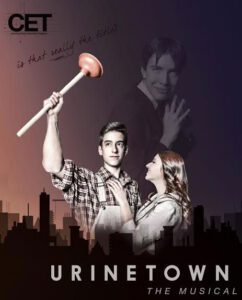
Isaac Scobey-Thal wields a plunger in the poster for CET’s Urinetown (2014). Scobey-Thal is now an aide for NYC mayor Zohran Mamdani. | Courtesy of CET
You could say Isaac Scobey-Thal realized the power of his voice during his years in Community Ensemble Theatre. Surprisingly, it wasn’t through song. Though his musical portrayals of Che in Evita, Sir Dennis Galahad in Spamalot, and Bobby Strong in Urinetown were notable, this discovery took place before the curtain even went up.
A 2015 Community High School grad, Scobey-Thal describes a favorite CET ritual: “Quinn used to gather the cast before every show, and he would give a speech … and I was totally electrified by those speeches and that pregame ritual. It got us focused, it got us ready and hyped up to get on stage.” And eventually, Scobey-Thal got to help lead that pre-show hype. “In my senior year, I was the president of CET, and I started helping to give those speeches and I just loved it. I felt totally myself in that moment, like I had found something that I was meant to be doing.”
Going on to Yale University as an American studies major, Scobey-Thal continued in theater, comedy, and a cappella groups outside of class. And he eventually moved on to a bigger stage: politics. Now an aide to New York City mayor Zohran Mamdani, Scobey-Thal held previous jobs in speechwriting—for U.S. senator Gary Peters and the vice presidential campaign of Kamala Harris.
Politics and theater have more in common than you might think. Scobey-Thal explains the synchronicity: “Good speechwriting in politics, like a theater program, is meant to … translate something big and complicated, like a show or a public policy, into something real and human and simple and hopefully moving.” And he notes that communal art, much like the best political campaigns that he’s worked on, “make people feel like they are part of something that can change their little corner of the world.”