

Richard Primus (second from left) with his fellow clerks and Ruth Bader Ginsburg on the steps of the Supreme Court. Primus says it was a “privilege” to work for Justice Ginsburg. | Courtesy of Richard Primus
U-M law professor Richard Primus, who began clerking at SCOTUS in 1999, found RBG “intensely disciplined”—she often worked past midnight. “We used to say she was a very flexible boss,” he says jokingly. “She didn’t care which twenty-three hours we worked.” But, he adds, “it was a privilege to do that work.”
Clerks from different political parties bonded on the top-floor basketball court, nicknamed “the highest court.” Primus recalls one day when RBG needed her clerks to make some changes to a case.
“I asked, ‘What time do you want this back?’ She asked, ‘What time is basketball?’ I told her, and she smiled and said, ‘Forty-five minutes after basketball.’ … She was aware that if she gave us an hour to exercise and blow off steam at 3 p.m., we’d be fresh at 9 p.m.”
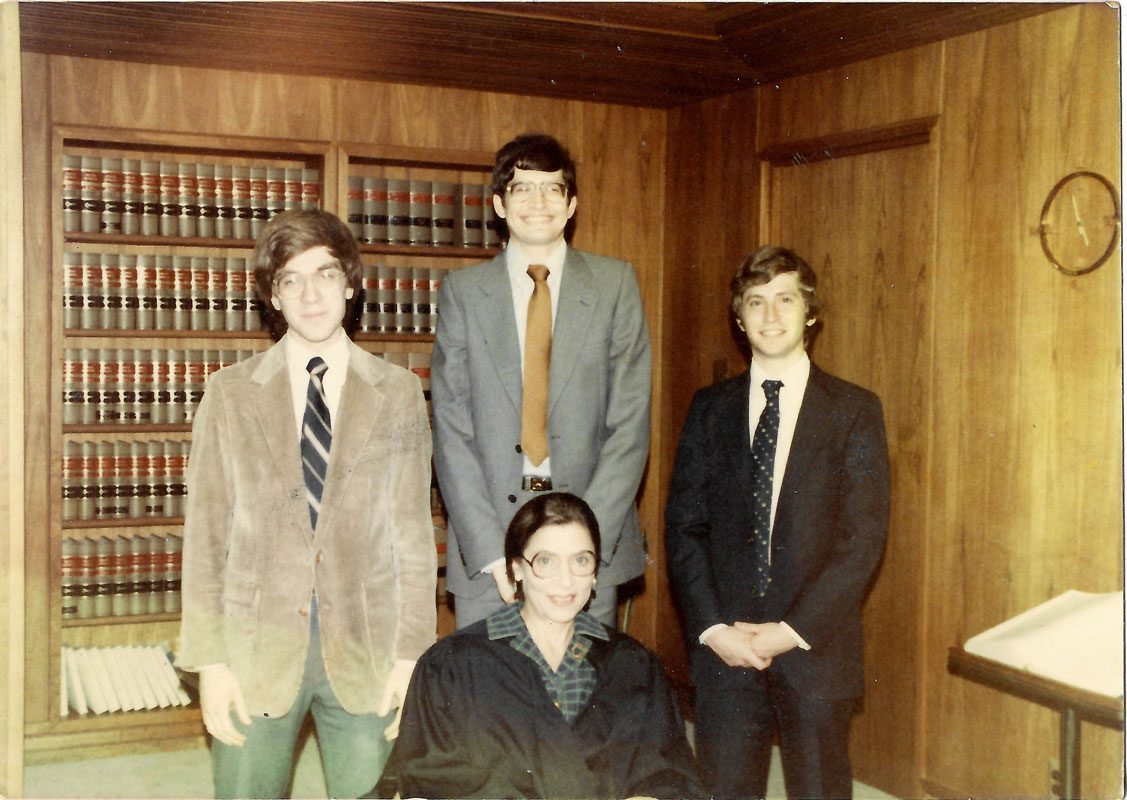
Jonathan Weinberg (left) describes RBG as a “hand-on judge who didn’t suffer fools.” | Courtesy of Jonathan Weinberg
Jonathan Weinberg, who teaches law at Wayne State, clerked for RBG in 1983–84 at the D.C. Court of Appeals. Recalling his interview, he says, “neither one of us was at that time very good at small talk. She would ask a question briefly, and I would answer the question briefly, and there would be a long pause.” Another question. Another answer. Another pause. “Apparently on that basis, she decided I was her sort of person.”
Soon after her three clerks arrived, Weinberg remembers, RBG took them on a tour of the district’s correctional facility. “She wanted the people who were assisting her to understand what was at stake.”
Weinberg describes RBG as a “hands-on judge who didn’t suffer fools. … If she didn’t think a clerk was performing adequately, she would do all of the clerk’s work herself.” When a clerk was doing excellent work? “You might send a draft of an opinion and find that she had already written it herself.”
Related: May Her Memory Be Our Innermost Revolution (Nov. 2023)
U-M law and philosophy prof Scott Hershovitz, who clerked at SCOTUS for RBG in 2006–07, says it was “the best job I ever had and the hardest job I ever had.”
Clerks wrote memos to help RBG prepare for cases. After a clerk perfected a draft, she would sit down with them to make changes. “There was a lot of red ink, but by the end of the year, you could see your progress,” says Hershovitz.
As exacting as she was, Hershovitz admired her ability to make friends across the political divide, including right-wing justice Antonin Scalia. “Some people are critical of her for that, but it was a genuine friendship,” says Hershovitz. “They had worked together on the D.C. circuit and had interests in common—opera, food. It wasn’t a strategic friendship.”

Eli Savit was inspired by RBG’s compassion for those who came before her bench: “she never lost sight that there are unique human beings with individual stories in every case.” | Courtesy of Eli Savit
Washtenaw County prosecutor and Democratic candidate for Michigan attorney general Eli Savit clerked for RBG in 2013. Once, he recalls, “we were going back and forth about a case. … I was in the middle of making a point when she looked down at my feet and said ‘Your shoes are not tied tightly enough. You are going to trip and fall.’” Her look said the conversation wouldn’t continue until he tied his shoes, so he did.
Adds Savit, “In many ways, she reminded me of my Jewish grandmother, if my Jewish grandmother loved opera more than anyone I ever met in my life and was a courageous jurist and a brilliant strategist.”
He was particularly inspired by her compassion for those who came before her bench. “What I’ve taken with me throughout my career is just how much she never lost sight that there are unique human beings with individual stories in every case,” Savit reflects. “Someone may have been traumatized, someone else’s liberty is at stake. Or in a child custody case, someone’s ability to hug a child.”
She was also a thoughtful boss.“She cared tremendously and celebrated everybody’s birthday,” Savit says. They would gather at exactly 4 p.m. to enjoy cupcakes and gifts, “and exactly at 5 o’clock it was back to work.”
Related: Political Ambitions, Made in Ann Arbor (July 2026)
Passionate Prosecutor (Jan. 2021)