
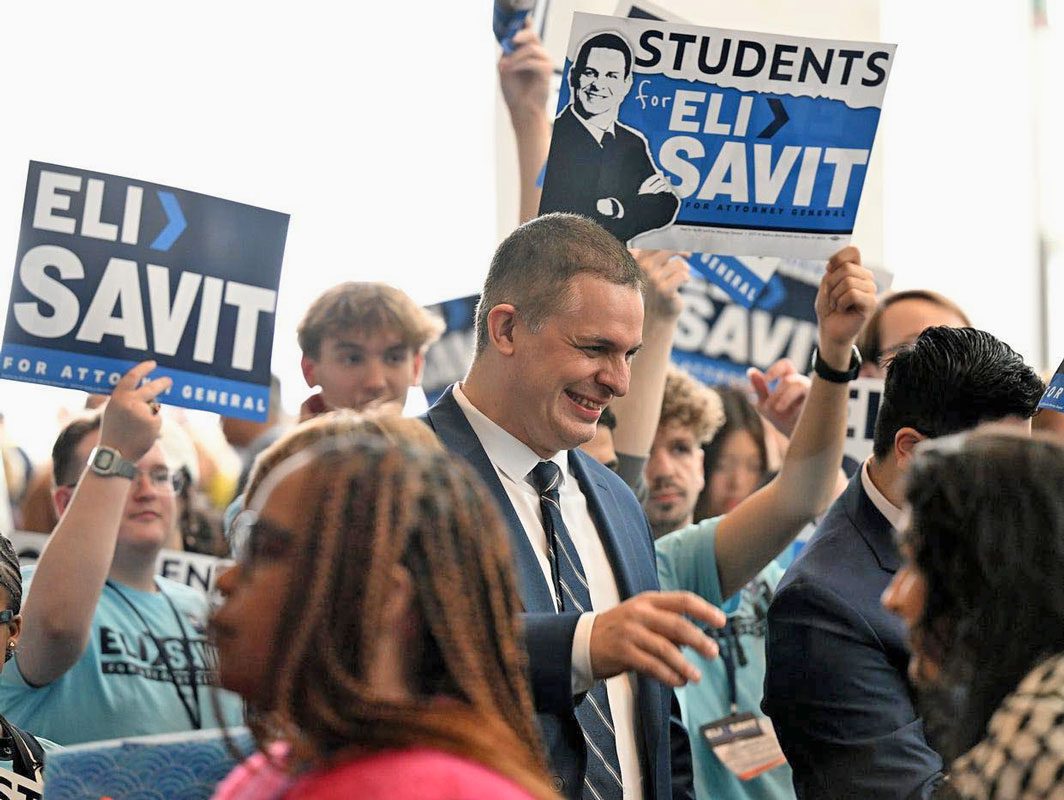
Eli Savit, Washtenaw County prosecutor, is the Democratic nominee for Michigan attorney general. | Savit Instagram
Eli Savit remembers his inaugural effort at taking on a cause. At age six, he had a subscription to Ranger Rick, the kids’ magazine published by the National Wildlife Federation. Savit was so taken by the plight of birds after the 1989 Exxon Valdez oil spill that he organized a “stop oil spills” club in his first grade class at Hebrew Day School.
The kids made placards and marched around the block. But Savit didn’t stop there. He called in a classified ad to the Ann Arbor News that read, “Stop Oil Spills,” using his parents’ phone number for verification.
“‘Eli, what did you do?’” Savit recalls his mother asking. “That was my first foray into activism.”
For Abdulrahman El-Sayed, who grew up in Bloomfield Township, the Ann Arbor memories came a little later. An aunt lived here, and he remembers trips to Jerusalem Garden and Afternoon Delight, as well as competing in a high school speaking tournament held at U-M. Arriving on campus later as an undergrad with the intent of becoming a doctor, he says, “I fell in love with it the way one does.”
Years later, El-Sayed, who goes by Abdul, joined Savit as an area resident, and now both are on statewide ballots as products of Ann Arbor. In April, Savit won the Democratic Party nomination for Michigan attorney general, hoping to succeed fellow Democrat Dana Nessel, whose position is limited to two terms.
Meanwhile, El-Sayed is in a primary battle for the U.S. Senate seat being vacated by Gary Peters. In late May, a poll by Lake Research Partners showed him with a narrow lead in a three-way race against U.S. Representative Haley Stevens and state Senator Mallory McMorrow.
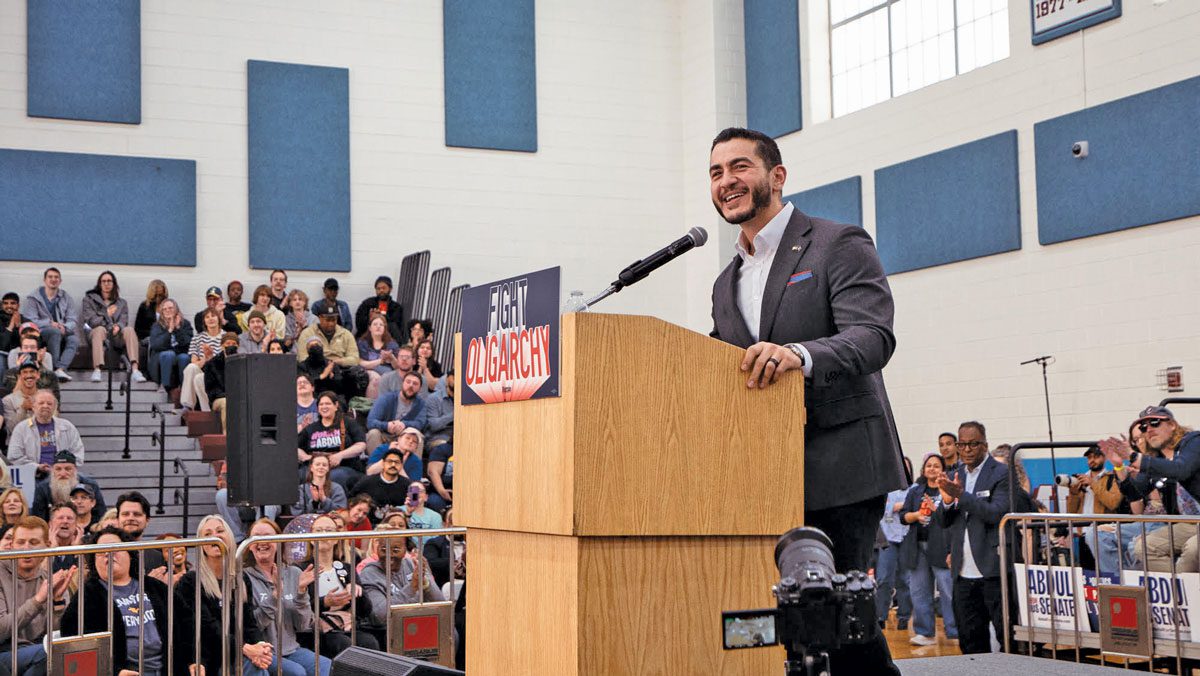
Abdul El-Sayed, a Democratic candidate for U.S. Senate, faces a tough primary battle. | Abdul for Senate
The two Ann Arborites say their campaigns are steeped in what they have experienced here, whether as a schoolchild, like Savit, or in formative college years, as in El-Sayed’s case.
Three years after his elementary school march against oil spills, Savit became a volunteer for Bill Clinton’s presidential campaign, going door-to-door in fourth grade, even though Clinton wasn’t his first choice among Democrats—he backed California governor Jerry Brown, whose environmental activism fit with his own interests. (Clinton won thirty-seven primary contests, including Michigan and Brown’s California.)
Clinton’s later years, including his impeachment by the Republican-controlled House, were a wake-up call for the student activist. “That was a period when I was exposed to divisions and fractions on the national scene,” Savit says.
El-Sayed had his own encounter with Clinton, albeit a far more positive one. In 2007, he was chosen to give the U-M student commencement address alongside Clinton, who received an honorary degree. After the talk, which is on YouTube, Clinton pulled him aside.
“He came up to me and said, ‘Why are you going to medical school? You have a real gift for this,’” El-Sayed recalls. “I literally laughed in his face. I said, ‘I have eleven letters in my name. I don’t get to run for office.’”
But he followed in Clinton’s footsteps by winning a Rhodes scholarship to Oxford. He was coached by Elleanor Crown, the scholarship coordinator for U-M’s honors program. They met when El-Sayed, then a sophomore, came to ask her a quick question. The pair spent the rest of a half hour chatting, and Crown said she was impressed by his ability to “listen to a question and respond to exactly what was said. That’s when I told him he had the ability to become a successful Rhodes scholar.”
Oxford, which dates to 1096, is the oldest university in the English-speaking world. “The history of it hangs over you,” El-Sayed says, which could be intimidating. One Oxford academic repeatedly called U-M “the university of Michigan state” and El-Sayed decided not to correct him. After completing his PhD in public health, he returned to the U.S. to earn a medical degree from Columbia University.
Savit left Ann Arbor to earn his undergraduate degree at Kalamazoo College, where he experienced a different kind of culture shock. The school’s enrollment, around 1,300, made it smaller than Pioneer High School, his Ann Arbor alma mater, which had around 2,700 students then. Savit, who had played basketball for Pioneer, chose Kalamazoo for college sports, and discovered its study abroad program.
He spent time in Madrid, where he became a fan of the Real Madrid soccer team, then returned to Ann Arbor for law school. He won a prestigious clerkship with the Supreme Court, working for Justices Ruth Bader Ginsburg and Sandra Day O’Connor. Then, he says he faced a quandary: “Where do you want to put down roots?”
He could have stayed in D.C. and pursued a career in private practice or at the Justice Department, but his heart, he says, lay in Michigan. However, a legal job at the state level seemed inaccessible for the young Democrat, since Rick Snyder was governor and fellow Republican Bill Schuette was attorney general.
A contact put him in touch with Detroit’s then-mayor, Democrat Mike Duggan, and he initially joined his staff in an education position. “It wasn’t what I set out to do,” Savit says. “It was a door that opened. It was extremely interesting and meaningful to me.”
He later became the city’s chief legal counsel, taking on a variety of cases and issues including criminal justice reform, and serving as the lead negotiator with Canada on city matters related to the construction of the Gordie Howe International Bridge.
A position in Detroit also brought El-Sayed back to the state. A mutual friend suggested he pitch himself to the city, and he delivered a résumé. Two weeks later, he was called in to interview for the position of health director. He helped rebuild the health department after Detroit emerged from municipal bankruptcy, then took over Wayne County’s Department of Health, Human and Veterans Services.
El-Sayed ran for governor in 2018, finishing a distant second in the Democratic primary to Gretchen Whitmer. At the time, his wife, Sarah Jukaku, whom he married as a U-M undergraduate, worked for U-M’s University Health Services as a psychiatrist, and the pair wanted to move closer to Ann Arbor.
They took an 800-square-foot apartment and then bought “the house you’ll live in for the rest of your life” in Ann Arbor Township in 2021. The couple has two daughters, and El-Sayed says he’s excited about raising them here. “There is a kind of attitude in Ann Arbor about the question of what is possible. How do we reach for politics that dignifies all people?” he says.
Savit decided to run for Washtenaw County prosecutor in 2020 after Brian Mackie chose not to seek reelection, and beat primary challengers Arianne Slay and Hugo Mack. He faced no Republican opposition in November, and hit the ground running in 2021.
Flashback: A Pivotal Race for Prosecuting Attorney (July 2020)
In a flurry of moves, Savit eliminated cash bail, making Washtenaw County the first in the state to do so. He waived prosecutions for marijuana and hallucinogenic-mushroom arrests as well as those for sex workers. Reelected in 2024, he says he decided a year later to run for attorney general.
But Savit cautions against expectations that he will pursue similar actions statewide. “The work we have done in Washtenaw County is not the work I’m trying to bring statewide,” he says. “No matter who is the attorney general, the day-to-day criminal justice work is done locally.”
His priorities, outlined on his website, include gun reform, civil rights protection, worker and consumer rights, and environmental protection. He’s been endorsed by a slew of active and former Democratic party officials.
Related: Savit’s Run (July 2025)
El-Sayed’s big endorsements include U.S. senator Bernie Sanders of Vermont and the United Auto Workers union, whose nod could be crucial in the crowded Senate race.
With a month to go before the primary, El-Sayed has been ubiquitous on social media and in appearances across the state, but he still finds time to indulge in a treat for himself and his family: ice cream.
His favorite flavor at Washtenaw Dairy is bear claw, but he spares some love for Blank Slate, where his order is a double scoop of brown butter cookie dough and cookies and cream in a chocolate-dipped waffle cone.
Savit is also a Blank Slate fan, but as a townie, “I’ve got to go with Washtenaw Dairy,” he says. “The ice cream is great. The donuts are great.”
This article has been edited since it appeared in the July 2026 issue of the Observer. The number of students at Kalamazoo College was corrected.