
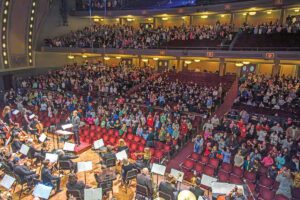
A2SO Link Up drew 2,415 students in third through fifth grade from across Michigan to Hill Auditorium, where they sang and played along with the orchestra. | Photo: Charlotte Smith
On a bright morning in early March, lines of young people pour from buses from all over Michigan and into Hill Auditorium. They look around the iconic theater excitedly as they fill the seats, many with recorders in their hands; they’ve been looking forward to this day. Onstage: the Ann Arbor Symphony Orchestra (A2SO). The lights go down, and the opening strains of Thomas Cabaniss’s “Come to Play” come up. The students beam; they know this song, and they are ready to join in.
This is Link Up. Provided in partnership with Carnegie Hall’s Weill Music Institute, the national initiative provides elementary schools with a music education curriculum that culminates with a live interactive performance where students play recorders or sing along with an orchestra.
The two Link Up concerts held at Hill Auditorium on March 4 drew 2,415 students from thirty regional schools. Conducted by U-M alum Yaniv Segal, the performances also featured the Paul Keller Ensemble and a violin solo by Pioneer freshman Hannah Lee, who won the 2025 A2SO Young Artist competition.
Flashback: Superconductors (Aug. 2021)
“It’s definitely our largest learning and community event that we hold every year,” says Marissa Honig, A2SO’s senior manager of learning and community. “The excitement and the enthusiasm and joy that the students get in the moment is really impactful, and we love to see that.”
Designed for third through fifth grade, the program provides interactive sheet music, recordings, videos, and classroom activities that use the repertoire to teach the basics of orchestral music. Students begin preparing for the concert as early as the beginning of the school year. During the concert, the music and lyrics are projected above the orchestra for students to put their training to practice. This year’s program was hosted by Emily Becker, a senior at the U-M School of Music, Theatre, & Dance who also works as a student music teacher at Tappan. A2SO trumpet player Becky Bloomer took an active role onstage, demonstrating the trickier recorder riffs and helping students stay engaged with the music.
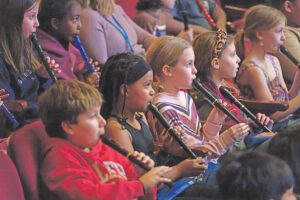 Alyssa Disher, a music teacher from Saline’s Washtenaw Christian Academy, has been participating in the program for three years and says it helps students learn to read music and sing and play together. “[The students] love it,” she says. “Initially the recorder is really hard—it can be squeaky—but having something like this to work toward is really special.”
Teresa Wilder, a music teacher from Howell’s Southwest Elementary School, who has been participating in Link Up since it started ten years ago, says it enhances what her students learn in class and gives them access to a professional music concert they might not have had otherwise.
Kelly Gubbini, a parent chaperone from South Arbor Charter Academy in Ypsilanti, attended with her fourth-grade son. It was her second time; she’d also chaperoned the concert three years before with her older son. “I enjoy how interactive the symphony orchestra is with the kids,” she says. “It kept the kids engaged.”
The Weill Music Institute offers four Link Up programs with curated musical selections; Honig chooses which one the A2SO will perform. This year’s program, The Orchestra Swings, featured songs like George Gershwin’s “I Got Rhythm” and Duke Ellington’s “Duke’s Place” and “It Don’t Mean a Thing (If it Ain’t Got that Swing).” In music classes leading to Link Up, students learned about the history of jazz and its distinct rhythms and accents, and even got to do their own improvising.
“It was really cool watching the kids get excited when they saw the pieces that we listened to in class being performed here,” says Wilder. “They’re like, ‘Oh my gosh, I remember that one,’ and they lit up with excitement.”
Honig says students in grades three, four, and five are at a pivotal age, and the orchestra hopes to inspire them to develop a love of music, as performers or fans. “[It’s about recognizing] certain musical things and just starting to build that kind of awareness and understanding that music is important,” she says. “It doesn’t have to be [them] sitting on a stage as a professional musician looking for a career, it’s just enjoying it.”
Related: A2SO @ 90 (Aug. 2018)
It’s a pivotal time for the A2SO too. According to data from the National Endowment for the Arts, attendance at live classical music events is on the decline. In 2002, 11.6 percent of U.S. adults reported attending at least one live classical music performance that year. By 2017, that number had dwindled to 8.6 percent. And in 2022, as the country took tentative steps toward post-pandemic normalcy, it was 4.6 percent.
“The pandemic certainly contributed to a nationwide decline in orchestra audiences, including here at the A2SO, but at the same time, it created an opportunity to reflect on how we can better meet audiences where they are,” says Trianne Newbrey, director of marketing and communications for the A2SO. “One of the challenges facing orchestras is finding cultural relevance in today’s world. Communities and audiences are shifting dramatically, and it’s our responsibility to evolve with them.”
To that end, the A2SO offers an eclectic array of learning and community programming: small ensemble presentations in area schools, instrument petting zoos, music mentors, KinderConcerts in local libraries, and chamber concerts at churches, senior living communities, and farmers markets.
“We are also in the final stages of launching a music and wellness program that will bring live classical music into healthcare environments,” says Newbrey. “As research continues to demonstrate the positive impact of music on overall well-being, we are expanding our work in this area.”
Newbrey goes on to say that, “Since the pandemic, we have seen our audience demographics lean younger,” and while she’s not referring to the excited elementary schoolers with their recorders in Hill Auditorium, they may one day make up future orchestra audiences.
“Our programs try to have a touchpoint on all the different stages of learning; we try to have things for elementary school, middle school, and high school,” says Honig. “Our hope is to be with our students throughout their education and to help them grow in music.”