
Not all of the half-a-million or so visitors to the upcoming annual Ann Arbor Art Fair realize it’s actually three fairs in one: the Street Art Fair (the Original), the State Street District Art Fair, and the Guild’s Summer Art Fair.
“It’s a big, year-round undertaking, so seeing it actually hit the street and come together is always so exciting,” says Karen Bauer, executive director of the Guild’s Summer Art Fair. Her counterpart at the State Street District fair, Nick Lemmer, relishes the combination of faces new and old: “We have a handful of artists who come back every year, and then we have a handful who will be there for the first time, which is always exciting,” he says.
For Angela Kline, executive director of the Original—the oldest of the three fairs—the best thing about the event is the way it brings people together. “It represents the collective effort of so many people from our community,” she says.
We spoke with three painters, one from each fair, whose work engages with “intersections,” a concept that encompasses much of what the fairs are all about: exploring points of connection and embracing individuality and commonality at once.
“Speaking of intersections,” says Kline, “our featured artist this year, Matthew Cornell, met his wife at the Original twenty-six years ago.”
Janina Tukarski Ellis (Ann Arbor Street Art Fair, the Original)
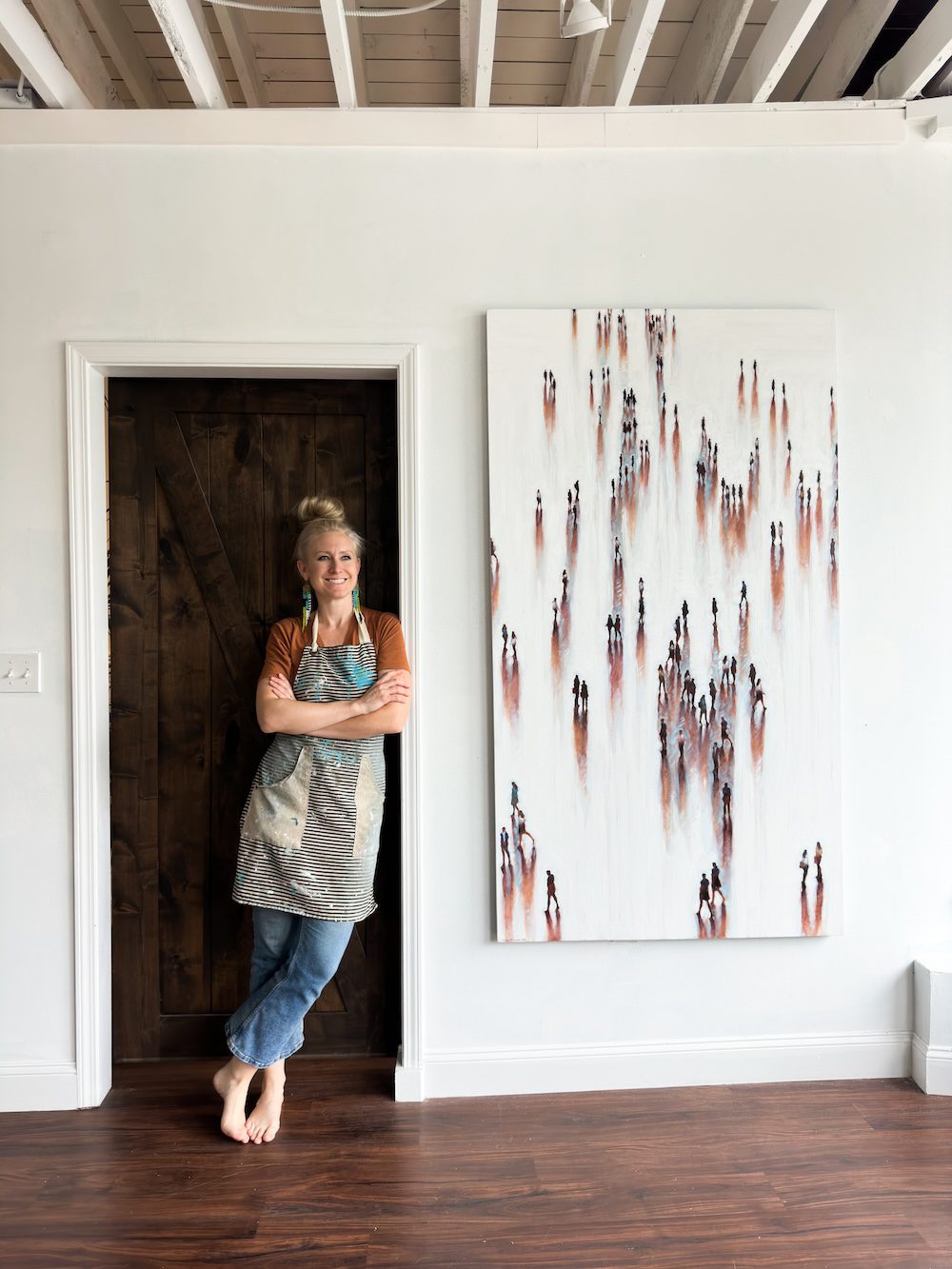 “If I could call every single one of my paintings Crossing Paths, I would,” says third-generation artist Janina Tukarski Ellis, who will be at the fair for the first time this year.
For as long as she can remember, she’s been fascinated by people—as individuals and in groups. “Everyone is unique,” says the South Carolina–based artist. “When I’m painting, I get to know the different people,” she tells me. “I get a sense of who they are through their body language, how they’re walking, and who they’re with.”
Her work depicts public places—train stations, city squares, art museums—full of people going about their days. While open to interpretation, many of those places are drawn from her hometown of Munich.
“I love the feeling of emerging from the subway into a city square,” she says. “The hustle and bustle of the people, the feel of the crowd, the sounds, the smells …”
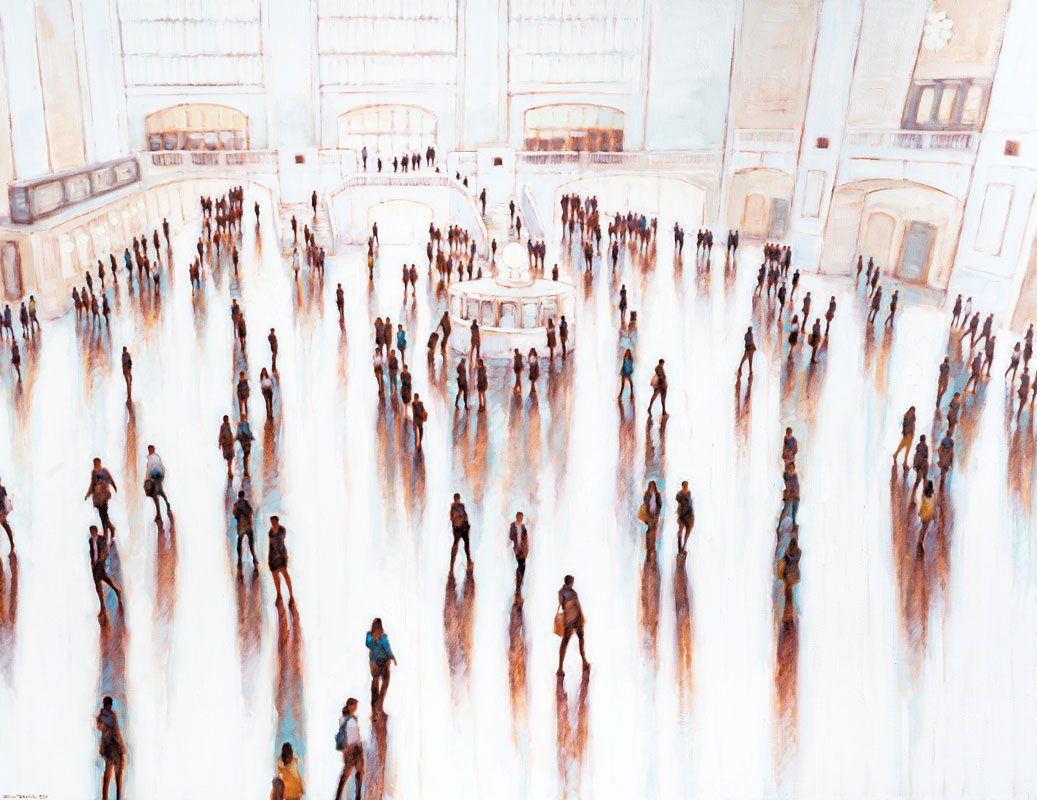
Crossing Paths: Tukarski Ellis’s works, like The Joy of Tuesday, depict public spaces, the people who fill them, and “a hint of who they are.” | Janina Tukarski Ellis
Such things—the ingredients that make up the cityscape—invigorate Tukarski Ellis.
Yet, for as much as her work delights in busyness, it has something calm and even ethereal about it. Figures in the crowd seem to shimmer, as if the ground beneath them were not solid earth but water.
“Even though my paintings are energetic, vibrant, and dynamic,” she says, “I mean them to be peaceful.” This she achieves through soft tones and brushwork, combined with lots of blue and white—elements that she says “create a little bit of a paradox.” Elongated shadows “exaggerate the flow of the patterns of the crowds of people,” tying the composition together.
Close inspection of the figures in her paintings reveals subtleties of body language—gestures and movements that quietly accumulate into character. “I’m trying to capture, in a few simple strokes, their essence, to give you a hint of who they are,” she explains. “They may have no identity, but they have a personality.”
Tukarski Ellis brings to bear the skills she honed during an intensive year studying at Akthof, a private art school in Munich where she focused on drawing form, anatomy, and musculature.
“I still approach my art from that direction,” she says. “The figures in my work are simplified, but there’s very much an understanding of how the parts of the body look together to create motion, and how someone is moving across a space.”
Tyler Voorhees (The Guild’s Summer Art Fair)
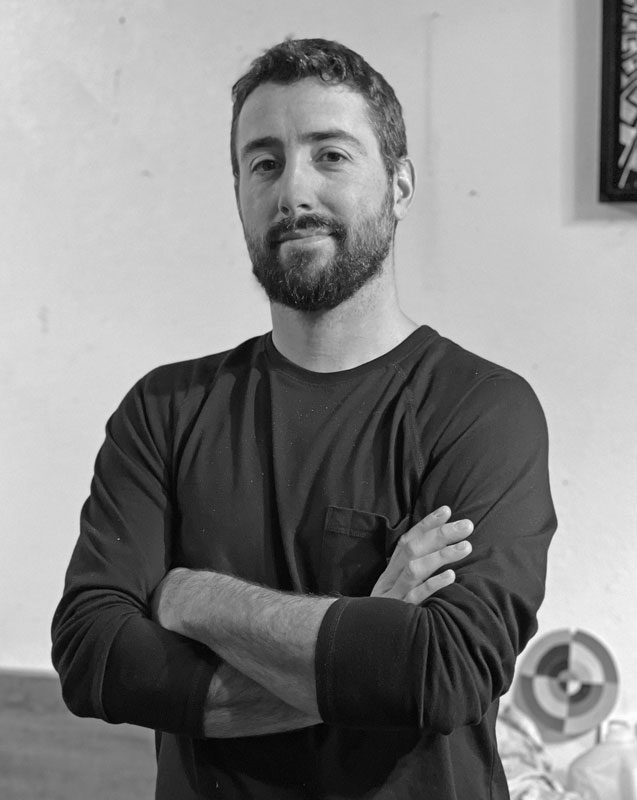
Courtesy of Tyler Voorhees
Tyler Voorhees’s journey as an artist began in the margins—literally. Bored and uninspired at school, he took to drawing long-limbed cowboys in the margins of his notebooks. Those tall figures, now a hallmark of his work, weren’t simply the result of limited page space; they were also an imaginative response to his childhood surroundings: the Great Plains of South Dakota.
“You can tell where a town is because there’s one lone water tower that rises above the landscape,” says Voorhees. “I always loved looking up at that, and I loved climbing tall trees and looking out across the land. Drawing that tall cowboy really brought to life my imagination of what it would be like to tower above the plains.”
One of the first stories he recalls hearing as a child is that of Paul Bunyan, a giant logger who would clear whole forests with one swing of his ax, and whose giant blue ox would drag the timber away.
Giant statures and blue-collar work have both been defining characteristics of his art ever since. Growing up in rural South Dakota, “everyone’s identity was tied to their work—you were a farmer or a mechanic or you worked at the bank,” he explains. “It’s a place where hard work is celebrated. The worst thing you can be called is lazy.”
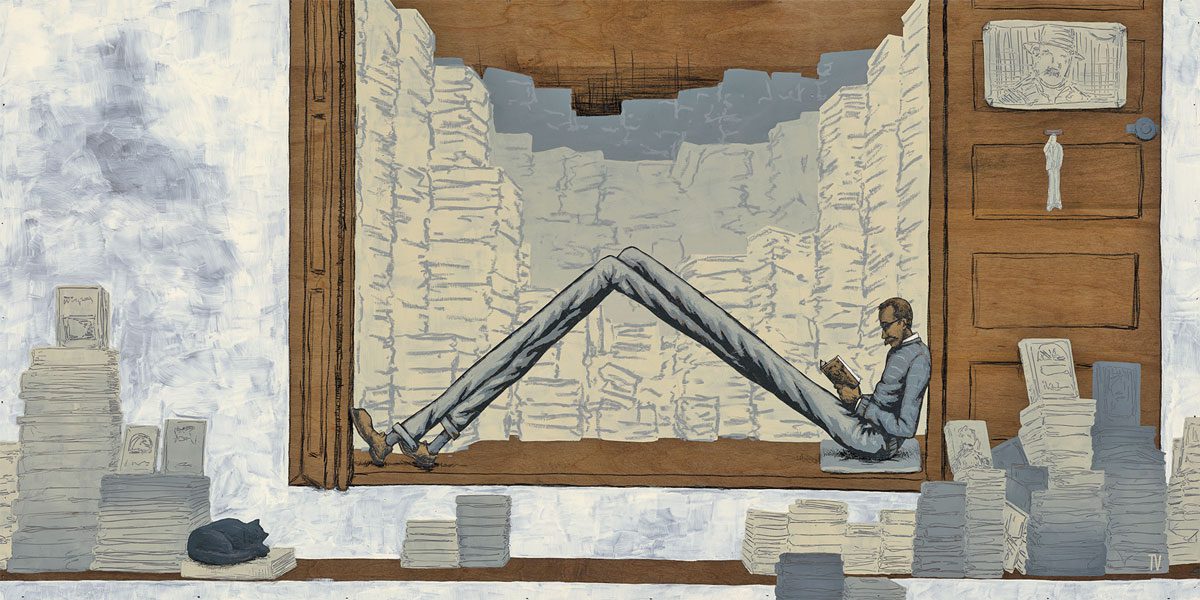
History Converges with the Surreal: In The Bookseller and other works, Voorhees draws inspiration from his youth in South Dakota, where “everyone’s identity was tied to their work.”
Jobs of Yesteryear, a series he’s been working on for over ten years, pays tribute to the history of labor, depicting workers in jobs that have long since vanished: cordwainers, elevator operators, log drivers, ice cutters, lamplighters, pinsetters, shipbuilders, always with elongated arms and legs and torsos.
The unexpected pairing—of history and the surrealist style he first experimented with in his school notebooks—is intended as both provocation and invitation.
“You see it when people walk into my booth and encounter my work,” he says. “It stops them in their tracks and forces them to be present with the art and ask themselves: what is the story being told and why is it being told? Why this really tall person? It creates a sense of wonder. And I think that’s really the beauty of finding the intersection of two incongruous, or perhaps unexpectedly congruous, things, like history and surrealism.”
It was perhaps inevitable that Voorhees would eventually find himself drawn to murals. “I thought it would be so cool to see this giant towering figure, literally towering above people,” he says.
He and his wife, whom he credits with being the brains behind everything the pair of them do, sought out opportunities to paint murals, eventually landing their first commission in 2018, in Tétouan, Morocco. In the courtyard of a school, with a group of curious students watching him all week as he worked, he painted a weaver at work on a loom, their spool trailing 150 feet along the wall.
Painting murals also appealed to his love of public art. “You can build community around public art,” he says. “It’s a way to bring people together in a way that really only art can.”
Phillip Harris (State Street District Art Fair)
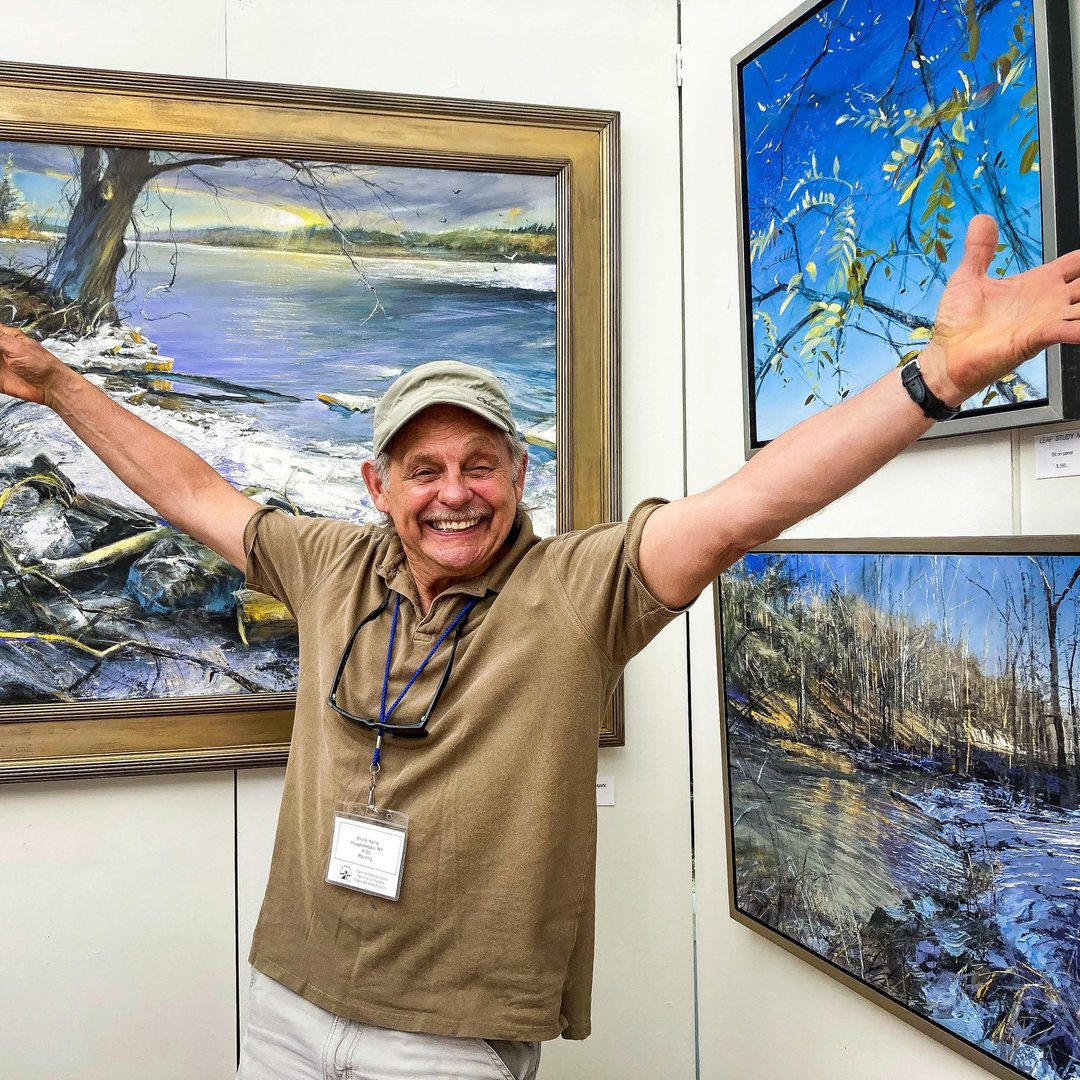
Courtesy of Phillip Harris
“I am drawn to the edges of places, where opposite natural forces meet,” writes Phillip Harris on his website. Last year’s winner of the State Street District Best in Show award, Harris works with oils to paint natural scenery, much of it characterized by a strong sense of movement—cascading rivers, windswept sand dunes, lightswept woodlands.
He doesn’t come from an artistic background, but he does come from a hardworking one. His father, raised in the rural South with no education beyond sixth grade, built a furniture business from the ground up, at one point employing a hundred men across two mills.
Harris inherited his father’s work ethic. “I love working,” he says. “I work all the time. Every day, I can’t wait to get to the studio.” When I speak with him, he tells me that, on each of the two previous days, he spent fourteen hours straight in his studio. “You get lost in it,” he explains. “You don’t have any sense of time; I couldn’t have told you what time it was.”
Edges captivate Harris for the way they embody contrast and confluence. “Our whole awareness—not just the visual, but our whole perceptual awareness—is based on contrast: light and dark, tall and short, big and small, loud and soft,” he says. “And when you’re at the edge of something, you’re at that line between the contrast; between the sharpness and the softness, the darkness and the light.”
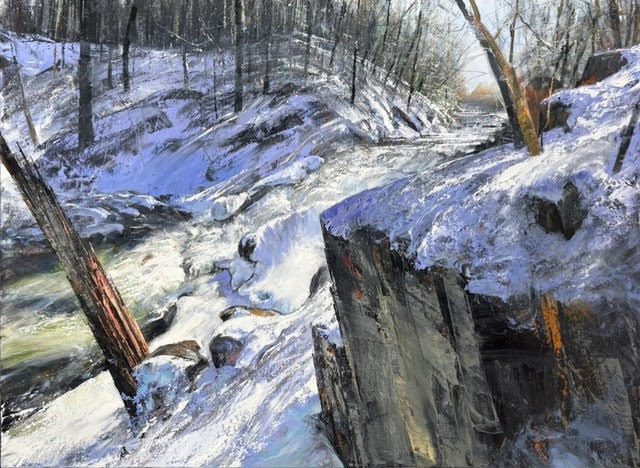
Edges as Encounters: Harris’s nature paintings, like Falls at Black Creek, are characterized by a strong sense of movement.
Harris is quite literally at home on the edge—living as he does on the shore of Pawleys Island, South Carolina, and before that on the bank of the Hudson River in New York’s Hudson Valley, both of which are the subject of many of his paintings.
Influenced strongly by the writings of eighteenth- and nineteenth-century naturalist John Burroughs, who lived and worked in a house near Harris’s in the Hudson Valley, Harris finds solace and sublimity in nature—something he tries to convey with his brush.
“The paint on my work is really heavy and thick,” he says. “I’m trying to create the spirit and energy of a landscape in my paintings. And I have people tell me all the time: ‘I feel like I’m here, I can hear this, I feel like I’m in this space’—and that’s a big compliment for me.”
The Ann Arbor Art Fair runs July 16–18.
Thurs., July 16: 10 a.m.–9 p.m.
Fri., July 17: 10 a.m.–9 p.m.
Sat., July 18: 10 a.m.–8 p.m.
annarborartfair.com