
Sheila Graziano
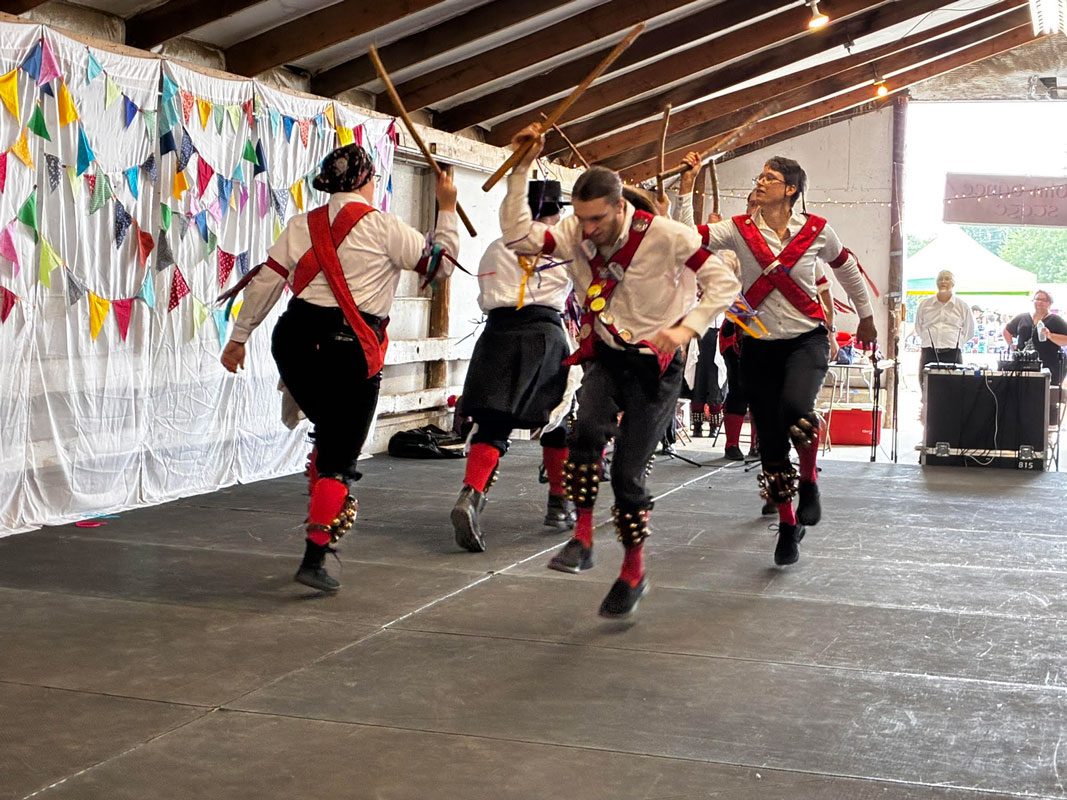
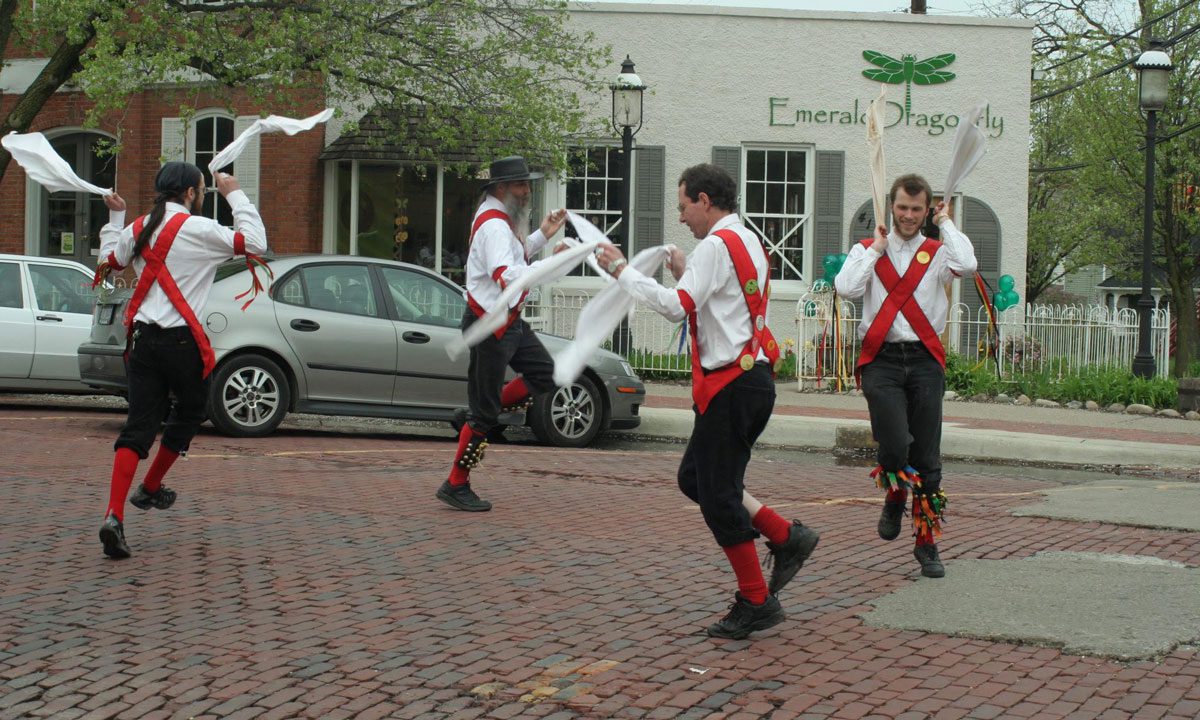
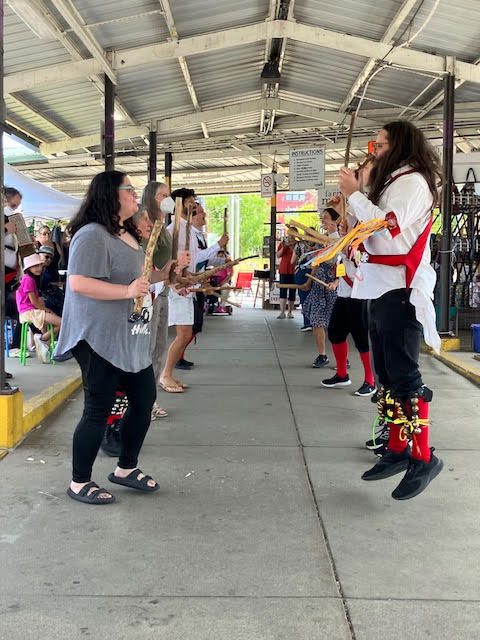
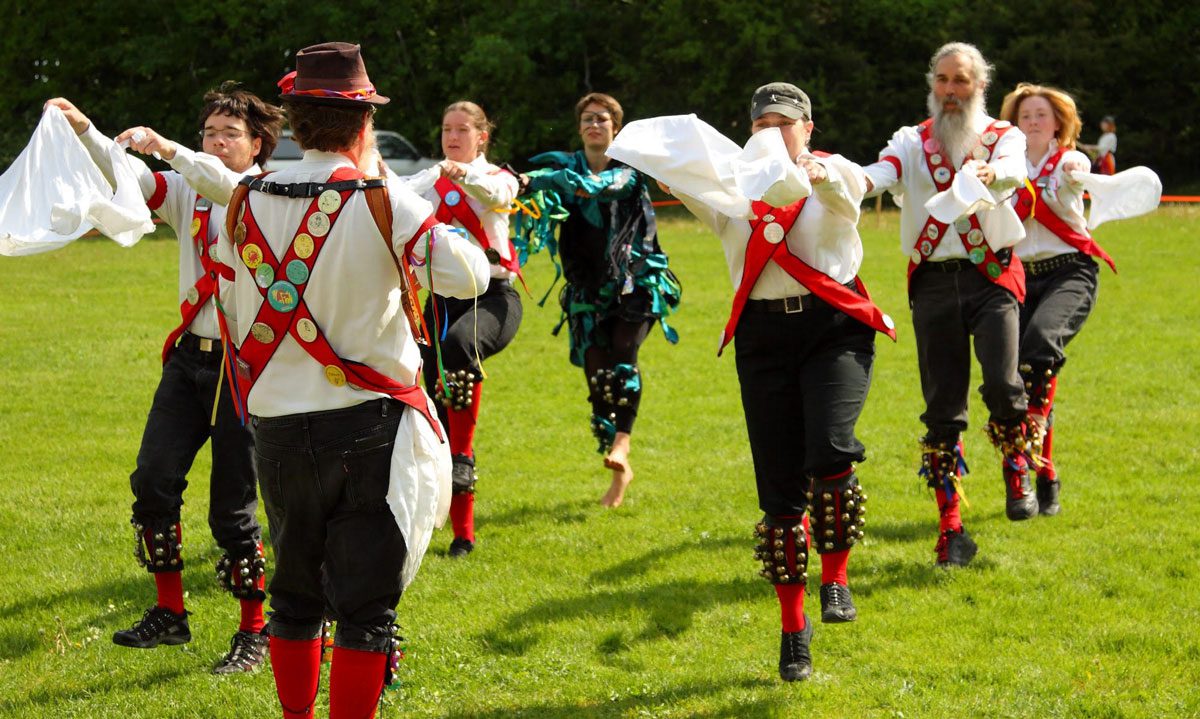
Maybe you’ve seen us practicing around Kerrytown or County Farm Park or Concourse Hall. “What are they doing with those sticks?” you might wonder. (Well, we’re mostly hitting each other’s sticks, or the ground, or slinging them around.) “Why are they waving handkerchiefs?” you might ask. (Sometimes we make them snap for a menacing hanky battle, sometimes we make them float to lull us into a sense of serenity.) “Why do they have bells tied to their shins?” (To be loudly and musically percussive—not to mention wake up the soil in the spring and scare away the evil spirits.)
We are Ann Arbor Morris. Morris dance is an ancient British folk tradition done for the purpose of performance and entertainment; in fact, what makes Morris different from most folk dances is that it’s done for display, not as a social activity. (And does your hobby have mentions in Shakespeare and older origins possibly related to pre-Christian horse cults? This one does!)
The 1960s and 1970s saw an international revival of many folk traditions. In 1976, a local group was constituted and instructed in the art of Morris dancing to perform at the Ann Arbor Medieval Festival. After the festival, they decided to continue dancing as Ann Arbor Morris and Sword. In the decades since its founding, Ann Arbor Morris—the “and Sword” was dropped at some point (although there is a rapper sword group now meeting some Monday nights, and they are amazing! I wish I had more time!)—has learned dances and styling from many teachers and other teams.
Bruce Sagan, who joined Ann Arbor Morris in 1980 as a postdoc at U-M, “immediately became good friends” with the other dancers. After a trip overseas, he writes, when he returned to DTW, “I found people from AAM at the gate in full Morris regalia. (Luckily this was before strict security restrictions at airports were in place.) And they danced as I got off the plane to welcome me home. I couldn’t have asked for a nicer homecoming.”
Courtesy of Ann Arbor Morris
I finally joined Ann Arbor Morris in 2025 after being thrilled to witness their performances around town for years. My group back home in Urbana-Champaign, Illinois, only did a few dances a year, and the squire—the position one dancer—had to call prompts in a pretty detailed way. Here in Ann Arbor, we dance all year, and the repertoire is extensive. We teach members to dance in any position and call it from memory! And the Morris dancers here don’t restrict themselves to the traditions and dances recorded in history: many have choreographed their own, following one or more Morris traditions—truly the folk process in action.
“The dancing itself is the biggest draw for me,” says Sam Nola, who’s been dancing Morris since she was a preteen. “[It’s] active and collaborative, somewhat like team sports.” Nola says the secondary draw is “the sense of continuing a tradition … teaching and learning long-established dances shared with people around the world, and also creating our own additions to be performed and shared.”
Sheila Graziano
This year is Ann Arbor Morris’s fiftieth anniversary, and we’re celebrating by dancing at various places our group has frequented over the years. (We are, however, skipping the many and diverse basements that have also sheltered the Ann Arbor Morris Dancers over the past half-century!) Come out and see us (or better yet, join us: We practice from 6–8 p.m. most Sundays and we’re always looking for new members).
On September 27, we’ll start at the Sunday Artisan Market at 1 p.m., and we’ll be at the corner of Main and Liberty at 2. Other likely spots include the lawn between Rackham and North Quad (where we practiced for many summers) and the Diag or Nickels Arcade or the Law Quad. We don’t have a precise schedule, but we plan to post real-time updates on our Facebook page on the day. Or just look for the people swinging sticks around, battling with hankies, and keeping the evil spirits at bay.
Related: A Chorus of One (Sept. 2020)
Courtesy of Ann Arbor Morris
Great article, even if I am not unbiased!