
An Ann Arbor resident was detained by ICE agents outside his home. He had traveled from Central America through a humanitarian program and had a pending application for asylum. He was afraid to go back, he said, because a family member had been murdered.
An Ypsilanti resident was detained at an asylum appointment with U.S. Customs and Immigration Services. He, too, feared violence if he returned to Central America.
Another Washtenaw County resident with a pending asylum application was detained after dropping his children off at school—one of them is a U.S. citizen with special needs. Back in Central America, a gang had tried to kill him.
President Trump and members of his administration, such as Department of Homeland Security (DHS) secretary Kristi Noem, have likened immigrants to an invading army. In response, they have increased Immigration and Customs Enforcement (ICE) funding and manpower.
“You see vehicles that look suspicious with dark windows and [when] you look inside you see [people] in bullet-proof vests and you know, it’s them: its ICE,” says a community advocate who wishes to remain anonymous. “It’s happening in our lovely county. It’s here.”
The Detroit ICE Field Office did not respond to repeated requests for comment, but local immigrant advocates say the restaurant industry has long been a target. In 2017, agents detained three Sava’s employees; months later, a Cafe Zola owner turned ICE away from the restaurant. Under the current administration, ICE was spotted patrolling Kerrytown as early as last January. An undocumented maintenance worker from Honduras who had worked in Kerrytown for over twenty years was detained in October.
While specific numbers of migrant workers in Ann Arbor’s restaurant industry are unavailable, national information speaks to their prevalence: in 2024, over 1 million undocumented migrants worked in restaurants. Legal immigrants made up 21 percent of restaurant employees—important to note because ICE has detained documented immigrants as well.
Related: ICE in A2
The nonprofit Michigan Immigrant Rights Center (MIRC) provides free legal services for low-income immigrants across the state. Manager of Policy & Communication Christine Sauvé estimates the need for services has quadrupled from normal levels.
Most undocumented immigrants, she explains, have no way to amend their immigration status. But for those who came to this country through lawful means—such as asylum seekers and those admitted on humanitarian parole—MIRC has historically been able to help them apply for other pathways to ensure they maintain their legal status. This is not always the case under the Trump administration.
“They just changed the rules mid-course for those people,” says Sauvé. “So even though those individuals came on a lawful program, with work authorization and applications pending, the administration said, ‘That is no longer possible. … We have now deemed anyone who came on parole to no longer be considered as having a lawful status in the country.’”
Related: Green Card Hell
One of MIRC’s Washtenaw County clients is a seventeen-year-old girl who was stopped by ICE agents. She tried to explain that she had been approved for a protection called Special Immigrant Juvenile Status and was waiting until she was eligible to file a green card.
“Officers did not believe her and were attempting to take her to a detention center, which is actually against federal law,” says Sauvé. Because of quick intervention from MIRC lawyers, who brought copies of her documentation, she was released.
Not all of MIRC’s clients are that lucky. And if an individual is detained, they’re likely to be transported to the North Lake Processing Center in Baldwin.
Operated by security company the GEO Group, North Lake is one of the largest ICE detention centers in America, with 1,800 beds.
In a December 5 letter sent to Kevin Raycroft, acting director of the Detroit ICE Field Office, state legislators urged the agency to improve conditions at North Lake, including overcrowding, lack of sanitation, limited access to potable water, and denial of medical care. Among the signatories were Carrie Rheingans, who represents Ann Arbor’s District 47, and city councilmember Ayesha Ghazi Edwin.
Ten days later, Chicago resident and Bulgarian native Nenko Gantchev died in North Lake.

Attorney and U-M professor Michael Steinberg and JD student Nithya Arun provide counsel to detainees at North Lake Processing Center. Despite Trump administration rhetoric that North Lake houses “the worst of the worst,” none of Steinberg and Arun’s clients have criminal records. | Mark Bialek
Michael Steinberg, an attorney and professor at U-M, provides counsel to North Lake detainees along with several of his students, including Nithya Arun, who is in the final semester of her three-year JD program. Steinberg and Arun state that after driving three hours to meet with their clients, they were denied entrance due to a “ghost policy”—a policy that Arun says has no record anywhere. They were later able to meet with their clients over Zoom.
“We’ve had people tell us that they feel like they were treated as animals when they were in detention,” says Sauvé. “Sometimes that’s physical, and sometimes that’s also through verbal abuse that they’ve endured either from agents that immigration agents themselves, or from other folks in detention, and it’s not policed or kept in check by detention officers.”
Beyond the conditions of the facility itself, advocates for detainees are alarmed that they’re being held long-term at all.
“The Trump Administration has reversed thirty years of practice and has refused to grant bond to anybody detained, no matter whether they have a criminal history, strong ties to the community, or even have evidence of the crime they’ve been detained for,” Steinberg says. “Under the Immigration and Nationality Act, [ICE] can’t refuse to grant [detainees] bond hearings.”
But that’s exactly what has been happening.
After Rashida Tlaib, who represents Michigan’s 12th congressional district, said she’d push back against ICE to “get them off [the] streets and keep families together,” the agency published a press release with nine examples of the “worst of the worst” detained at North Lake.
But the numbers paint a decidedly different picture. According to data from ICE, of the average daily population of 1,329 detainees at North Lake between October 1 and January 8, 90 percent had no criminal record. Among female detainees, that number was 94 percent—just seven of the average daily population of 113 detainees.
Like most of the people at North Lake, none of Steinberg and Arun’s clients have a criminal record. Nevertheless, one of them has been held there for three months.
“[He] has a one-year-old daughter at home,” Arun says. “He’s missing all of those milestones that parents have with their kids and that’s just got to be so heartbreaking.” Many of the people detained are the breadwinners for their families, she adds. “When we talk about immigration enforcement, it’s not just [about] the person who is subjected to detention, it’s their family, their community. [Detention] has really strong ramifications.”
On January 9, Ann Arbor Indivisible held a vigil at Liberty Plaza to mourn the fatal shooting two days earlier of American citizen Renee Nicole Good by an ICE agent; it drew around 380 attendees. The next morning, the group organized a rally and march called Ice Out for Good. Steering committee member Gus Teschke says around 400 people gathered at State and North U and marched to Liberty Plaza.
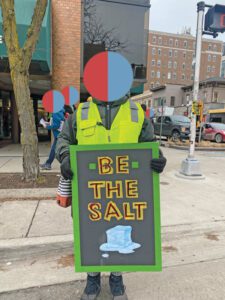
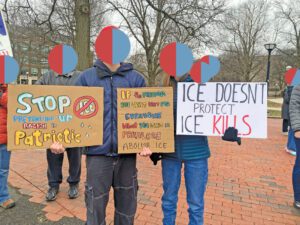
“I’m here today because we have to get rid of this administration and to make sure that everyone knows what this administration is doing to the country,” attendee Thomas Gebhardt told the Observer. “Not just the poor people, but everyone.”
At Liberty Plaza, there were readings by local poets and a speech about Good. “Yousef Rabhi, county commissioner, blew the roof off the sky after that,” says Teschke with a smile.
Speaking into a megaphone, Rabhi introduced himself, bent over to retrieve an ice scraper, thrust it toward the sky, and bellowed, “Fuck ICE!
“We are working at a resolution on the county level to make it so that ICE is banned from our facilities,” he continued, impassioned. “Banned from our buildings, banned from our properties, banned from our resources, and ultimately we need to ban them from our community.”
Three days later, Trump visited the Detroit Economic Club.
“Starting February 1, we’re not making any payments to sanctuary cities or states having sanctuary cities because they do everything possible to protect criminals at the expense of American citizens,” he asserted during the January 13 speech. As the Observer went to press, he had offered no further explanation.
Neither Ann Arbor nor Washtenaw County are designated by the Department of Justice as sanctuary jurisdictions; in fact, East Lansing is Michigan’s only sanctuary city. But local leaders have spoken out against ICE.
Mayor Christopher Taylor posted a video of the Ice Out for Good rally on Facebook. “Ann Arbor will not submit,” he wrote. “We will never cooperate with ICE, never authorize them to use City resources to support their lawless agenda of hate.”
Related: Not Quite a Sanctuary
Prosecutor Eli Savit has been outspoken about immigration issues since 2021, when he and over 100 other criminal justice professionals signed a letter to the DHS asking for an end to programs using local police to conduct federal immigration enforcement. And Sheriff Alyshia Dyer is a member of the Law Enforcement Immigration Task Force. “We safeguard everyone in our community,” she said in a Q&A with the organization, “and we are not mandated to enforce federal immigration law.”
Related: Target: Immigrants
In a quieter form of resistance, community members across Ann Arbor are tracking ICE to alert at-risk populations of their whereabouts on social media and over secure group messages.
“One thing that comes to mind is the mental health of the children with parents who are undocumented,” says an anonymous advocate. “They’re afraid to go to school. One day they might come home and their parents aren’t home …
“Talk about mental health. A lot of these kids are U.S.-born children; we are traumatizing our future adults, our future Americans, for life.”