
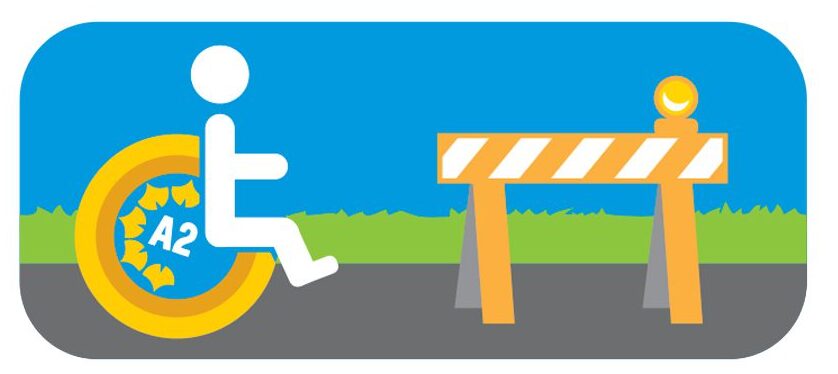
Illustration by Tabi Walters
“When you say you are making a walkable downtown, you instantly exclude me,” says Carol Shulman, an Ann Arbor resident of more than sixty years with severe mobility issues.
She’s talking about A2 Summer Streets, an initiative from the Main Street Area Association (MSAA) now entering its fifth year. From June 4 to September 28, the city closes downtown sections of Main, Washington, and Liberty to vehicles, turning them into pedestrian walkways from 4 p.m. Thursday through Sunday night.
“Usually, whoever I’m going out with drops me off and then goes to park. You can’t do that if downtown is closed,” says Shulman. “There are one or two handicap spaces [per block], and if those are gone, you are out of luck.”
She’s not alone. According to Health for All Washtenaw, 3 percent of Ann Arbor residents have ambulatory difficulties.
Ed Shaffran, who owns several downtown properties, says A2 Summer Streets was the reason he stepped down as an MSAA board member five years ago.
“You have essentially penalized people with disabilities,” he says. “They can no longer be dropped off in front of that restaurant because they have to go somewhere else.
No part of the city’s application for street-closing events mentions ADA compliance; instead, says Ann Arbor communications director Steve Kilar, compliance is managed through internal review. “For every permitted special event, plans are reviewed in advance by city staff before going to the city council,” he emails. “Organizers must maintain accessible routes, including pathways and curb ramps, and event staff should be available on-site to address accessibility needs if they arise.”
And according to Ashley Shafer, MSAA’s executive director, that’s exactly what A2 Summer Streets does.
“When streets close, existing curb ramps and accessible crossings remain in place, ensuring individuals can enter and navigate the event area at each intersection without needing to travel more than a block,” she emails the Observer. “All closures follow City of Ann Arbor guidelines, maintaining ADA-compliant access points throughout the event footprint. Pedestrian pathways remain clear and navigable to support accessibility for all attendees.”
But for Shulman, who says that “on a bad day even twenty feet can be a problem,” it’s still not enough. In the summer, she no longer attempts to go downtown.
“How ironic that the restaurant has to be ADA compliant, but I can’t get to the restaurant,” she says.
Calls & Letters, July 2026: Accessibility Is a Two-Way Street
I wanted to respond to the “Walkable, but Inaccessible” Up Front piece. While I feel for the folks interviewed here, I disagree that the program is negative for everyone with disabilities. I love the Ann Arbor closed streets program—I think it brings a vibrancy to the community that we otherwise lack. But the reason it’s especially important for our family is that we have an autistic kiddo who has a very hard time sitting still. Summer and Fall streets allow us to go out to eat with him because he can safely run around, make noise, and stim without getting in anyone’s way while the rest of our family waits for food. Unlike Shulman, we can’t enjoy downtown restaurants as a family unless the streets are closed. I hope next time you’ll consider both perspectives.
Evelyn Hollenshead