
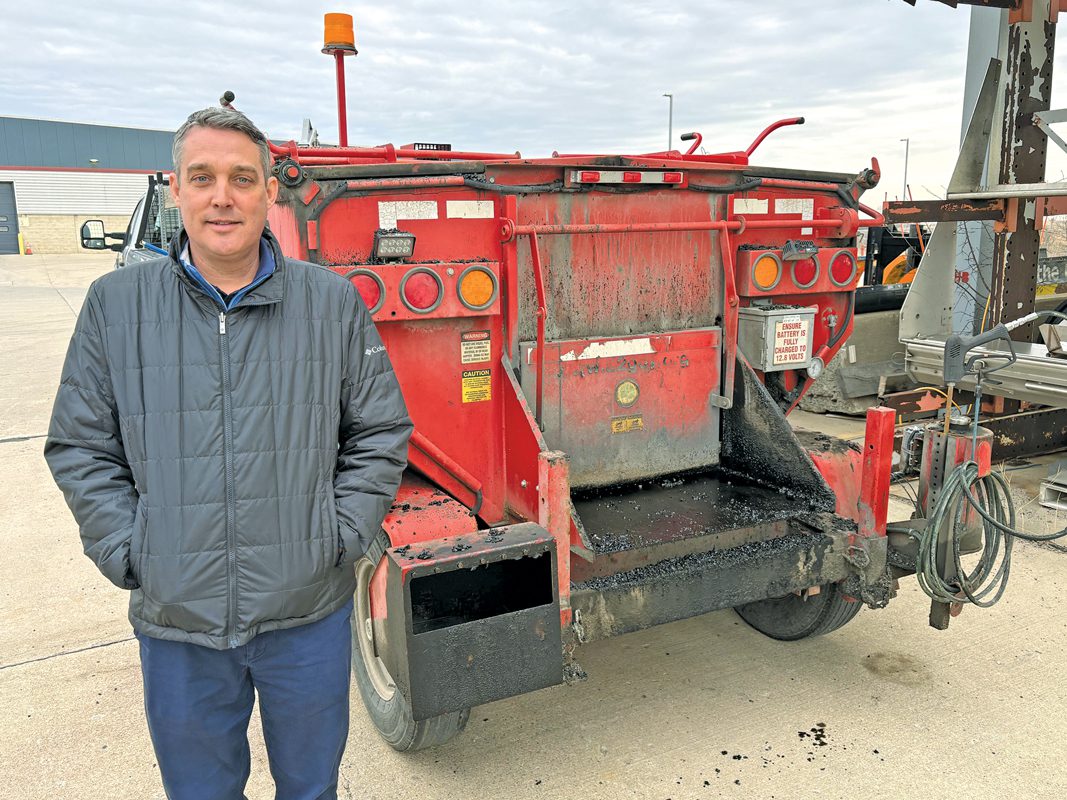
Paul Matthews, public works manager, with a towable hot-asphalt patch unit. The Michigan Department of Transportation says patching potholes is like putting a bandage on a gaping wound: “It doesn’t repair the damage.” | Ben Klayman
Katie Vloet feels a combination of hope and resignation when she looks at pothole-scarred Berkley Ave., where she lives: hope that one day her street will be lucky enough to be picked for repaving by budget-constrained city officials, and resignation about driving on asphalt that seems more like a rocky lunar landscape.
“You kind of have to slalom to get down the road,” Vloet says. “Pretty often, you’re driving on the wrong side of the road just to be able to make it down without destroying your suspension.
“I feel like we will probably always live on a street that’s sort of a cheese grater because it’s two blocks long,” she adds. “It’s never going to be as big a priority as most other streets.”
Those tire-swallowing holes are created during the weather’s freeze and thaw cycle where subfreezing temperatures are quickly followed by fifty-degree days. Moisture like snow and ice melt seeps into the pavement, freezes and expands, and then thaws to create gaps.
“This year, we had a lot of frost in the ground,” says Ann Arbor Public Works Manager Paul Matthews from his offices on Stone School Rd. “We had an extremely cold winter and that damages our roads.”
The average weight of a new U.S. vehicle in the 1981 model year was about 3,200 pounds, according to the Environmental Protection Agency. That rose to 4,111 pounds in 2004 as pickups and SUVs grew in popularity, and increased another 6 percent above that weight in the 2024 model year. When these increasingly heavier vehicles drive over weakened points in the roads, it leads to potholes.
Michigan Governor Gretchen Whitmer in her 2025 State of the State address talked of her desire to fix “those damn roads,” calling safe streets necessary for economic growth. She said roads that will “rattle your brains out” are all over the state and cost drivers more than $750 a year. Ann Arbor Public Services spokesman Robert Kellar adds that it is also a safety issue, as drivers swerving to avoid potholes can hit other vehicles or people.
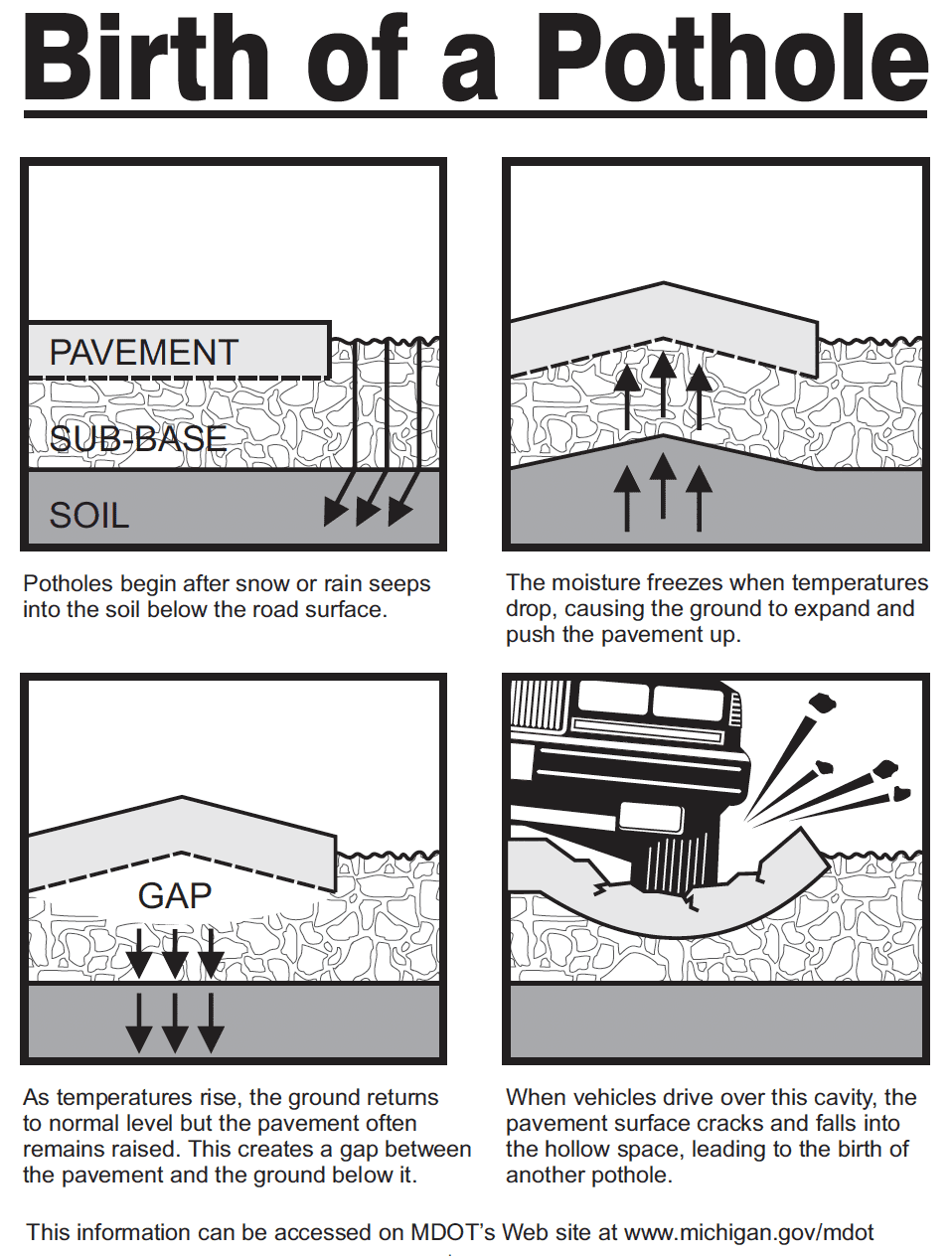
Courtesy of MDOT
The best fix for potholes is repaving the roads, but that can be costly, and not every road can be addressed. In March, Ann Arbor City Council set aside about $21.6 million for road, utility, and mobility projects this year, including $1.3 million for street maintenance like hot asphalt patching. In FY 2026, the city budgeted $18.5 million for right-of-way maintenance that includes snow removal and street sweeping. Potholes are a sliver of that spending, totaling just under $380,000 so far this fiscal year.
Flashback: Potholes and Potshots (Aug. 2018)
As a short-term fix, city officials, like municipalities all over the state, use cold and hot asphalt patches. The cold ones are a ready-to-use, cost-effective approach employed during the winter when asphalt plants are closed, while hot patch is a premium repair method using heated asphalt to provide greater adhesion and durability. Think of the hot patch “like a really thick Frosty that’s lumpy,” Kellar says, referring to a Wendy’s frozen dessert.
Everyone involved stresses that patching potholes is a temporary fix and better road funding is the ultimate answer.
“Patching potholes is similar to putting a bandage on a gaping wound—it slows the bleeding, but doesn’t repair the damage,” the Michigan Department of Transportation says on its website.
For Matt Kerrigan, who lives in Ann Arbor’s Old West Side on Second St. in front of a series of potholes—including one so large his neighbor has joked about planting flowers in it to make a point—he would prefer the city doesn’t spend money on temporary fixes.
“It’s a pure waste,” says Kerrigan, who works in finance. “I would say, just don’t do it. Every time I see [the city patching], I text the neighbor across the street, ‘They’re wasting money again.’ It would be different if that bought us until winter.”
The Michigan Infrastructure & Transportation Association (MITA), a construction industry trade group pushing for greater infrastructure spending, called out the problem on April 1 with the launch of its second annual Pothole Payback contest, which pays five motorists each month through June up to $800 for vehicle repairs caused by road damage.
“The Pothole Payback contest will remind our lawmakers that the depth of our road maintenance problems and the pain drivers face haven’t gone away,” MITA executive vice president Rob Coppersmith said in a statement.
In 2014, Ann Arbor officials started the A2 Fix It program, where residents can request pothole patches and other fixes online or through an app. Matthews said the city has a goal of filling a pothole within seventy-two hours of notification.
The demand is certainly there. In 2024–2025, 42.7 percent of the City of Ann Arbor’s 665 lane miles were in poor condition, according to the most recent data from the Southeast Michigan Council of Governments. Another 37.7 percent were fair; only 19.6 percent were good. A decade before that, those respective figures were 63.1 percent, 20.8 percent, and 16.1 percent for 234 lane miles.
“We know we still have work to do,” Ann Arbor City Councilmember Travis Radina writes in an email.
The tough winter is reflected in the higher demand to patch potholes. In the first three months of this year, some of the city’s seventy-nine public works employees have filled in 934 potholes. That three-month total far outstrips the 785, 769, and 715 addressed in the three full fiscal years before that. In the current fiscal year that started last July, the total stood at 1,200 potholes at the end of March.
In addition to the A2 Fix it program, Matthews says public works employees drive through the entire city several times during the winter looking for problems, and other departments will alert them if any are spotted. “We would never not patch a pothole,” he adds.
Vloet says her soon-to-be sixteen-year-old daughter, who is earning her license, doesn’t much care for driving on their street, but at least she will be prepared for Michigan roads. One other “faint bright spot” is the speed-bump nature of the potholes.
“People tend to drive down our street really fast when they’re trying to get around traffic on Main, and they can’t right now because they will leave part of their undercarriage behind if they tried to do that,” she says, laughing.
Calls & Letters, June 2026
Our Mileage May Vary
In the article about potholes in the May issue, it mentioned that in 2024–25 the City had 665 lane-miles of road, while a decade earlier the City had 234 lane-miles. It doesn’t feel like the roads have tripled in ten years, so I am curious about the difference. Has the City been annexing roads?
Valerie Mates
It has not, and we should have noticed that discrepancy, which has to do with what data is reported to SEMCOG. Ann Arbor is required to share road condition data on what are known as federal aid roads with SEMCOG. It’s optional for communities to share road condition data on non-federal aid roads. Ann Arbor reported only federal aid road data in 2014–15. The 2024–25 numbers in our article included data for both federal and non-federal aid roads, which is why the number of miles of road increased. In 2024–25, Ann Arbor reported on 239 miles of federal aid road. In case you’re curious, 18.7 percent of them were in good condition, 43.3 percent were fair, and 38 percent were poor.
Please give this Klayman kid another assignment. It appears this kid may have some potential.
Agreed! Klayman took a mundane (though relevant) subject and made it entertaining and educational. Would be interested to read more from the new kid.