
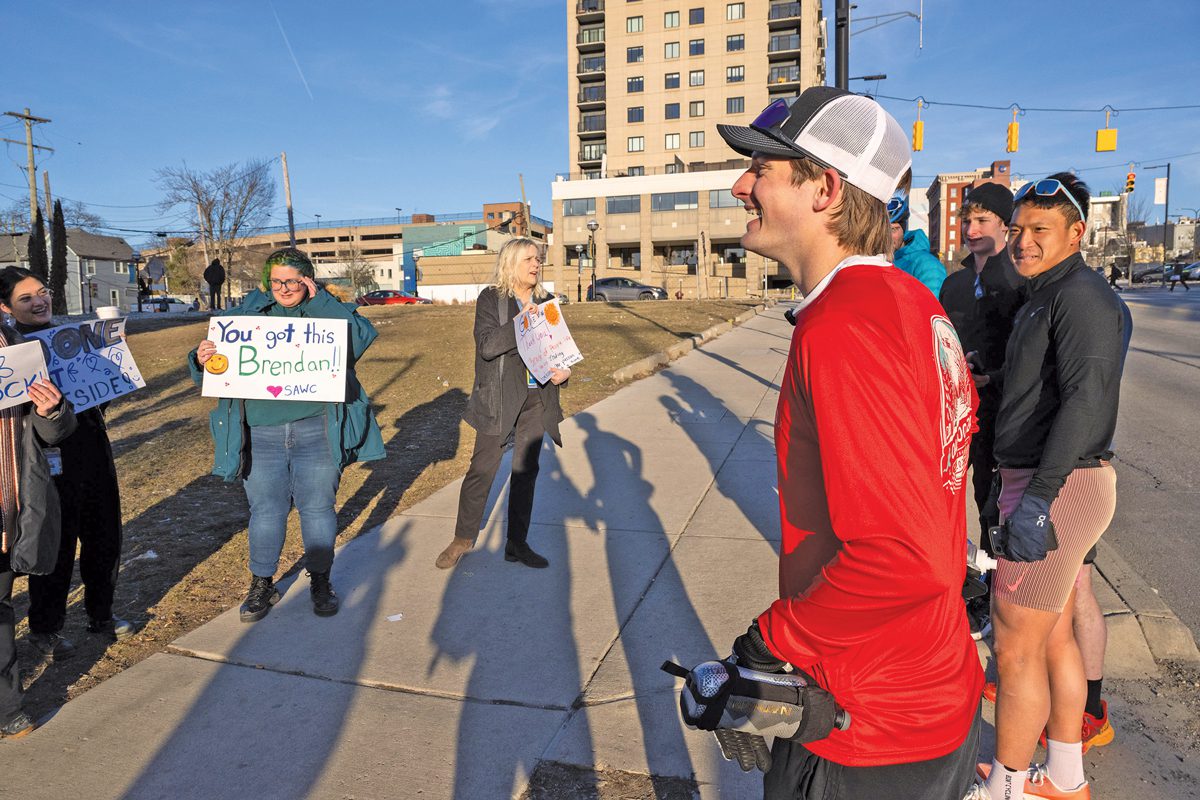
Brendan LaFrenier greets supporters outside the Delonis Center fifty-five miles into his 213.6-mile run across Michigan. | Mark Bialek
Some people went to college, met the person of their dreams, and settled down. Others occupied themselves with studying, networking, and building their careers. Yet others (ahem) enjoyed keg stands and parties, and never signed up for a class that started before 10:30 a.m.
Then you have people like Brendan LaFrenier. Originally from Grand Rapids, he’s a twenty-one-year-old U-M senior majoring in chemistry with plans to attend SUNY’s Optometry School—oh, and for fun, he runs hundreds of miles in ultramarathons. Recently, he put those miles to good use with Endurance for Change, a project combining long-distance running, filmmaking, and community service with a goal of raising $100,000 for ten Michigan homeless shelters.
From March 3 to March 6, LaFrenier ran 213.6 miles across Michigan, averaging fourteen hours and fifty miles per day, with a total run time of ninety-nine hours and fifty-three minutes. An RV with a film crew, made up mostly of U-M students and staff as well as some friends from Grand Rapids, followed him along the way for an upcoming documentary.
LaFrenier and his team visited each of the ten partner shelters on his run. In Detroit, they volunteered at Pope Francis Center and ran a community mile at Covenant House with their residents and staff; in Grand Rapids, they refueled at the Dégagé Ministries bakery, where residents bake cupcakes and cookies for sale; and at the Delonis Center, they stopped for photos while staff waved signs and cheered.
Flashback: Ann Arbor on the Run (Oct. 2011)
LaFrenier started running during his sophomore year of high school, which coincided with the Covid lockdown. He soon realized that he had a talent for long-distance endurance racing. Marathons turned into Ironmans (a triathlon race consisting of a 2.4-mile swim, 112-mile bike ride, and 26.22-mile run) turned into four ultramarathons (defined as any race longer than the customary 26.22 miles).
Along the way, he met someone from the U-M Triathlon Club who had biked across the state. At the time of that conversation, LaFrenier had already finished an ultramarathon and a full Ironman and wanted to push himself further.
“I wondered if I could run across the state,” he says. “I plotted out the route and thought, ‘I can do this.’”
That planted the seed that grew into Endurance for Change.
This endeavor was not LaFrenier’s first marriage of community service and marathons. In December of 2024, he ran 100 miles as part of an addiction recovery race in Raleigh, North Carolina, raising $2,500 for Healing Transitions, a nonprofit focused on addiction recovery.
“When you are running, you sometimes want to give up,” he acknowledges. “That’s why you need to be running for something bigger than yourself.”
Volunteering at a homeless shelter in Grand Rapids sparked LaFrenier’s desire to give back to that population. “That was the first time that homelessness really touched my heart. I saw someone struggling with homelessness, and I realized that not everyone was as blessed as I am.”
As the project gelled in LaFrenier’s mind, he pitched the project to his friend Nick DelFranco, a U-M senior majoring in film and philosophy. In August, the two friends founded Endurance for Change and began preparations: assembling a support team and a film crew, reaching out to Michigan shelters, and for LaFrenier, countless hours of training.
Soon, all that was left was the run.
The ultimate goal of the film, LaFrenier says, is to capture both the run and the human stories behind homelessness, while also challenging some of the common misconceptions.
“We went to all ten partner shelters and interviewed clients, staff, and volunteers to really understand the issue of homelessness,” he says. “Just like you can’t run 200 miles alone, you can’t battle homelessness alone. You need a community of support.”
LaFrenier continues: “Most people will see a panhandler asking for money at freeway exits or downtown; that is part of it, but not the complete representation of homelessness. We’ve gone to almost a dozen shelters. We’ve interviewed people struggling with it, the staff, the volunteers. People often think that the homeless are lazy and that couldn’t be further from the truth. They work. They go to school. It’s not a laziness crisis—it’s an affordable housing crisis. …
“We are all one or two unfortunate events from being homeless. I spoke to one gentleman who had a hip replacement two years prior. He lost his job, and then the medical bills just put him under. … People group everyone into the same realm, stigmatizing the issue, and our project is trying to shine light on the fact that homelessness looks different” than many people may think.
The film team began postproduction work shortly after the conclusion of the run. Stephen Elsinger, a junior at the School of Music, Theatre, & Dance, is composing custom music. “We have many hands helping out, and we expect the film to be released this fall,” says LaFrenier. From there, it will be entered into film festivals and eventually be on YouTube.
As the Observer went to press, Endurance for Change had raised $33,259 of its goal. People can continue to donate on its website until April 1; after that, LaFrenier encourages donating to Michigan-based shelters.
Another way to help? “Thinking about how you see homelessness and people struggling with it,” he says. “That’s the biggest thing you can do—change your mindset. We hope this run will help people do that.”
And about the aforementioned keg stands: when I opine that it seems that this generation is much more civic-minded than perhaps some others, LaFrenier agrees.
“I have a lot of confidence in my generation to move the needle to transform lives and make a difference,” he says. “There were so many people who jumped to help with this project. The people at U-M have such big hearts and care about such good causes. I feel honored to be a Wolverine.”