
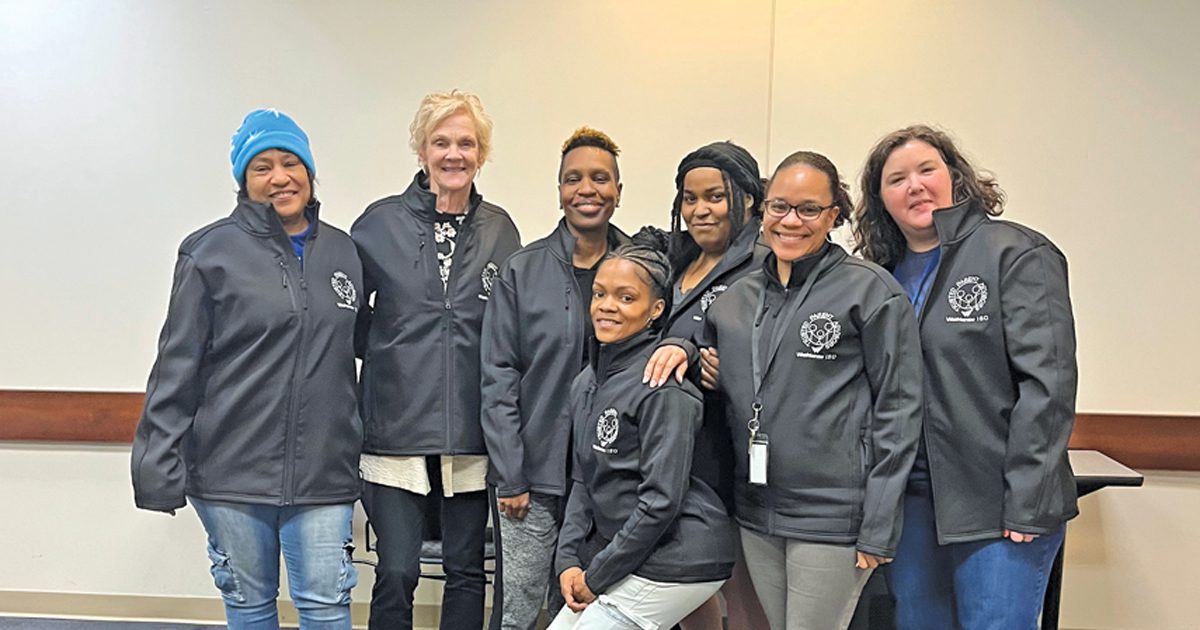
Washtenaw County Success by 6 staff and Trusted Parent Advisors (left to right): Kelly Goolsby, Margy Long, Icshia Leatherwood, Sentra Brownlee, Tasha Palmer, Michelle Myers, and Colleen Klus. State funding cuts have imperiled the organization and forced others across Michigan to close. | Courtesy of Success by 6
“What the collaboratives do is indispensable,” says Naomi Norman, superintendent of the Washtenaw Intermediate School District (WISD).
But it would seem that lawmakers disagree. Last year’s state budget cut all funding for early childhood support programs known as Great Start Collaboratives (GSCs). Representatives from intermediate school districts (ISDs), the agencies that run GSCs, described being “blindsided” and caught “off guard” by the cuts. Since then, WISD staff have been working with other ISDs across the state to raise awareness among legislators about the role of GSCs and push for funding to be restored.
“When we heard that the funding had been cut, our first priority was to figure out how to ensure the continued support of the services they provide,” says Norman.
WISD’s Collaborative, called Success by 6, unites families and specialists across healthcare, early education, childcare, and social services. It works to coordinate and enhance programs focused on early childhood health and education, with the goal of setting up every child for a strong start when they enter kindergarten. To that end, staff at Success by 6 partner with individuals called Trusted Parent Advisors, who “serve as a bridge both to families and to organizations and schools,” says community engagement specialist Colleen Klus.
Related: Mom Power! (Sponsored Content, May 2023)
Margy Long, director of Success by 6, says the elimination of the Early Childhood Block Grant—worth $19.4 million—from the budget affects several programs, not just GSC work: “The cuts also impact our literacy program, through which we purchase and distribute books for children age zero through five, working alongside on-the-ground, grassroots organizations as well as Michigan Medicine pediatric offices. Our two home visiting programs are caught up [in the cuts] too, one of which we run with a nonprofit in Washtenaw County called SOS Community Services.
“We were lucky,” adds Long. “We have other local grants that we can continue to draw on, as well as some carryover funds from the state that can see us through until the end of our fiscal year,” the last day of June.
Not all of Michigan’s GSCs were so lucky, however. In October, Scott Koziol, superintendent of Charlevoix-Emmet ISD, told the Detroit Free Press that the Cheboygan-Otsego-Presque Isle counties GSC would be closing within a couple of months. In November, the Allegan County GSC wrote on its website that, “as we wrap up our final week of service, our Allegan County Great Start Collaborative team wants to extend a heartfelt THANK YOU to all of our incredible partners and families.” On January 15, the Kent County GSC published a letter on its website stating that, after twenty years of providing services, “due to the loss of state funding, we will be unable to continue serving our community beyond January 30, 2026.”
Following the release of the budget, the ISDs came together to strategize. “We started working at the state level to try to understand why the cuts were made and ascertain what we could do to reprioritize funding,” says Norman. “I’ve personally been working with the Michigan Association of Intermediate School Administrators.”
The reasons for the cuts remain unclear. Long speculates that they were a casualty of eleventh-hour negotiations: “At midnight, the funding might have been included in the budget, but by 3 a.m., when they came out of the room, it was gone.”
Norman explains that “one of the challenges of doing really good collaborative work is translating it into the kind of measurable, quantifiable outcomes that legislators tend to look for. It can be especially tricky where every collaborative tailors its program differently in order to meet its particular community’s needs. I’ve taken the cuts as a challenge for us to be far clearer and more explicit about the impact of our work going forward.”
Governor Gretchen Whitmer’s Executive Budget Recommendation for the 2027 fiscal year—her last—restores funding for GSCs. As its name suggests, however, it is only a recommendation. In the coming months, the state legislature will negotiate a budget bill, which, once passed in both chambers, will go to the Governor’s Office to be signed into law.
While this process has in recent years tended to conclude in late June or early July, last year it took until October 7, after a Democrat-controlled Senate and Republican-majority House of Representatives were unable to reach agreement. Lawmakers had to pass a one-week stopgap budget to avoid a government shutdown at the start of the fiscal year, which begins on October 1.
In the meantime, amid the uncertainty resulting from the budget cuts, Norman says she is seeking to “reassure everyone in her district that we’re really committed to taking care of our youngest community members.”