
Ted Arnold had thirteen years left on his lease for Pinball Pete’s in the Galleria Mall, where he’d consolidated three Ann Arbor gaming arcades into its lower-level food court in 1996.
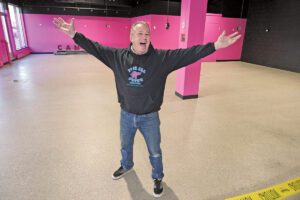
Ted Arnold knew the large, broad-windowed space at 500 E. Liberty was “perfect” for the next iteration of Pinball Pete’s. | Photo: J. Adrian Wylie
One day in 2023, “Michigan Daily walks down the stairs and says, ‘Hey, what do you think about the fact that they’re going to tear down your building?’” he recalls. “I had no idea. I was blindsided.”
Flashback: Marketplace Closings (Nov. 2025)
Sure enough, a lease clause allowed eviction in the event of redevelopment. Following its $18.35 million purchase, Landmark Properties is now laying the groundwork for The Metropolitan, a 950-bed student housing project.
The proposal’s well-attended public forum included one mom whose son struggled with math until it “clicked” with his need to manage his allotment of quarters at Pinball Pete’s.
“That support from the community was a game changer for me,” says Arnold, who just turned sixty-four. It wasn’t the first time; Pinball Pete’s, which includes a smaller arcade in East Lansing, survived the pandemic with the help of a successful $125,000 GoFundMe campaign.
Flashbacks: Pinball Rescue (Feb. 2021) & The Michigan Flippers Tournament (Aug. 2023)
Scot Greig, who manages the Carver-Gunn Building at E. Liberty and Thompson for owner John Carver (and also owns the nearby Necto nightclub and Bill’s Beer Garden), had an idea. Greig “cold-called me out of the blue,” says Arnold, and suggested what became Pinball Pete’s next home.
The 5,600-square-foot ground level had been vacant since Douglas J Salon moved to Kerrytown in 2021. Six decades of past tenants included women’s clothier Kay Baum, Harry’s Army Surplus, and Simulation Station, an arcade memorable for its Amaze ’N’ Blue Machine in which, as the Observer reported in 1981, “seat-belted passengers are made to feel, to a degree, that they are flying in space, shooting the rapids, descending a toboggan ride, riding a rollercoaster, and racing a sports car.”

Flashback: Down with the disreputable pinball parlor (Sept. 1981): see page 77
Touring the broad-windowed building, Arnold recalls, “I said, ‘This is perfect!’ It was meant to be. I was blown away.”
He’d hoped for a seamless transition before the December closure on South U, but the build-out had its fits and starts. The building needed bigger restrooms and an elevator. The basement, which was never a public space, was musty with the smell of Dawn Treader’s stored books. Depending on inspections, he expects to open early in March.
It sports a hotter shade of pink and bright signs galore, including the one that topped the former Campus Theatre, Galleria Mall’s predecessor. “I’m more passionate about signs than I am about pinball,” Arnold cheerfully concedes. He lives in a former Lansing firehouse so stocked with neon that even the prolific local signmaker Mark Chalou was impressed.
Chalou created Pinball Pete’s seventeen-foot vertical outdoor sign, flanked by a pair of pink elephants. He says it’s part of his “legacy project” to enhance decorative illumination along the entertainment corridor that includes the Necto and the Michigan and State theaters.
Flashback: Sign Wizard (Feb. 2015)
The elephant logo dates to the 1970s, when Arnold and two older brothers started with a single Gottlieb Mayfair pinball machine in their parents’ East Lansing garage. Its popularity among neighborhood kids led to a pop machine, candy, and more pinball, until authorities prompted them to find a legitimate venue.
They eventually rented an old donut shop that came with a rooftop fiberglass elephant. Painted pink and alliteratively dubbed Pete, the branding of a half-century business was born.
At its peak they had seven arcades and forty-two sites for pinball, video games, and pool tables in other businesses—bars, skating rinks, grocery stores.
Flashback: Cave of Wonder (Mar. 2018)
It’s been another type of virtual rollercoaster over the years—the 1980s boom of electronic games (think Pac-Man fever), the later introduction of fighting (e.g. Mortal Kombat) and driving games (Daytona USA is “hands down, the best driving game ever made,” Arnold says), and home consoles, leading to a contraction of the arcade industry.
Ted eventually bought out his brothers. Tim, the eldest, “wanted to go warm and dry to save his machines,” so he moved to Las Vegas and runs the Pinball Hall of Fame on the Strip. Another partner, Mike Reynolds, recently retired, so investing in a new twenty-year lease required “the business’s life savings, and my own,” Arnold says. “It was a battle,” but one that made him new friends in Greig, Carver, and Chalou.
The old-school experience is still mediated by quarters and tickets for prize redemption games such as Skee-Ball.
“There used to be a mom-and-pop arcade in almost every town, and now they’re all gone,” he says with a gravelly yet genial tone. “Arcades were always a place for kids to socialize, to get out of Mom and Dad’s hair. Before home video games, that’s where you went. It’s where you met a girl. We’ve had marriage proposals, we’ve had first dates. …
“For supporting us all these years and continuing to support us in the future, thank you, from my heart, for the chance. Not gonna let you down.”
Pinball Pete’s, 500 E. Liberty. (734) 213–2502. Daily 10 a.m.–TBA. pinballpetes.org
Got a retail or restaurant change? Email [email protected].