
“The U.S. has tapped into less than 5 percent of domestically produced organic waste for energy and fuel production,” says Aquora Biosystems CEO Tim Fairley-Wax. “Right now, a tremendous energy potential is lost to landfills and wastewater treatment plants. We want to change that.”
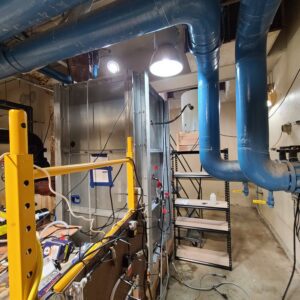
Aquora Biosystems’ technology converts food waste, manure, sewage sludge, and dairy and brewery byproducts into fuel. | Courtesy of Tim Fairley-Wax
To that end, the post–graduate student and two of his former professors in the U-M Environmental Biotechnology Lab have developed technology that converts food waste, manure, sewage sludge, and byproducts from dairies and breweries into three crucial energy sources: methane, diesel, and jet fuel. The cofounders estimate that when they get their system off the ground, their waste fermentation-to-fuel technology will be capable of providing one-quarter of all U.S. jet fuel demand by 2050.
Fairley-Wax earned his master’s of environmental engineering at U-M, working with professors Lut Raskin, a pioneer in the field of anaerobic waste fermentation, and Steve Skerlos, an engineering professor and entrepreneur. The three have teamed up to launch Aquora Biosystems.
“We’ve talked with dairy farmers, cheese producers, and food waste producers across the country,” Fairley-Wax says. “These businesses want to make money on their waste, but so far haven’t found viable cost-effective technology. That’s where we come in.”
An additional bonus from Aquora’s system is the nutrient-rich liquid fertilizer that results during organic waste fermentation. “This could help farmers in the region where Aquora biorefineries can be built, reducing crop cultivation costs and protecting farmers from supply-chain challenges.”
They’re offering a win-win scenario, where waste disposal can be dramatically reduced—or eliminated—and fuels can be sourced in nontraditional ways. Aquora’s technology requires half the footprint of existing facilities, says Fairley-Wax, “while boosting low-cost waste-to-fuel production by 20 percent or more.”
Aquora is still scaling its technology, hoping to provide system upgrades to existing wastewater plants and to power new biotech facilities. The team will begin its first pilot project in the next few months—they’re exploring a couple opportunities here in Michigan, as well as in the Northeast.
With Aquora still in the “pre-revenue stage,” Fairley-Wax has headed west, to a Chain Reaction Innovations Entrepreneurship at Argonne Laboratories in Colorado, funded by the U.S. Department of Energy.
Related: The Headlong Growth of LynxDx (Aug. 2021)
Meanwhile, U-M professors Stephen Forrest and Andrej Lenert have devised a technology that transforms excess heat from industrial processes into electricity. Their company, located on the west side, is called Heat2Power.
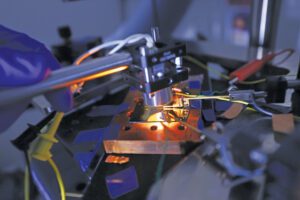
Heat2Power’s thermovoltaic cells are similar to solar cells—only instead of capturing sunlight, they capture heat and convert it into electrical energy. | Photo: Brenda Ahearn, Michigan Engineering
“For example, steel, when it cools after being cast, just wastes that excess heat by radiating into the air,” says Forrest, whose background is in engineering, computer science, and physics. “That excess heat on cooling could be converted to electricity using thermophotovoltaics such as we make at Heat2Power.”
Thermophotovoltaic cells work much the same way as solar cells—only instead of absorbing sunlight, they absorb heat and then convert it to electrical energy.
Heat2Power’s technology also has a storage component made up of stacks of insulated bricks. “When electricity is needed, the heat radiated from the bricks impinging on the cells is converted into electricity,” Forrest explains. This addresses the age-old issue with renewables: solar panels won’t heat your home at night, and wind can’t be accessed on a breezeless day.
“Renewables are the most cost-effective way of generating energy, but they are not always there,” notes Forrest. “Solar and wind, for example, generate too much electricity to all be used at the time of generation, for instance at midday or at windy conditions. This excess electricity can then be used to heat the bricks for use at times when the sun or wind is down. Waste heat can be used in the same way: heat up some liquid and run it through the bricks.”
Common approaches to store energy are problematic—such as lithium batteries, which Forrest explains, pollute the environment. “You have to mine lithium,” he notes. “Another way to create energy is to pump water uphill during the day … and spin turbines at night [to run generators], but in a lot of places where solar and wind are available, water is in short supply.”
That’s why they say the component H2P cell they make is essential. As data centers proliferate, for example, it will be necessary to produce enough electricity to run them. But the grids consumers rely on can also take advantage of this technology, which means Heat2Power may not only lower industrial costs—it could also eventually lower household electrical bills.
In addition to transforming waste into valuable resources, these two U-M spinouts share another commonality. Last year, Crain’s Detroit Business found that half of the start-ups that come out of U-M leave the state, but both Aquora and Heat2Power stayed headquartered in Ann Arbor.