
In 2019, Whitney Wilkes-Krier found her first monarch caterpillar on a stalk of milkweed in her yard.
She had been working on clearing her property and reintroducing native wildflowers to support pollinators like butterflies. She took a quick picture and sent it off to a friend, who’d been raising monarch butterflies for years. Her friend advised her to take the caterpillar indoors with some milkweed to keep it safe from predators like birds, spiders, and wasps.
Monarch caterpillars eat voraciously for about two weeks, and then assume a “J-hang” position where they shed their skin and form a mint-green chrysalis dotted with gold flecks. They remain in that state—metamorphosis—for ten to twelve days, at which point the chrysalis turns transparent, and the butterfly emerges.
“We released our first monarch, a beautiful male, and it sparked a joy in us that made us want to continue raising them,” Wilkes-Krier says.



Photos courtesy of Whitney Wilkes-Krier
By the summer of 2020, Wilkes-Krier and her family had grown their backyard into a safe haven for monarchs, and released 156 butterflies by the end of the year. Her husband even registered their yard as an official monarch way station on monarchwatch.org as her birthday gift.
Finding monarch eggs and larvae became a blissful and busy pastime for them, and they wanted to share the joy of raising and releasing monarchs with others. That’s when Wilkes-Krier began giving starter kits with midsized caterpillars and a supply of milkweed to friends.
Flashback: Burns Park Butterflies (Aug. 2021)
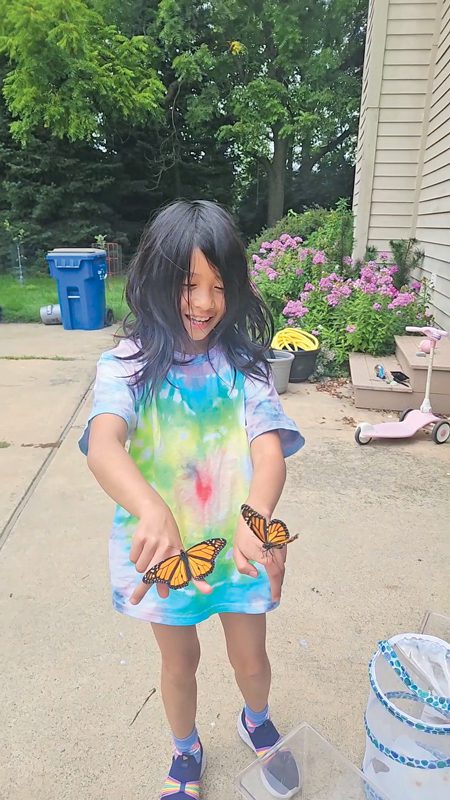
Susin Tang’s daughter Melody makes a couple of new pals. With their friends the Wilkes-Kriers, the Tang family have raised hundreds of monarchs. | Courtesy of Susin Tang
Susin Tang had been looking for little projects to keep her young daughters occupied through Covid lockdown, so she took one of Wilkes-Krier’s kits. The family enjoyed the experience so much that they started to research what caterpillar eggs looked like and where to find them on milkweed. The next summer, they were surprised to find milkweed already growing in their own yard. Their monarch-raising journey really started to take off when Susin’s husband, Kevin, gathered the milkweed pods and scattered the seeds throughout their yard at the end of the summer in 2021.
Since that season, Susin has passed along monarchs in varying stages to friends and neighbors interested in raising their own. Kevin tracks their activity on spreadsheets: logging the eggs they find and tracking them through every stage of growth from larvae to full-grown butterflies. “Some die as caterpillars,” Susin explains, “and some never make it out of the chrysalis. Even when a butterfly is emerging, it is such a delicate moment.”
Over the years, the detailed notes and logs Tang and Wilkes-Krier keep have helped them identify patterns and trends. They share their data with local Facebook groups, such as Downriver Butterflies, which focus on butterfly conservation—some of the best resources they’ve found for knowledge and support. These butterfly advocates have noticed an alarming drop in survival rates in the last two years—a combination of fewer eggs and fewer larvae completing the process.
“In 2023, about half of the caterpillars would die for no reason,” Tang explains. Members of Monarch Butterflies, another Facebook group Tang follows, thought it was due to the Canadian wildfires.



Photos courtesy of Susin Tang
“In 2024, we had a drop in eggs, and only took in sixty-nine eggs compared to 135 from 2023,” says Tang. “Last year, we took in 210! I think overall many people also had more eggs. Hopefully, it means it’s trending back up.”
Between them, Tang and Wilkes-Krier have raised “several hundred” monarchs. This estimate does not include the eggs and caterpillars they have passed along to others to nurture and release. But for these women, it isn’t about the number of monarchs saved—it’s more about being part of something bigger.
“I love that this is something I get to share with my kids,” says Tang. “It gives them a bit of responsibility and something meaningful to be part of.”
“Raising monarchs feels important to me because they are, like any creature, a part of the biodiverse world I want to preserve for my children,” Wilkes-Krier says. “We should all care about the monarchs, about all endangered and threatened species, and about the way our footprints have destroyed vital ecosystems and native habitats.”