
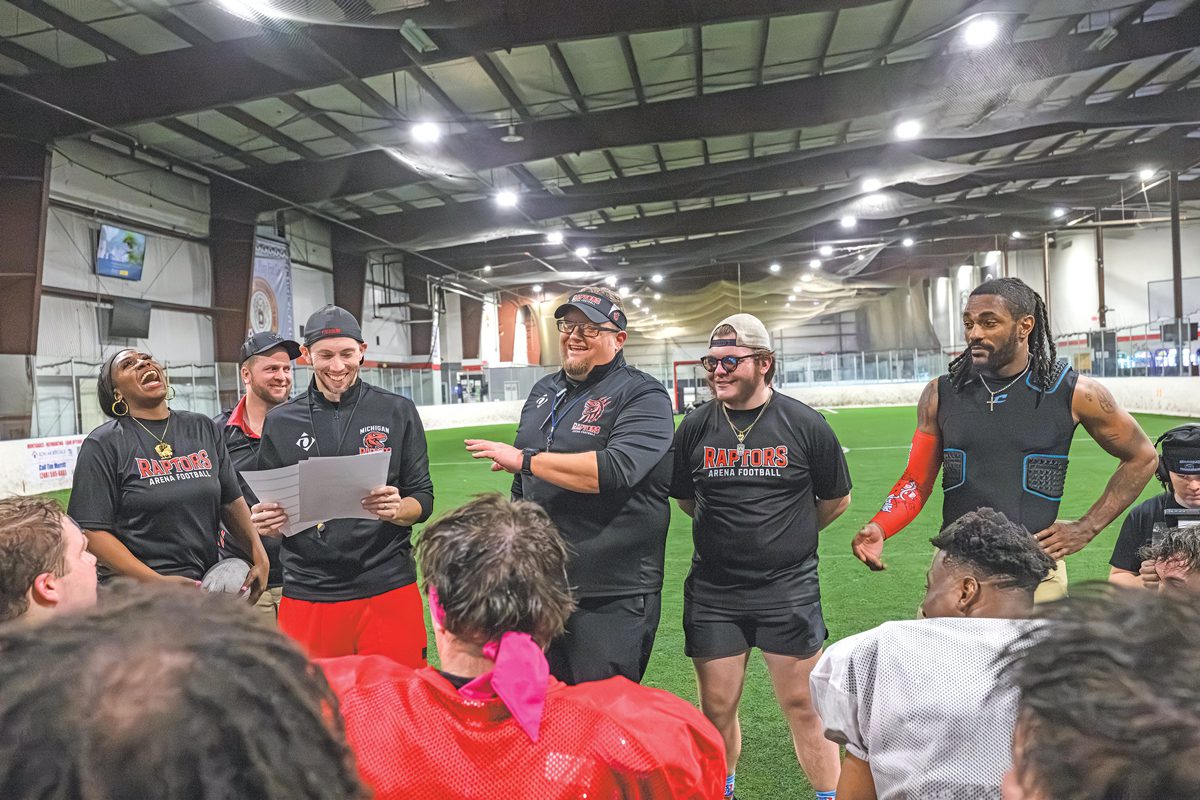
(From left) Conditioning coordinator Tiera Derrick-Jones, defensive coordinator Jason Kolokithas, offensive coordinator Chris Kolokithas, head coach Jeff Pitock, and special teams coordinator Eric Lawrence address the Raptors during a March practice session. | Doug Coombe
They don’t play the typical 11-on-11 gridiron game, though—the Raptors are bringing arena football to the city.
“There’s less linemen, but it’s a little more extreme given inside a hockey rink,” explains Raptors owner and head coach Jeff Pitock. “Basically, when the ice comes out of the hockey rinks, the turf goes down, then it’s basically no out-of-bounds. You can play the ball off the walls, you play the ball off the nets the way we structure it and play it.”
Given the significantly smaller size of the field, teams—with eight players, rather than eleven—pass the ball more than they run, resulting in an action-packed tempo.
The game was first devised in the 1980s by Jim Foster and has fluctuated in popularity since. There has been no shortage of leagues and teams over the years, but for much of arena football’s history, the Arena Football League was the top-dog association. The AFL was created by Foster himself in 1986, and it survived until 2019, when it was forced to shut down after it filed for bankruptcy.
But several success stories came out the league—most notably the discovery of NFL star quarterback Kurt Warner. After getting passed over by the NFL following his college career at Northern Iowa, Warner signed with the AFL’s Iowa Barnstormers in 1995. His play with the Barnstormers was so impressive that two years later, he signed a future contract with the St. Louis Rams. In 2000, they won the Super Bowl, and Warner was named Super Bowl MVP.
Detroit was home to two AFL teams: the Detroit Drive, which entered the league in 1988 but relocated to Massachusetts in 1994, and the Detroit Fury, which joined in 2001 and lasted until 2005.
Related: AFC Ann Arbor: The question was never why bring minor league soccer to Ann Arbor.
Today, Michigan has at least six other teams in four leagues spanning from Muskegon to Novi, and Ann Arbor’s Michigan Raptors are the latest team to join the ranks. The Raptors are set to play in the American Arena League 2, which currently has fourteen teams in nine states. They’ll play home games at WideWorld Sports Center.
“Ann Arbor was, in all reality, a no-brainer,” Pitock says. “Because it is a college town, it is a football town.”
As a member of the Detroit Fury in the early aughts, Pitock himself is no stranger to arena football. He also spent his last two years with the Michigan Avengerz, a fellow AAL2 team based in Novi. As someone who grew up playing American football at both the collegiate and professional level, he found that transitioning from traditional rules to arena rules was a process. But over time, he has come to appreciate the sport as its own entity; related, yet separate from the behemoth that is American football.
“If you like extreme sports, it puts football right in the forefront of it,” Pitock says. “It’s worth coming to check out.”
The AAL2 is a professional league, meaning that if a player joins a team out of high school, they forgo their college athletics eligibility. Because of this, players come from all walks of life. Some are high school graduates seeking an alternative route to college ball; others are former college players looking for another chance; and some, like twenty-nine-year-old quarterback Clayton Jordan, haven’t played since youth league.
Jordan’s buddy told him about the opportunity during a workout, and he decided to try out. His play was impressive enough to earn a spot, and the Redford native hasn’t looked back. For Jordan, playing for the Raptors is as much about community as it is about football.
“Ann Arbor has been waiting for a pro team to come take over football,” Jordan says. “I’m a maize-and-blue believer, I love Michigan, it’s my team since I was a little one. So playing right down the road from them has been kind of a blessing in disguise.”
The Raptors’ season kicks off with a preseason showcase against the Detroit Bandits on March 28 at WideWorld Sports Center, and the first official home game takes place on April 11 against Pitock’s former team, the Michigan Avengerz.
It’s going to be a fun ride come join us for this journey