
We present to you five strangers who all either live or work in Ann Arbor. Although they don’t know each other, they’re all connected in the little ways that make a community: frequenting the same spots, walking the same sidewalks, common heritage, similar interests and motivations. From sharing their art with the public to sharing hope with rehabilitating patients, cleaning sideburns to cleaning the roadside, inventing new ways to work out and new worlds to read about, we were inspired by these five people’s stories and reminded of the myriad ways all of our lives overlap.
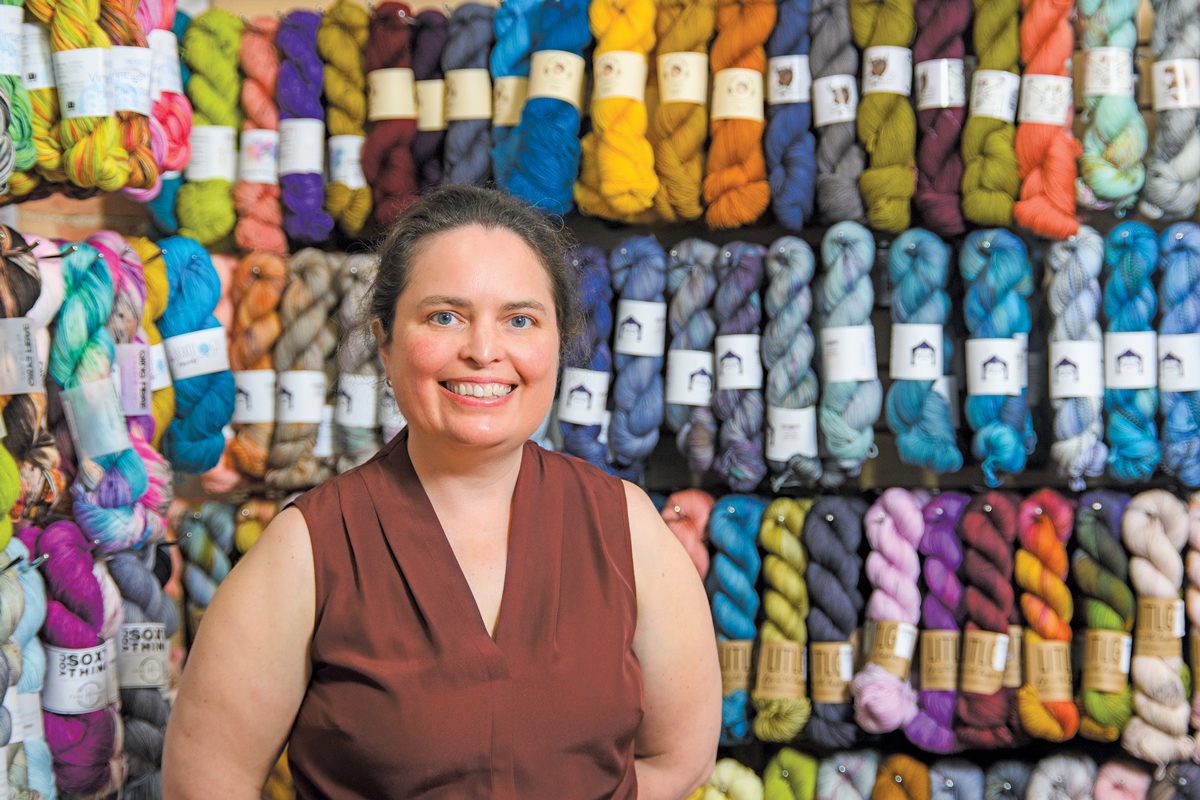
Ursula Whitcher | Doug Coombe
Ursula Whitcher, Mathematician & Sci-Fi Novelist
by Latitude Brown
Ursula Whitcher has lived all across the country, growing up in Baltimore, Maryland, and Portland, Oregon, and moving through Washington and California for graduate school and a postdoc. She began her career as a math professor in Eau Claire, Wisconsin, but today, she calls Ann Arbor home. “I’ve found that the Pacific Northwest culturally feels very continuous with places like Ann Arbor and Wisconsin,” she says.
Whitcher’s Ann Arbor life is bookended by the Argus Farm Stops. The Packard location is close to her home in Lower Burns Park, where she might stop for a morning latte on her way to work at Mathematical Reviews, a research database that indexes pure and applied mathematical papers. She’ll get lunch at the nearby Liberty Argus, and then, coming back home, she sometimes makes a third café stop back on Packard to pick up groceries or a quick snack. Our conversation took place at the Packard location, where she ordered a hot samosa on a cold March day. (This writer had a lemon poppy seed muffin.)
Related: Tracey Bennett (Dec. 2022)
Outside of work, Whitcher enjoys rock climbing at Planet Rock, a sport she describes as “stereotypical for math people.” She’s also involved in a range of community groups: the Society for Creative Anachronism, where her contributions have ranged from hand-knitted socks in Ancient Egyptian style to a guide to reading Latin dictionaries; Ann Arbor Indivisible, where she and her neighbors protest the Trump administration; the Science Fiction Writers of America, where she connects with her fellow writers; Poet Tree Town—her poem, “Leaning on the Melting Point,” is on display at Spun on N. Fourth Ave.; and our regional science fiction and fantasy convention, ConFusion, which has been running for either fifty-one or fifty-two years, depending on whom you ask.
Related: Poet Tree Town (Apr. 2023)
Her debut collection of short stories set in the same world, North Continent Ribbon, was one of library director Eli Neiburger’s AADL 2025 Staff Picks. Of the book, he writes, “For some reason, I particularly liked the one about the dedicated public servant who still rides
the bus.”
For her part, Whitcher prefers to get around on foot and experience the city at street level. These on-the-street adventures often inform her poetry and prose, bringing a relatability to her sometimes fantastical writing.
On any given day, she might pass Jake Ciolino on the sidewalk—he lives on the Old West Side and is partial to a cappuccino with a cinnamon bun at the Liberty Argus.
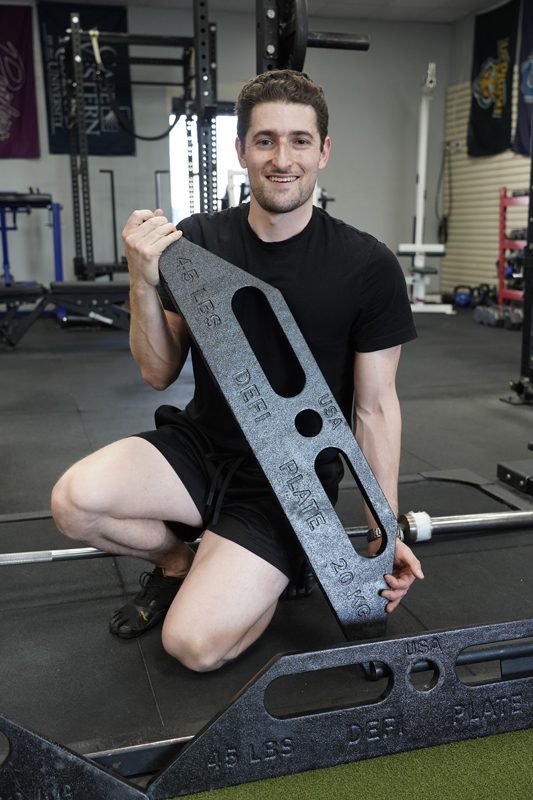
Jake Ciolino | J. Adrian Wylie
Jake Ciolino, Physical Therapist, Amateur Strongman, & Inventor
by Alex de Wild
Jake Ciolino works at Trinity Health Ann Arbor Hospital, where he specializes in neurorehabilitation—helping patients to recover from spinal cord injuries, strokes, amputations, and other traumatic injuries. A devastating accident set him on his career path.
“A drunk driver killed my friend and paralyzed my girlfriend at the time,” he says. “I spent many days at the U-M inpatient rehabilitation hospital visiting her—it’s what made me want to be a physical therapist.”
As well as the meaningful nature of the work, he relishes the chance it gives him to interact with people from different walks of life and places around the world.
“My favorite thing about living and working in Ann Arbor is the international community,” he says. “I love experiencing different cultures and learning different languages. At my hospital, I have coworkers teaching me Tagalog, Tigrinya, and German. I have friends from Italy, England, Iran, and Lebanon. It’s amazing how many different parts of the world are represented in such a small area, and it’s really nourishing to be among so many different worldviews.”
Ciolino’s grandparents grew up in a Sicilian community on the east side of Detroit. “They continued to speak a dialect of Italian, but the language was lost to us grandkids,” he laments. “I did a four-month clinical internship in Umbertide, Italy, and I worked my ass off to learn the language the best I could. I’m good enough to provide standard clinical care and have a basic conversation, but far from fluent or eloquent.”
After work and on weekends, he pours his spare time—of which he has precious little as the father of two young children—into a passion project he calls DefiPlate, a trapezoidal weight plate that he conceived during the Covid-19 pandemic.
“I was training in my garage a lot at the time because of social distancing. But the low ceilings meant I couldn’t lift weights above my head, which was frustrating,” he says.
Thanks to its shape, DefiPlate, which Ciolino was able to bring to life with the help of an engineer friend from childhood, requires less overhead clearance than the traditional, circular weight plate. It also makes possible so-called deficit training, whereby range of motion is increased—hence the name.
Related
Diane Winner: Financial advisor, weight lifting champion (Jan. 2021)
Last August, I joined Ciolino at a strongman competition in Plymouth. In addition to competing—which is to say, lifting Atlas stones and cars and other such dainty objects—he ran a booth for attendees to try out DefiPlate. This past March, he showcased it at “The Arnold,” a trade show in Columbus, Ohio, that bills itself as the world’s largest health and fitness expo. And in June he’s hosting an event in Dexter—what he’s calling the DefiPlate Games, a combined dead lift and 5K run competition open to one and all.
Like Ciolino, Perry Vitto has Italian roots: his dad’s side is from Calabria, and his mother—maiden name Capone, no relation to Al—is Sicilian.
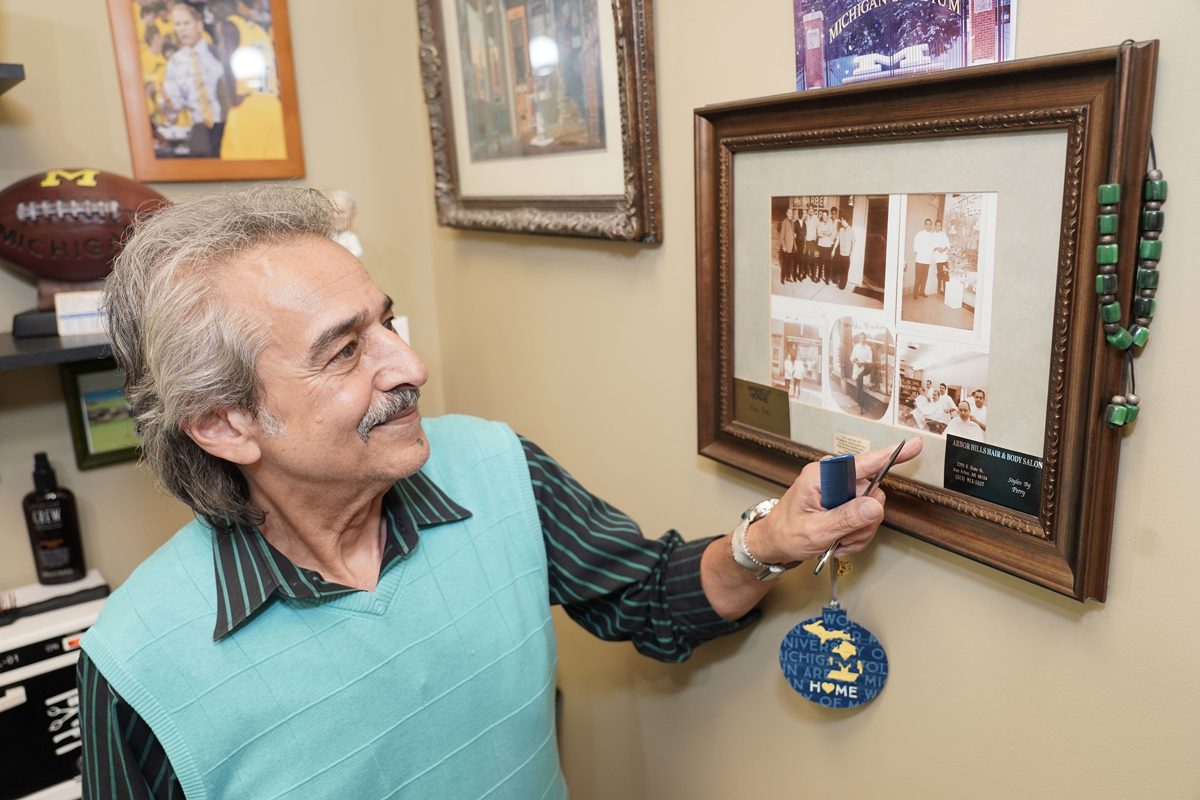
Perry Vitto | J. Adrian Wylie
Perry Vitto, Barber to the Local Stars
by Gregory Anderson
This year marks Perry Vitto’s fifty-first year behind the barber chair, a milestone that comes with the kind of clientele you don’t rack up by accident: Michigan coaches, civic leaders, and longtime regulars who’ve made his chair less a stop for a trim than a weekly confessional.
These days Vitto works out of a small suite at My Salon Suite off Eisenhower. He’s got salt-and-pepper hair and a matching mustache, and he wears his hair a little longer in back—just enough to feel current without looking like he’s trying. He’s an early riser—up at 5 a.m., in by 7:30—and he doesn’t make a big deal of the commute from Canton, which he shrugs off as “less than a half hour.”
Asked what he likes about the job after all these years, Vitto answers like a man who’s said it a thousand times because it’s true: “You stand around talking to your friends all day,” he says, “and then they pay you.” Over the decades, plenty of those friends have arrived with recognizable résumés. Vitto cut Jim Harbaugh’s hair back in 1986, and he’s seen too many Michigan football staffers to list. He says former governor Rick Snyder has been coming to him for roughly twenty years, and longtime U-M power broker Ron Weiser is another regular.
While those names make Vitto sound like a barber to the locally famous, he shrugs at that framing. The work, he insists, isn’t about celebrity; it’s about constancy. A barber, if they’re good, becomes part of the rhythm of somebody’s life.
Related:
Barber Jim Kemppainen (Sept. 2019)
Busy Barbershop (Jan. 2018)
That’s how Vitto can casually mention former Michigan basketball coach John Beilein, one of the most beloved figures in recent Wolverines history, as just another recurring appointment. Beilein lives in Naples, Florida, now, Vitto says, but returns to Ann Arbor for regular motivational talks at Michigan Medicine—and when he’s in town, he sits in Vitto’s chair. Snyder, meanwhile, occasionally treats his barber to courtside seats—close enough to appreciate “how big the players really are.”
For someone with a lifelong career in barbering, Vitto was a reluctant recruit. Nearly every male relative in his family cut hair—dad, uncles, cousins, and grandfather—so he tried asbestos work instead, remembering Marlboros and black dust, and sums it up with grim hindsight: “Everybody I worked with is dead.” Two years was enough. He listened to his dad, went to barber school, then learned the real craft at an Ann Arbor shop called Sir Edwards—back in the 1970s, when “everybody had long hair.”
Fifty-one years in, Vitto isn’t talking retirement. Asked how long he wants to keep barbering, he doesn’t hesitate: “Till I can’t. I love doing it.”
After any number of haircut/confessionals with Vitto, John Beilein likely ended up at the Crisler Center, where his team would have been cheered by the U-M Alumni Pep Band, directed by John Wilkins.
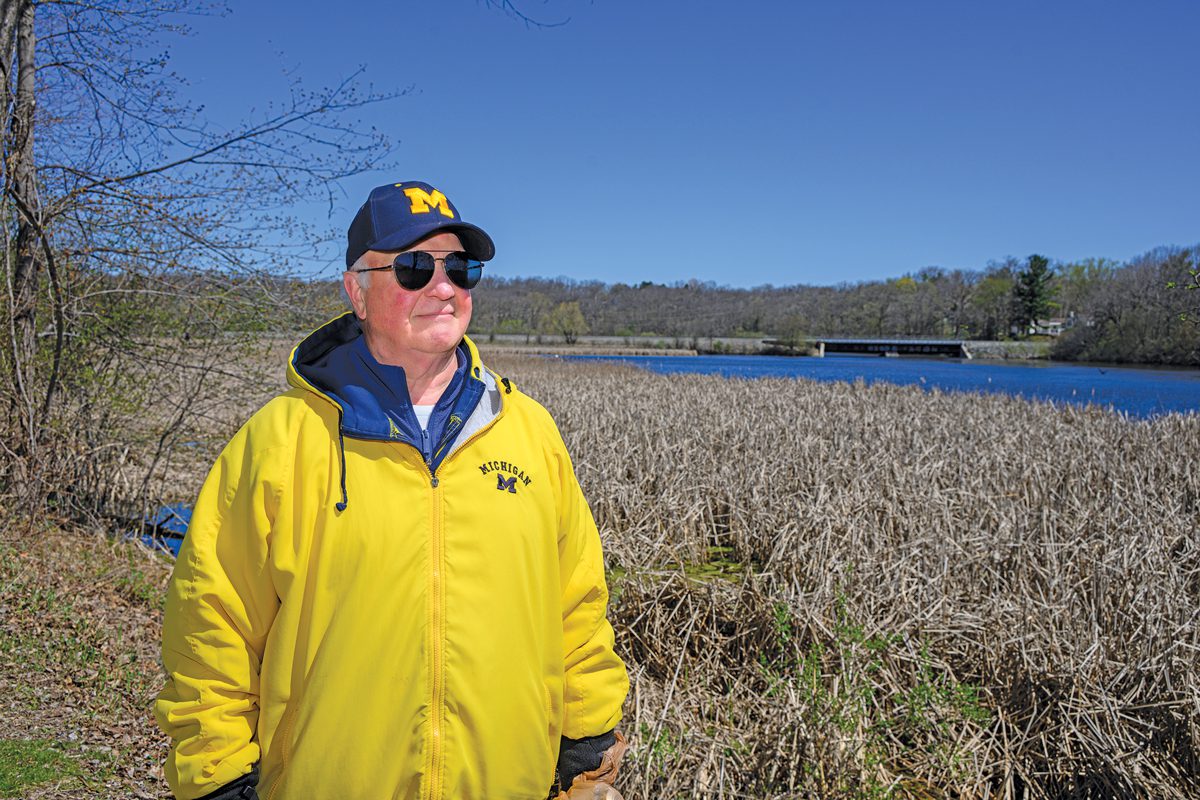
John Wilkins | Doug Coombe
John Wilkins, the Keeper of Huron River Drive
by Bree Stilwell
If you’ve driven the span of Huron River Dr. between Foster and Barton Dam, you’ve seen John Wilkins. You’ve likely even gotten a friendly wave. Bedecked in U-M gear, carrying a repurposed plastic grocery bag full of litter or pushing a hand mower (or both!), he’s appropriately earned the nicknames the West Side Angel, Mower Guy, and the Keeper of Huron River Drive. When asked how he maintains his joy after more than thirty years of tending the same 1.5-mile stretch of road, Wilkins replies, “Love is the bottom line.”
Wilkins didn’t plan on building this particular legacy. Born and raised in the Wines neighborhood, he worked for a kitchen building company after finding his first year of college at Eastern Michigan outside his zone of interest. He loved playing trumpet, was good at it, and had “too much wild oats to sow.” He was also really good at cleaning. “When the house was ready to be sold, I was in charge of washing the windows, cleaning all the crap out of there, and I really enjoyed that. I got a taste for cleaning things.”
Wilkins met his wife in 1978, while she was a member of EMU’s marching band. With the support of her career at Chrysler, Wilkins doubled down on his love for music, receiving both his bachelor’s and graduate degrees at U-M before beginning a twenty-two-year tenure as band director at Mumford High School in Detroit.
During one of his early morning jogs along the river, his flashlight zeroed in on beer bottles, cigarette butts, and unidentifiable “junk in the woods.” Wilkins remembered his wife beachcombing for trash years earlier on the shores of Lake Michigan.
On his path along the shoulder of Huron River Drive, “the grass was so tall in spots. There was no place to run on the side of the road. So, one day I saw a bag in the woods and I grabbed it, and I started picking up stuff.”
Related: Corvette Crash (July 2017)
Since retiring from Mumford—and from twenty-one years as director of the U-M Alumni Pep Band—he exercises his mind and his body on those three-mile walks, reciting historical speeches like the Gettysburg Address, along with the name of every corps, division, and brigade commander who fought in the battle itself. When a local stops to chat, he says, “That makes my heart full. I already feel full of joy when I clean that road up a little bit, but that’s just icing on the cake.
“It’s fun to feel connected to the community and then I just kind of secretly give them this little gift. This little gift of saying, I’m doing this not just because it makes it look more beautiful, which it already is. But this is for you, my neighbors.”
And speaking of secret little gifts…
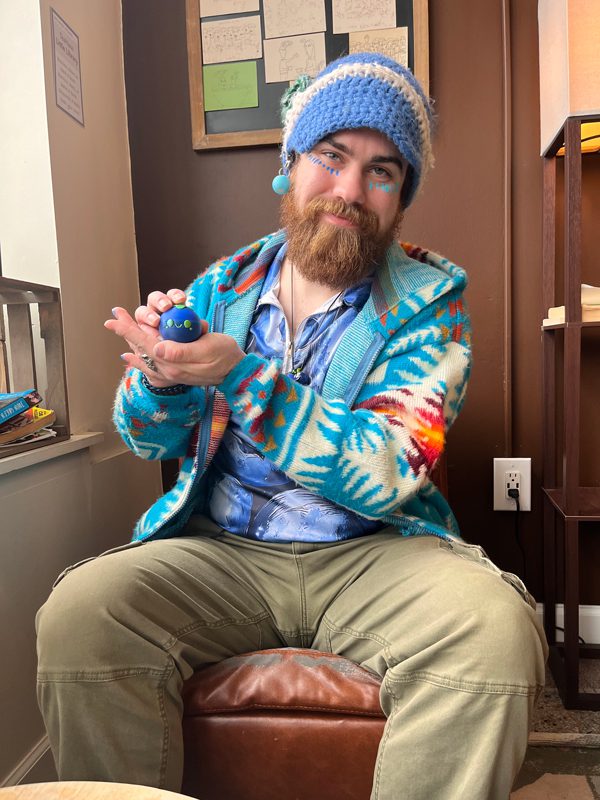
Chris Kovach | Alex de Wild
Chris Kovach, The Blueberry Man
by Alex de Wild
Chris Kovach floats through Ann Arbor like a modern-day Johnny Appleseed, scattering 3D-printed blueberries in hopes they’ll brighten someone’s day. It all started, somewhat improbably, with video games.
“As a kid, I loved playing Sonic the Hedgehog on GameCube,” says twenty-six-year-old Kovach. “It was a coping mechanism. My dad was in and out of prison and my mom was an alcoholic. She took pills, partied a lot, and was inebriated pretty often. I was raised by my grandma—she was my mom and my dad.”
Growing up, he associated Sonic-the-Hedgehog blue with escape. For reasons he can’t quite put his finger on, his fondness for blue evolved into a fondness for blueberries. “It wasn’t so much their taste,” Kovach says—although nowadays he likes to make blueberry jams and preserves—“as it was something about their shape and uniqueness, and of course their blueness.”
At eighteen, college didn’t seem like a viable financial option, so he took a job at a hardware store in his hometown of Ypsilanti. Later he moved into low-income housing maintenance
—cleaning out apartments after tenants had passed—before landing at the Lowe’s on Carpenter Rd.
Last year, he heard about the Michigan Reconnect Scholarship, which covers tuition for Michigan residents twenty-five and older who haven’t yet completed a college degree. With the support of the scholarship, he enrolled at Washtenaw Community College, where he’s now pursuing an associate’s degree in 3D animation, with plans to transfer to Eastern Michigan University’s Simulation, Animation and Gaming program for his bachelor’s.
It was at WCC that he 3D-printed his first blueberries. The idea came to him after he’d been through a rough patch that included a bad breakup. What better way to lift his spirits, he thought, than by sharing his love of blueberries?
Initially WCC’s campus was his stomping ground, but today it’s downtown Ann Arbor, especially Kerrytown. Sporting flecks of blue face paint and blueberry-themed clothing—a knitted blue Strawberry Shortcake hat he got on Etsy, a multicolored Alpaca sweater he picked up at a music festival, and a necklace with blown-glass blueberry beads—he bops from shop to café to bookstore tucking blueberries into nooks and crannies, Boo Radley style—always in discreet spots and never where he isn’t welcome. Occasionally he’ll leave one when he delivers a DoorDash order—a side gig that helps fund his blueberry habit.
Some spots have made what Kovach calls “blueberry homes”—little families of blueberries gathered on a shelf or windowsill. The owners of Sparrow Market have put one up above their fruit stand.
“It’s fun,” says Jeff Condit, who owns PizzaPazza. “Chris comes in to get food with his grandma. It would be great if more people did stuff like what he’s doing.”
Related: From Food Truck to Kerrytown
Local kids collect the blueberries, which come in all sorts of colors and patterns; some are themed, like the ones Kovach made for Halloween, Christmas, and Pride. A basketball blueberry in maize and blue is in the works to commemorate U-M’s recent national championship victory.
“I do this to put a smile on people’s faces and brighten their day; it’s all out of pocket and I never expect anything in return,” says Kovach. “The little things, like a thank you or like a compliment—they mean the world to me. I never take them for granted. I remember every single little thing.”