
Christy DeBurton says perimenopause was “a rollercoaster I was not prepared for.” The Ann Arbor yoga and wellness instructor experienced symptoms including mood swings, insomnia, heart palpitations, and hot flashes. “I thought I was healthy and I did all the things, and it still really hit me.”
Not to be confused with menopause, which is when a woman has gone twelve consecutive months without a period and her ovaries are no longer producing hormones, perimenopause is a transitional state characterized by fluctuating hormone levels, irregular periods, and physical symptoms like the ones DeBurton experienced. Menopause and the menopause transition “remains one of the most overlooked and underserved areas in medicine,” according to the Menopause Society, a nonprofit focused on educating health care professionals.
Frustrated that she couldn’t find the resources she needed to manage her symptoms, DeBurton did her own research and published an online guide to perimenopause.
“There wasn’t anything out there” a decade ago, says DeBurton, now fifty-four. “And then just a few years ago, everyone started talking about it, celebrities started talking about it, Oprah started talking about it.”
Karen Walker, a Trinity Health IHA gynecologist who has specialized in women midlife and older for four decades, attributes the change in part to social media. And that’s not the only change she’s observed.
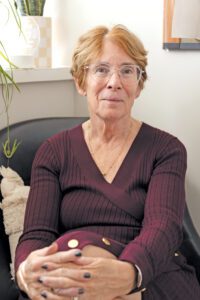
Until recently, decisions about menopause treatment were at the sole discretion of physicians. Dr. Karen Walker embraces the new concept of shared decision-making between doctor and patient. | Annie Comperchio
“Shared decision-making is a new concept in the last few years,” she says. “Decision-making should not have been from the physician but it should be in concert with the patient. … You explain the risk and proceed instead of forbidding hormones.”
She’s referring to hormone replacement therapy (HRT), which is easier to access now than it has been for the last two decades.
The release of early results from the Women’s Health Initiative study in 2002, stating that HRT had more risks than benefits, led to a dramatic drop in its use and an FDA black box warning—the highest level of safety warning issued by the department. But since then, “newer hormone formulations have been approved [and] more intensive review of the data has raised some questions about the WHI study itself,” according to the Women’s Health Updates newsletter published by the National Women’s Health Resource Center. Last November, citing “more than two decades of fear and misinformation,” the FDA removed its black box warnings from HRT.
But even though HRT helps some women, there is no “one size fits all” treatment for perimenopause and menopause. Each case is different, and each woman will have her own mix of symptoms, so Walker recommends that women see their gynecologist or primary care doctor to help manage them. She adds that a follow-up appointment after a few months may be needed to tweak treatments, because “it’s a big subject and takes time to discuss and manage.” Walker also recommends the Menopause Society’s website for science-based information.
“The whole difficulty in managing menopause is that we all bring something different to it,” Walker says. “We bring something different to it genetically. We bring something different to it from a lifestyle pattern. We bring something different from a family history, and from our outlook on life and our tolerance for discomfort.”
In Lansing, lawmakers are listening. Last August, legislators introduced four bipartisan bills that would ensure access to medically necessary treatment for menopause and perimenopause.
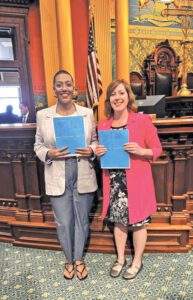
Reps. Morgan Foreman (left) and Julie Rogers hold House Bill 4815 and House Bill 4814, respectively. If passed, these bills would require both private health insurers and Medicaid to cover FDA-approved treatments for menopause and perimenopause. | Emily Connelly/Michigan House of Representatives
“As a woman approaching that part of my lifetime … knowing it’s something I’m going to face, I felt that menopause, and perimenopause as well, is getting treated as an afterthought,” says Representative Morgan Foreman, who represents House District 33, which includes Ann Arbor. “There is no required insurance coverage for care for women, and women are left to figure out what to do and get themselves through this period. And it’s not just like it’s a one-month thing—it can last years and a decade for some women. This is just about fairness.”
One of the bills requires private health insurers in Michigan to cover treatments, including hormone replacement therapy and other FDA-approved options; Foreman’s House Bill 4815 extends those same protections to Medicaid recipients. That bill is currently in the committee on insurance. “We’ll see where it goes this part of the term,” she says, “but I don’t actually expect us to reintroduce this until next term when we hopefully have the majority in the House.”
Nationally, Congress introduced the bipartisan Advancing Menopause Care and Mid-Life Women’s Health Act in 2024 which would allocate $275 million over five years for research, provider training, and public awareness. Although the bill has not advanced, more than a dozen states have since introduced related legislation. Also, last year, the Michigan Women’s Commission hosted “Menopause: It’s a Movement!” conversations around the state “to destigmatize this topic and create policy solutions.”
Locally, University of Michigan Health launched its Menopause Clinic last fall. Cofounded by Drs. Natalie Saunders and Kathryn Welch, its multiple clinic sites offer “individualized, multidisciplinary assessment and treatment,” Saunders wrote via email. Offerings include “hormone replacement therapy and nonhormonal options, mental health screening, lifestyle and preventive health counseling, and coordination with other specialties as needed.”
Saunders shared that “there is a lot of interest in menopause care, and unfortunately with that comes some disinformation. It can be challenging to know what is evidence-based and what is not.”
Among other resources, Saunders recommended Dr. Jennifer Gunter’s book, The Menopause Manifesto, her The Vajenda newsletter, and the OvaryActive podcast.
Menopause is a “complex, multisystem health transition,” Saunders explains. It can include multiple symptoms that for many women have been “underrecognized and poorly managed” because only about one-third of general physicians are trained in menopause treatment. (There is currently no federally mandated training in this field for physicians.) The Menopause Clinic was established to address this gap, she writes. All of the clinic’s providers are Menopause Society Certified Practitioners who’ve received additional education in this area. Last summer, the Menopause Society also launched the NextGen Now initiative to support comprehensive perimenopause and menopause training programs for healthcare providers.
Dr. Gustav Lo, who had a thirty-five year career as a primary care physician before he founded RegenCen longevity clinics (Ann Arbor’s opened in 2023), says gynecologists and primary care doctors aren’t doing enough for women in perimenopause and menopause.
“The average perimenopausal woman will go to six different doctors before they find somebody who will finally treat her hormonally,” he says. “We’ve really, really done a disservice to women by denying them the opportunity for the dramatic health improvements that we know exist with the HRT by trying to make them afraid of their own hormones.” He urges women to do their own research on the subject.
Lo says RegenCen’s twenty-six clinics in Michigan and Florida “do conventional medicine but we think unconventionally about it.” They use rice-sized pellets inserted under the skin, and sometimes topicals, to deliver bioidentical hormones. RegenCen services are not covered by insurance, and Lo says pellets, which are not FDA approved, run about $1,400 per year.
“Most doctors still refuse the right combination [of hormones] because there is still no testosterone product that has ever been approved for women,” Lo says. “Women are really missing that [testosterone] the vast majority of times. I guess, if there’s a way to put it succinctly, women need this combination of hormones probably lifelong,” he says of estrogen, progesterone, and testosterone.
For women who don’t want to or can’t do hormone therapy, DeBurton believes lifestyle changes can help them manage symptoms.
“What you eat makes a difference,” she says. “Getting enough sleep makes a difference. The exercise you do makes a difference. Your mindset makes a difference.” With a student base at her yoga studio and in her online classes that is “almost all perimenopausal and older,” she also thinks it’s vital “just having someone else to talk to who’s been through it.”
Rep. Foreman, who was diagnosed with endometriosis in fifth grade, says she understands the struggles women face.
“I’ve been not listened to. I’ve been discouraged at the doctor’s,” she says. “But I want to encourage other women and other policymakers across the country that we have to do the right thing to take care of the matriarchs, the women, the girls of our society. We have to take care of the whole person.”