
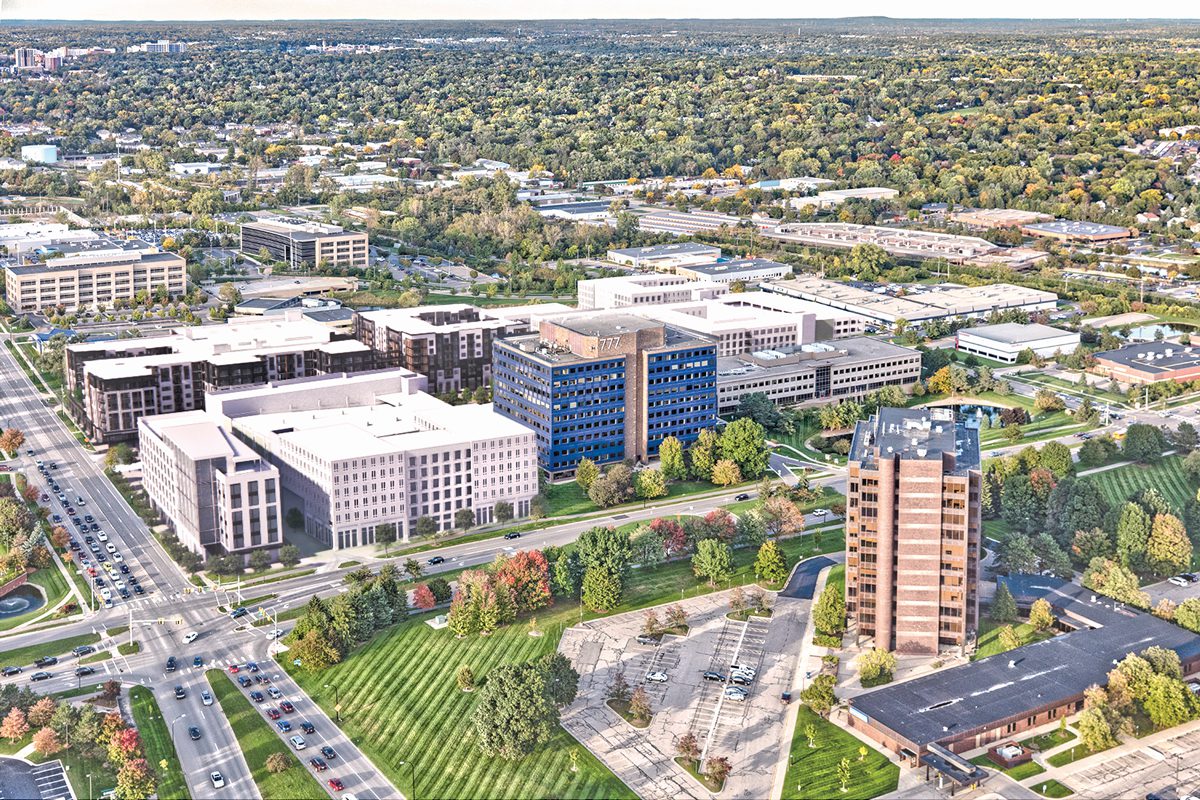
A February city council vote brought Arbor South one step closer to completion. Pictured here as an architectural rendering, it aims to bring more than 1,000 apartments and condos, plus a hotel, services, and open spaces, to the parking lots around the 777 Building. | Courtesy of Oxford Companies
He was referencing Arbor South, a $588 million plan to build more than 1,000 apartments and condos, as well as a hotel, services, and public spaces, on the parking lots around the 777 Building on Eisenhower Pkwy. (The Litmus Test, June 2024). Proposed by Ann Arbor’s Oxford Companies and Ohio developer Crawford Hoying, it was the first response to council’s rezoning of the area for high-density development, and councilmembers had been weighing whether to support it financially for almost a year.
The proposal on the table called for the city to pay for the project’s infrastructure, including streets and three parking garages. It would find the money by asking the county to classify the area around 777 and a neighboring building as a “brownfield.” Though Michigan’s brownfield act was originally developed to address environmental contamination, it also can be used to replace facilities that are “functionally obsolete”—including parking lots. Through tax increment financing (TIF), the cost would be repaid from the future taxes Arbor South itself generated.
Mayor Christopher Taylor says he wasn’t directly involved in city staff’s discussions with the developers, but knew that they “wanted to do something big and bold.” The city’s response was equally bold: $182 million in TIF funds for the work itself, according to Giant, which could amount to as much as $373 million including interest.
The brownfield plan needed just six votes from the eleven-member council. However, a related public-private agreement defined many important details, including city ownership of the structures—and purchasing property required an eight-vote supermajority.
Taylor leads a pro-growth council whose members often vote unanimously to encourage development. But this time, their comments suggested that four weren’t on board.
“Two, I think, expressed fairly settled opposition,” Taylor says. “The other two continued to think it through on their own lights.”
At the January meeting, only two community members supported the brownfield plan during public comment. Eleven questioned the cost and the public benefits cited to justify it, objecting that it provided too much parking and too little affordable housing. Several pointed out that the city’s own brownfield ordinance said that public support should cover only 20 percent of the project’s cost; according to Giant, at Arbor South it would be 31 percent.
Complicating everything, the plan had just undergone a major revision. Some councilmembers were concerned that owning the parking could create financial risks, so the latest version shifted the ownership, and the TIF money, to the developers.
That eliminated the need for the public-private agreement, which would let the project advance with a simple majority of six votes. But the agreement also included climate-friendly requirements like geothermal heating for the affordable housing, and councilmembers wanted to know if those commitments would still be honored. Crawford Hoying’s chief operating officer, Jeremiah Thomas, confirmed that almost all would carry forward—but council voted 7–4 to postpone the issue yet again.
Ward 4 rep Dharma Akmon was in the majority that night, but she expected to lose when the brownfield finally came to a vote. Akmon once worked next door to the 777 Building, and remembers “playing Frogger across all of that traffic” just to get lunch. She was glad to see that, as the rezoning intended, Arbor South would create a more walkable, mixed‑use district.
But “the first time I heard about the project, there was no city involvement that I knew of, except that we had rezoned this corridor,” Akmon recalls. So it was “a bit of a shock” to later learn that it was only economically feasible with a “$373 million brownfield plan that diverts taxes … maybe for the rest of my life.”
The city brownfield act makes an exception to the 20 percent ratio for projects that include affordable housing, and Arbor South would have more than 200 units. But while Giant told council that public funding would account for 31 percent of the total, “I think the way that we typically calculate these, the ratio is about 56 percent,” Akmon says.
Taylor argues that the past calculation was misleading, because it included interest when calculating the city’s total cost, but not the developer’s. Giant agrees, and says that the 31 percent calculation includes interest paid by both.
To Akmon, that was still too much. But at the next council meeting, in early February, a development agreement formalized Thomas’s verbal assurances. Positive public comments outnumbered negative ones, two previously uncommitted council members announced their support, and council voted 8–2 to approve the biggest TIF in Ann Arbor’s history. Joe Giant had his answer.
At press time there were still steps ahead, including county commission approval of the brownfield plan and review by the Michigan Economic Development Corporation. “They’re important steps,” says Thomas, “but they’re less of a threshold question than the political support that was necessary from the city of Ann Arbor.”
Oxford Companies CEO Jeff Hauptman previously described Bridge Park, a Crawford Hoying project in Dublin, OH, as a model for Arbor South. But the political receptions have been very different. According to Matt Rubino, Dublin’s chief financial officer, the city financed the first two parking structures there. A regional authority financed four more, and now owns all six. Yet Lindsay Weisenauer, Dublin’s chief communications and public relations officer, says that has “not been controversial at all.”
Taylor is not surprised. “Municipal ownership of parking structures, in other jurisdictions, is not a controversial topic,” he says.
Two years ago, Hauptman described Arbor South as a potential model for large-scale residential redevelopment here. Asked if he thinks it’s proved the concept, he defers to Thomas.
The TIF “allows Arbor South to be self-supporting in its development,” Thomas says, “and that is encouraging for anyone that has ideas of putting something at substantial scale into the marketplace in Ann Arbor. And what it means is that each development can stand on its own two feet, and can be evaluated on its own merits.”
Given the lengthy and contentious political process, should future developments expect the same level of public support? “Ann Arbor has its own political culture, and you know, it’s what makes the conversation fun,” Taylor replies. “I’ll tell you when we get close to the vote on the next one.”
This story has been edited since it appeared in the March 2026 Observer. The photo credit has been corrected.
‘The TIF allows Arbor South development to be self supporting in its development.’ An oxymoron? Because you have difficulty crossing a street to get lunch is a pretty good reason to gift $180 to $300 millions of our tax dollars to benefit a for-profit corporation. The Ilitches have moved their business model to Ann Arbor. Sarcasm intended.