
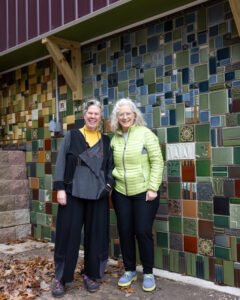
Elisabeth Thoburn (left), Nawal Motawi, and a garage wall mural of Motawi Boneyard tiles. | Gregory Anderson
The first thing I notice is the mural. It spreads across the side of Elisabeth Thoburn’s garage on Silver Lake in Pinckney in a tumble of color and texture—sky, forest, sun, and a thousand small squares of Motawi tile.
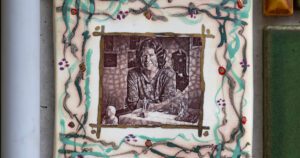
The I.B. Remsen tile of Elisabeth Thoburn. | Gregory Anderson
“That’s just because that’s what I had,” she laughs. “I like the hodgepodge. It’s hard when you deal with the Boneyard to be systematic; I work with what I get.”
Hidden among the glossy blues and greens is a single tile that doesn’t belong. “Do you know I.B. Remsen?” she asks. “He was playing with transferring photographs onto ceramics when he was the ceramics instructor at WCC. He made each of us in our department a portrait tile. It looks grainy and nobody may be able to tell that it’s me—but I know it’s me.”
That portrait is the only non-Motawi tile in the mural—a quiet signature in a field of seconds.
I work in marketing and communications at Motawi Tileworks, and over the years I’ve seen how strongly customers connect to our handmade tile. But Thoburn stands apart for the sheer scale of what she has built—drawing almost entirely from the Boneyard, the back-room racks of slightly imperfect and overrun pieces sold at a discount in our Ann Arbor studio.
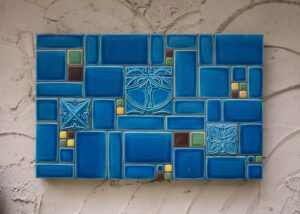
A concept board. | Gregory Anderson
Inside, the house feels less like a gallery than a retreat—quiet, shadowed, layered with color. The kitchen floor ripples like a quilt: large squares, each with “one iridescent, one circle, and one finger tile.”
“If I’d known how rare they were—and how rare the iridescent—I wouldn’t have used them all up in here,” Thoburn says.
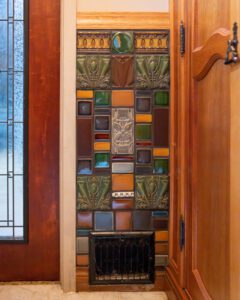
The entryway. | Gregory Anderson
She installs the tile herself with construction adhesive, arranging and reworking until the compositions feel balanced. Once the layouts are set, she hires tradespeople to handle the grouting. The black grout, professionally applied, ties the variation together and gives the rooms their visual cohesion.
The Boneyard is utilitarian—racks of art tile and bins of field tile sold by the pound, first-come, first-served, and entirely in person. Over seven years, she gathered thousands of these second-quality tiles and installed them room by room. At retail pricing, the square footage of tile covering her floors, walls, fireplace, and outdoor mural would easily total well into six figures. Purchased as seconds and overrun field tiles sold by the pound, it became something else: a material vocabulary she could experiment with.
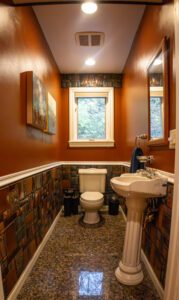
The bathroom. | Gregory Anderson
That investment shows everywhere. Beyond the garage mural there are three sets of house numbers, a coffee table, the landing for an outdoor spiral staircase, the entryway, the fireplace surround, Celtic knot insets in a guest bedroom, mosaic panels on the kitchen floor, and bathrooms that function as small galleries. “Every nook and cranny I could find space for tile, there’s tile,” Thoburn says.
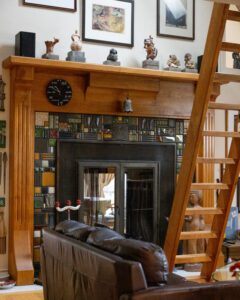
The fireplace. | Gregory Anderson
Some installations were planned; others evolved. A strip of medieval dog tiles was laid upside down by a contractor. Now it’s a punchline: “It’s resting on its laurels!” The fireplace mirrors itself with subtle deviations—“just enough to give you something to worry about.”
Owner Nawal Motawi, who drove out from Ann Arbor with me, studies a deep green patch. “That looks super old,” she says. “That’s what happens when you fire Lee Green and the kiln gets too hot—overfired, it starts to make that black crystalline lug. I used to make lots of those … not on purpose!” The two women laugh.
Related:
A Life in Tile: Nawal Motawi
Over coffee, the backstory surfaces. “My hometown is Dresden in what used to be East Germany,” Thoburn says. “Dresden was a vibrant art city. We had five orchestras, theaters, and galleries galore.”
She had wanted to study art history and run a gallery. “Art can say a lot of subversive things you couldn’t say out loud.”
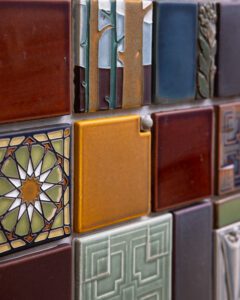
Detail of the outdoor mural. | Gregory Anderson
But political nonconformity had consequences. “My father was the director of a church music school. I didn’t vote, and I didn’t go to youth organizations. None of us four children were allowed to study or pursue the careers we wanted.” Instead, she worked in a gallery and immersed herself in the art world. “Most artists tell you something if you just look hard enough.”
In 1979 she met an American political science student while traveling in Poland. “He said, ‘I’m going to come back within five years,’ and I’m like, ‘yeah, yeah.’” Five years later, the doorbell rang. “He said, ‘I promised I’d be back!’”
They wrote letters, met on weekends between East and West Berlin, and married in 1985. At twenty-five, she moved to Michigan with limited English and determination.
Her first job was at a Canton frame shop. “They had to keep me in the back because I was an embarrassment,” she says. She cut glass and matboard—and quickly reorganized their cutting system to eliminate waste. “You didn’t waste stuff in East Germany. They asked me, ‘What did you do?’ I said, ‘I used my brain.’”
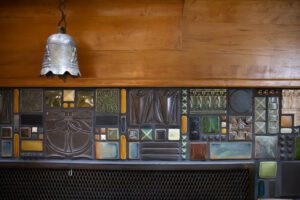
Fireplace detail. | Gregory Anderson
Eventually, she enrolled at U-M, auditing classes at first. “I took phonetic notes. At night I was reading them to my husband—‘What did she say?’”
A B-plus on her first paper wasn’t good enough. “I was like, ‘B-plus? I need As—because next semester I need a scholarship.’” She earned a bachelor’s in art history with highest honors, followed by two master’s degrees despite what she calls “the worst GRE scores ever admitted.”
For three decades she taught art history, religion, and humanities at Washtenaw Community College.
Her husband, David Goldberg, a retired WCC math instructor, contributes his own handmade pottery—mugs, bowls, and vases—to the shelves. Together, they’ve built a home shaped by thought and touch.
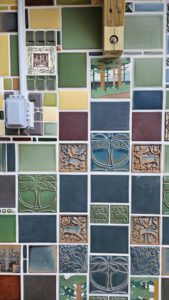
Mural detail. | Gregory Anderson
The tile work began with a practical problem: a kitchen floor that needed replacing. “I had just been in Arizona where they have so many tile floors—all that Southwest style,” she recalls. “I said, ‘I’m going to do that.’” Then she stopped herself. “Come on, I’m an art historian! Are you stupid? You work with materials that are local, right?”
Around the same time, her friend Celibeth Donnelly—who had started at Motawi as a bulb glazer and later became production manager—was downsizing. “She said, ‘I have two boxes of vintage tiles you’ll find nowhere else.’ So I bought them by weight.”
Those boxes led her to Motawi’s Boneyard, where she became a regular. “In the beginning, I came every week for a box. They’re gone by Saturday,” she says. “You have to be close by. You can’t do this online.”
That commitment to sourcing locally places her in a long Michigan ceramics lineage that includes Pewabic Pottery in Detroit—where Motawi first learned tilemaking more than thirty years ago. “It’s that same idea,” Thoburn says. “You work with what’s around you. You go to the studio, you see what’s possible.”

The artist in her home. | Gregory Anderson
By the time coffee is poured, the house feels alive—part studio, part gallery, part memoir. Thoburn raises her cup toward Motawi. “Without you, I couldn’t have done any of this.”
“I’m in love with what you’ve done,” Motawi replies.
The rooms remain dim, the light thin and slow-moving; the few iridescent tiles gather what brightness they can and seem to amplify it.
“I just hope when we sell this house—if we have to sell this house—whoever buys it buys it for the tiles and not despite them.”
For a woman once told she wasn’t allowed to study, every surface now speaks in her chosen language. In Thoburn’s house, the fragments have found their place.
I want a tour!!!
If you are interested in a tour, I will schedule one for you. 🙂 Just email me: [email protected]