
At Bongz & Thongz on E. Liberty, employees are carefully packing up the inventory of CBD, psilocybin, and other botanical products along with a huge collection of elaborate glass smoking paraphernalia, some priced in the thousands of dollars, for a move to the vacant space next door. The kratom inventory is in the back. “We’ve been selling it since we started” in 2012, says proprietor Mohammad Hassan. “It’s the oldest medicine known to man.”
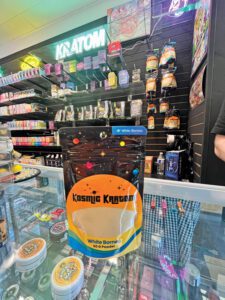
Bongz & Thongz sells a variety of kratom products in both pill and powder form, including natural and lab-made varieties. | Amy Sumerton
That’s hyperbole, but in Southeast Asia the leaves of the native kratom tree have been used for centuries to treat pain, combat fatigue, and elevate mood. Companies now process the dried leaf into the powders, tablets, capsules, and liquid shots on sale at vape stores and gas stations across Ann Arbor and Washtenaw County. About 20 million Americans use kratom on a daily basis, according to University of Florida chemist Chris McCurdy in a recent lecture at U-M.
Not all kratom is equal. Over the last decade, the market has evolved from simple powders and teas to concentrated extracts, and now to lab-made chemicals. One of Bongz & Thongz’s kratom products is Twisted7, a lab-made version of a chemical in kratom called 7-hydroxymitragynine, or 7-OH. It’s also sold under names like Dozo Perks, Press’d, and Hydroxy Typhoon.
Like an invasive species, 7-OH is disrupting the local kratom ecosystem, replacing natural diversity with a brutal monoculture. The natural kratom leaf contains at least forty different alkaloids, organic compounds that can sometimes alter behavior or perception. (Caffeine is an alkaloid.) The main alkaloid in the kratom leaf is mitragynine, which has some weak opioid activity but also a multiplicity of other effects, including acting on serotonin receptors and altering dopamine release in the brain. 7-OH is present in only trace quantities in the leaf. But by itself it latches tightly to opioid receptors—very much like standard opioid drugs, with similar effects. In his talk, McCurdy called 7-OH “pure opioid being sold without a prescription.”
Eliza Hutchinson is a U-M family and addiction medicine physician and director of the Packard Health addiction medicine program. A year ago, the vast majority of patients that she started on the drug buprenorphine, to treat opioid addiction, were using fentanyl, with only a rare patient needing help with kratom or 7-OH. Now they’re up to about a third.
“We are commonly seeing individuals who struggled with opioids years ago, worked tremendously hard to stabilize their lives in recovery, only to find themselves accidentally addicted to kratom or 7-OH,” Hutchinson says. “They need higher and higher doses just to feel well and avoid withdrawal symptoms. They lose their jobs, their health, and connection with their families.” Some of her patients spend $30,000 a year or more on these products. “They often tell me, ‘Doc, this feels just like heroin.’”
Ray Dalton, clinical director for Dawn Farm, a recovery program, is seeing the same thing. “People who once had problems with opioids,” he says, “now are coming in with kratom habits, or 7-OH habits.” Same for Jason Schwartz, director of social work and spiritual care for Michigan Medicine. “I’ve seen a lot of people in long-term recovery who started using kratom, thinking it was safe,” Schwartz says, “and precipitating horrible relapses, and great difficulty getting off the substance.”
Data provided by the Michigan Poison & Drug Information Center in Detroit confirm the surge. Statewide, total kratom exposures—requests for help—almost doubled last year. The center recorded its first 7-OH case in April 2025, and 7-OH ultimately accounted for more than a quarter of 2025 cases. A disproportionate number were severe, including drug withdrawals and ICU admissions. As with any opioid, 7-OH overdose can lead to respiratory failure, cardiac arrest, and death if not treated promptly with naloxone.
The clerk at one Ann Arbor vape store, who asked that he and the store not be named, told this reporter that some customers drop $200 in a single day on 7-OH products like Dozo Perks, a blister pack of four tablets scored in quarters. “They’ll buy three or four of those [packs] and do them in one day,” this person says. That’s at least twelve times the maximum daily dose indicated on the package.
Retailers often market kratom as a benign natural product. That works because public awareness is low. “People know kind of what to expect from an energy drink, they know what to expect from cannabis, they know what to expect from other substances, from alcohol,” says Schwartz. “But I don’t think people really know what to expect from this.”
Kratom sellers won’t necessarily tell them. “You can’t OD on it. No one’s ever died on it,” says Hassan at Bongz & Thongz. “It can’t harm your liver. The worst thing that happens is an upset stomach—the poops.”
Hutchinson has seen the stomach problems, but says the rest of that statement is false. Kratom overdoses, liver damage, and deaths are very real. One of Hutchinson’s patients, a father of three in recovery from an opioid addiction, tried 7-OH from a vape store to boost his energy for parenting and work. Weeks later, he died from an overdose, although it’s not certain that 7-OH was solely responsible. Many kratom-only deaths have been documented.
In March, the Michigan House passed a bill to ban all kratom products with a 56–48 vote; forty-seven Democrats and one Republican voted no. “What we are experiencing with kratom is a crisis,” says the bill’s sponsor, Cheboygan Republican Cam Cavitt, in a press release. “Our children are being poisoned by products that they can easily purchase at gas stations.”
The House Democratic Caucus responded in a statement. “There is no question of the growing concern around this product, and no one is saying, with this vote or otherwise, that the concern isn’t justified,” it reads. “What we are saying is an outright ban, without any testimony or dialogue, is not the solution.” The bill has been referred to the Senate Government Operations Committee.
A parallel debate is taking place in vape stores, medical clinics, and addiction recovery centers across Ann Arbor. “As soon as ‘ban’ comes up, people freak out,” says Schwartz. That’s because so many people now use kratom, for better or worse. “With any substance, it’s probably a minority of users who will develop a problem, or develop a bad outcome,” he adds.
The abuse potential of 7-OH is so much higher than natural leaf kratom that it shouldn’t even be considered a kratom product, McCurdy told his U-M audience. Leaf kratom, on the other hand, could prove useful as a painkiller or to help people get off opioids, and a few such clinical trials are underway. A great many people in the community already use kratom on their own for those purposes.
A Deeper Look
The Epidemic: Opioids are killing one person a week in Washtenaw County (Feb. 2018)
One of them is Sam Saalberg. I first met Saalberg on a Thursday afternoon in April at Select Smoke Shop on W. Stadium, where he was buying kratom tablets. Saalberg, who’s conversant in basic kratom pharmacology, has worked professionally promoting regenerative agriculture and agroforestry conservation in Ecuador, and is currently employed locally as a butcher. He takes kratom for pain relief, to boost energy and focus, and as a substitute for alcohol. Saalberg describes himself as a former “polysubstance drug user, alcohol, for a few years” in the 2010s. When he first encountered kratom, around mid-decade, “I was living in recovery, and I found that it was very, very difficult to adjust to living a normal life while having these constant cravings.”
Saalberg first bought kratom in powder form at the now-closed Ethnospot on S. State. He quickly moved from using it weekly to three times daily, continuing for six or seven years. Thanks in part to kratom, he says, “I was able to fix a lot of personal relationships, I was able to save a lot of money, I was able to make progress in school, I was able to make progress in work.”
But international travel made access complicated, so he decided to end his daily use. Doing that was “not nearly as bad as a drug withdrawal, but it’s about as hard to quit as nicotine,” he says. “You feel sick, you kind of fixate on it, but it’s not like a horrible sickness.” Those symptoms abated after about a week. He now uses kratom only occasionally, he says, not by habit, as a natural alternative to conventional drugs. “I feel better not taking any prescription medications,” he says. “I really highly value being able to use these extremely beautiful plants that Mother Nature gave us in order to navigate this world.”
Saalberg has tried 7-OH, and doesn’t recommend it. “I was like, ‘I don’t think this fits in with what my version of being a person in recovery is,’” he says. “Because it’s very potent, it’s very fast-acting, it’s very strong, it’s very addictive. I believe you can get physically addicted after only two to three days of use. It’s really, really scary.”
But he thinks a total kratom ban would be a loss. “Just kratom itself, I think it should be legal, I think it should be regulated,” he says. “But the 7-hydroxymitragynine, I think that unfortunately is opening the door to people who never would have tried opioids.” He also worries that a ban would push current kratom users toward more dangerous substances. “Are they going to go try and pursue street drugs afterward, because they have this itch that they can’t scratch anymore?” he asks.
“That’s a very real concern,” agrees Schwartz, who says that any restrictions must include measures to help current kratom users adjust. That includes the medical system. “There are a lot of seniors who use kratom for pain management, and find it effective,” he says.
So far kratom and 7-OH are completely legal and unregulated in Michigan, and in about half of all states. One downside is that users don’t know exactly what they’re taking, McCurdy said in his lecture. 7-OH tablets, for example, could contain solvents and impurities left over from production. He favors tight regulation of kratom products, not criminalization, but wants to see 7-OH a controlled substance at the federal level. The FDA last year signaled its intention to do that, but has yet to act.
“We’ve had outbreaks of salmonella with these plant products,” said Nathan Menke, an addiction specialist on the U-M psychiatry faculty, in a recent public live-stream. “We’ve had heavy metals, there’s lead in some of these products. … Companies can do whatever they want, with no consequences.”
State-level kratom legislation is all over the map. About a half dozen states have banned kratom products entirely or in part. At least twice that many have approved various consumer protections that include age restrictions, product testing, and labeling requirements.
Whatever the outcome in Lansing—ban, partial ban, consumer protections, or the status quo—it will at best be a partial solution. “Even if we were to ban kratom and 7-OH, the market will always be there to meet demand with new products,” says Hutchinson. (New and even more potent kratom alkaloid preparations are already hitting Ann Arbor.) “It’s really important for us as a community to take on the root causes of addiction.” That, she says, includes supporting families to prevent the childhood trauma that often leads to substance use; ensuring affordable health care, both physical and mental, so people don’t turn to substances like 7-OH and fentanyl; and access to effective treatments, like buprenorphine, which eases withdrawal symptoms and blocks other opioids.
“There’s been this fantasy that if we get the perfect drug policy, we’ll end drug-related harms,” says Schwartz. “It’s not a problem we can solve, it’s a problem we have to manage. And no single strategy will effectively manage it.”